On this day in military history…
The Gallipoli campaign effectively ended in early January 1916, with the final Allied troops evacuated from the Helles sector on the night of 8–9 January. Although much of the fighting had ceased weeks earlier, the end date marked the quiet conclusion of one of the First World War’s most ambitious and ill-fated operations. Conceived as a way to break the stalemate on the Western Front by forcing the Dardanelles, capturing Constantinople, and knocking the Ottoman Empire out of the war, Gallipoli instead became synonymous with miscalculation, poor coordination, and immense human cost.
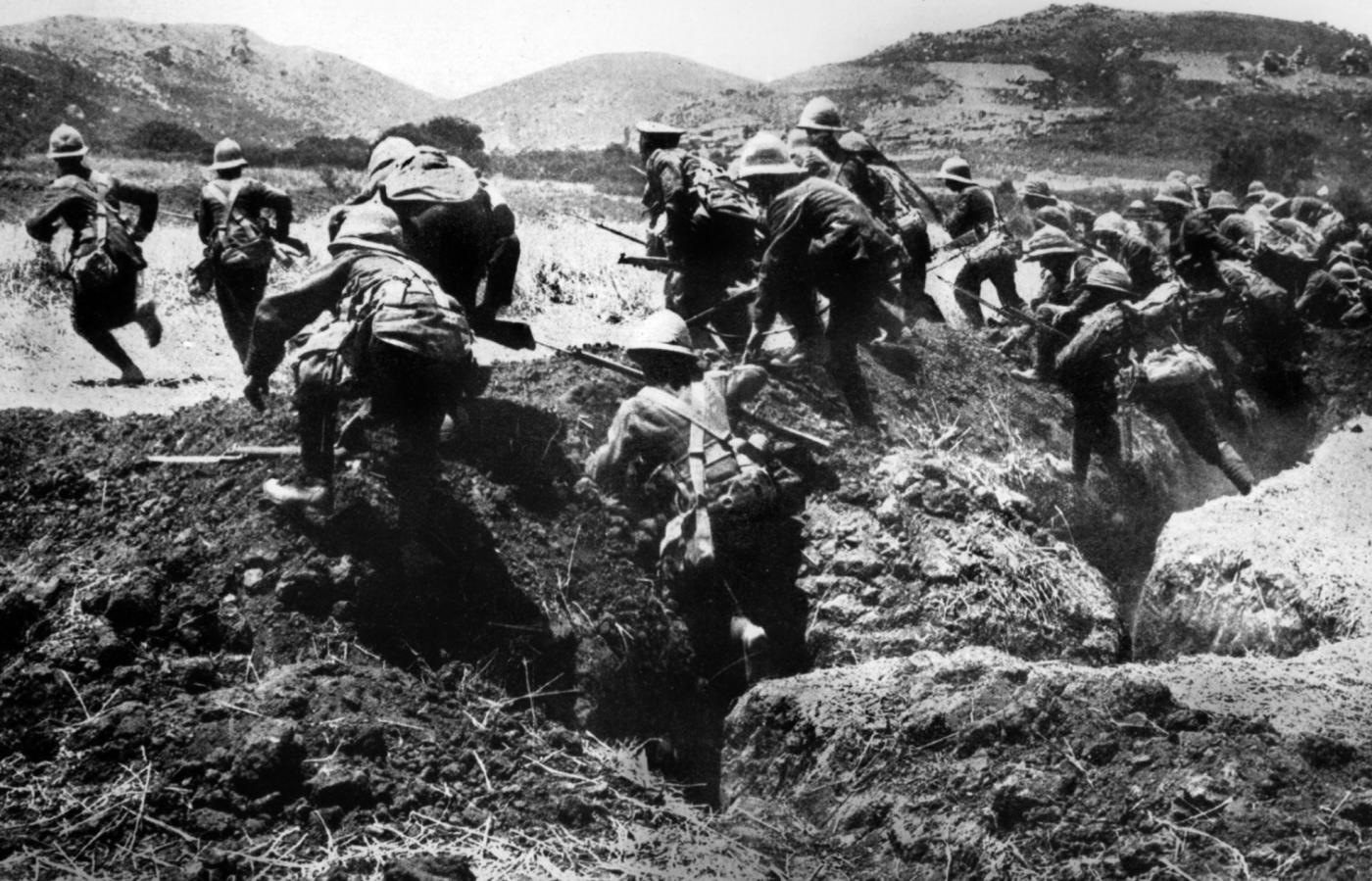
By the time the campaign ended, it was widely seen as a disaster for the Allies. What began in February 1915 as a naval attempt to force the straits failed when several battleships were sunk or damaged by mines and shore artillery. The decision was then made to land troops on the Gallipoli peninsula in April 1915, notably at Cape Helles and at what became known as Anzac Cove. From the outset, the landings were plagued by inaccurate maps, underestimation of Ottoman defenses, and a lack of clear objectives. Troops found themselves pinned to narrow beaches under fire, unable to advance inland against well-positioned defenders.
The campaign unfolded over months of grinding trench warfare, disease, and logistical chaos. Summer heat, flies, and lack of water were followed by winter storms and freezing conditions. Attempts to break the deadlock, such as the August offensive at Suvla Bay, were poorly executed and failed to achieve their goals. By autumn 1915 it had become clear that victory was unlikely, and attention shifted from how to win the campaign to how to end it without further catastrophic losses.
On the Allied side, overall command at the start rested with General Sir Ian Hamilton, who reported to the British War Office. Hamilton was an experienced officer but struggled to impose coherent control over a complex joint operation involving British, French, Australian, New Zealand, and other forces. He was eventually recalled in October 1915 and replaced by General Sir Charles Monro, who quickly concluded that evacuation was the only sensible course. Politically, the campaign was closely associated with Winston Churchill, then First Lord of the Admiralty, whose advocacy of the Dardanelles strategy made him a focal point for criticism when it failed.
Opposing the Allies was the Ottoman Fifth Army, commanded by the German general Otto Liman von Sanders. Among his most capable subordinates was Mustafa Kemal, later known as Atatürk, who played a decisive role in stopping the ANZAC advance during the early landings and in subsequent fighting. Ottoman forces, fighting on home territory and defending strategically vital ground, proved resilient and adaptable. Their success at Gallipoli became a defining moment in modern Turkish history.
Casualties were enormous on both sides. The Allies suffered roughly 250,000 casualties, including about 46,000 killed. The Ottoman Empire sustained a similar number of casualties, with estimates also around 250,000, including approximately 56,000 dead. These figures reflect not only combat losses but also the heavy toll of disease, which claimed tens of thousands of lives in unsanitary and overcrowded conditions.
Responsibility for the failure has long been debated. Military planners were blamed for underestimating the Ottomans and overestimating the ability of naval power and hastily landed troops to achieve strategic goals. Political leaders were criticized for approving an operation without clear planning or unified command. There was also blame at the operational level, where hesitation and poor communication squandered rare opportunities for breakthroughs. In truth, the disaster was the result of a combination of flawed assumptions, inadequate intelligence, and the difficulty of coordinating a complex amphibious assault with early twentieth-century technology.
Despite the failure, some lessons were learned. The importance of detailed planning, accurate intelligence, and unified command in joint operations became clearer. The successful evacuations in December 1915 and January 1916, carried out with minimal casualties, demonstrated that careful deception and organization could achieve what earlier phases of the campaign could not. These experiences influenced later amphibious operations, most notably during the Second World War.
There are also enduring human and cultural legacies. For Australia and New Zealand, Gallipoli became a foundational national story, commemorated annually on Anzac Day. For Turkey, the defense of Gallipoli helped elevate Mustafa Kemal as a national hero and laid part of the groundwork for the modern Turkish state. Ironically, the campaign remembered for its chaos and loss ended with one of the most efficient withdrawals of the war, a quiet conclusion to a campaign that had begun with grand expectations and ended in sobering reality.