Pershing M26 Tank
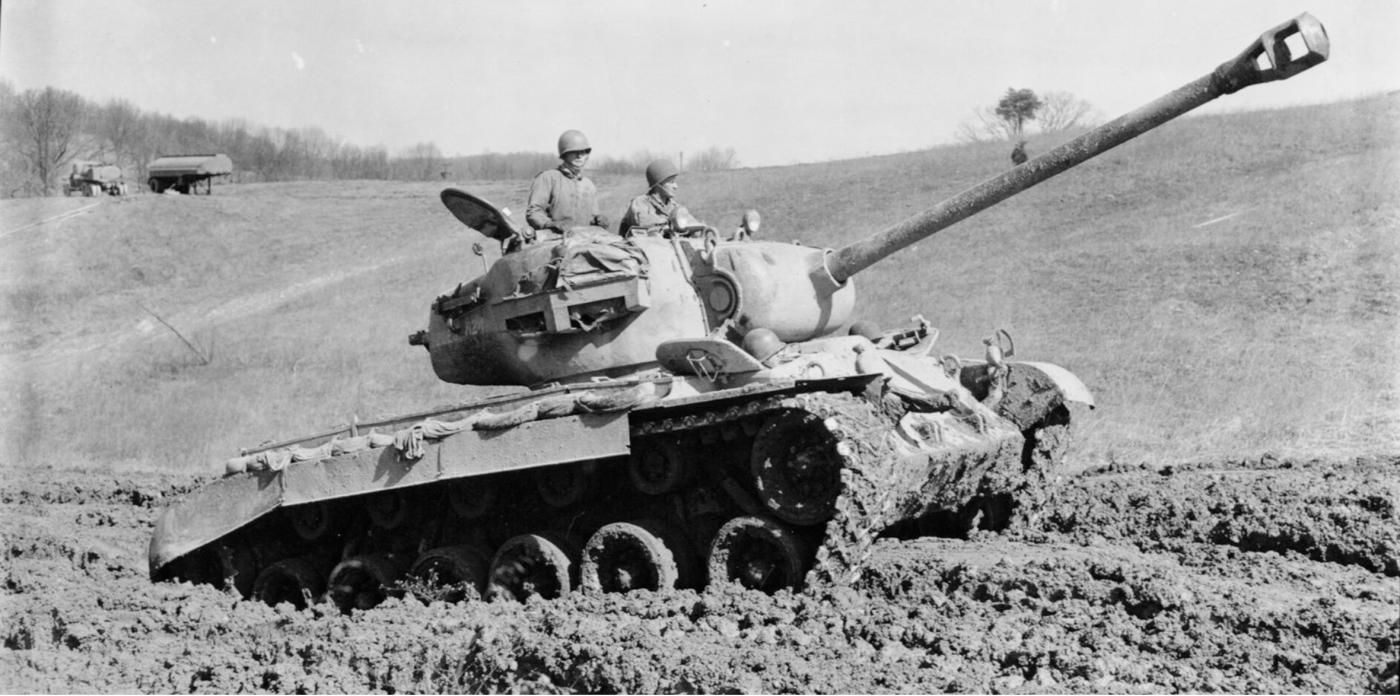
The heavy tank introduced into United States service on 25 February 1945 was the M26 Pershing, a vehicle that represented the culmination of several years of American tank development aimed at countering increasingly powerful German armour. Although officially classified at first as a heavy tank, it was later reclassified as a medium tank after the war, but in the context of its time it was designed to match and defeat German heavy tanks such as the Panther and Tiger. Its arrival so late in the war meant that it saw only limited combat, yet it marked a turning point in American armoured design and laid the foundation for post-war main battle tanks.
The design of the Pershing can be traced back to 1942 when American forces encountered German tanks in North Africa and realized that the standard M4 Sherman, while reliable and easy to produce, was increasingly outmatched by German armour and firepower. The U.S. Army Ordnance Department began a series of experimental heavy tank and improved medium tank designs, including the T20, T22 and T23 programs. The final development that led to the Pershing was the T26 series. Key figures in the design process included engineers and ordnance specialists within the U.S. Army Ordnance Department, rather than a single named designer. The project was overseen by the Ordnance Department’s Tank-Automotive Center in Detroit, working with industrial partners such as the Fisher Tank Arsenal of General Motors and the Detroit Arsenal Tank Plant.
The Pershing’s design reflected lessons learned from combat in Europe. It was built with much thicker armour than earlier American tanks. The frontal hull armour was up to 102 mm thick and sloped to improve effective protection, while the turret front was approximately 102 mm as well, giving it significant resistance against German anti-tank guns and tank cannons. The side armour ranged from about 50 to 76 mm depending on the location. Compared to the M4 Sherman, whose frontal armour was typically around 51 mm, the Pershing offered far greater protection and could survive hits that would have destroyed earlier U.S. tanks. The sloped armour design also increased the likelihood of enemy shells ricocheting off rather than penetrating.
Firepower was one of the Pershing’s most important improvements. It was armed with the 90 mm M3 gun, a high-velocity weapon capable of penetrating the frontal armour of German Panther tanks at typical combat ranges and even threatening the Tiger I. The gun fired a range of ammunition types including armour-piercing, high-explosive and later high-velocity armour-piercing (HVAP) rounds. With HVAP ammunition, the Pershing could penetrate over 150 mm of armour at close range. This gave American crews a fighting chance against the most formidable German tanks. The main gun was mounted in a large, well-armoured turret with a powered traverse system, allowing rapid engagement of targets. Secondary armament included two .30-calibre machine guns, one coaxial with the main gun and one mounted in the hull, plus a .50-calibre heavy machine gun on the turret roof for anti-aircraft and anti-infantry use.
The tank was powered by a Ford GAF V-8 petrol engine producing around 500 horsepower. This engine gave the Pershing a top speed of roughly 25 miles per hour (40 km/h) on roads and somewhat less cross-country. Despite its heavier weight of approximately 41 to 42 tons, the Pershing had mobility comparable to late-model Shermans, though it was more mechanically complex and sometimes less reliable in early service. The vehicle used a torsion bar suspension system rather than the vertical volute spring suspension of the Sherman, providing a smoother ride and better cross-country performance. This suspension design would become standard on later American tanks.
The crew of the M26 Pershing consisted of five men: commander, gunner, loader, driver and assistant driver/bow machine gunner. The interior layout was designed to provide more space and improved ergonomics compared to earlier tanks, allowing the crew to operate more effectively during combat. The commander had access to a rotating cupola with vision blocks and a machine gun mount, improving situational awareness and defensive capability.
Production of the Pershing began in late 1944 and continued into 1945. Approximately 2,200 M26 Pershing tanks were produced by the end of the war, with the majority built by Fisher Tank Arsenal and the Detroit Arsenal. However, only a relatively small number reached Europe before the German surrender in May 1945. The first Pershings arrived in Europe in January 1945 and entered combat in February. They were issued primarily to the 3rd and 9th Armored Divisions for combat evaluation in what was known as the Zebra Mission, an effort to test the new tank under real battlefield conditions.
In combat, the Pershing demonstrated that it could engage German heavy tanks on more equal terms than the Sherman. There were several notable engagements, including battles in Cologne and at the Remagen bridgehead, where Pershings fought German Panther and Tiger tanks. In one famous action in Cologne in March 1945, a Pershing destroyed a German Panther in a duel captured on film by an American combat cameraman. These engagements showed that the 90 mm gun and heavier armour provided a clear improvement over earlier American tanks.
Despite these successes, the Pershing’s late introduction meant it had limited impact on the overall outcome of the war in Europe. By the time it entered service in significant numbers, German forces were already retreating and the conflict was nearing its end. Only about 20 Pershings saw front-line combat in Europe before Germany surrendered. A small number were sent to the Pacific, but they arrived too late to see action before Japan’s surrender in August 1945. As a result, the tank did not significantly influence the outcome of World War II itself.
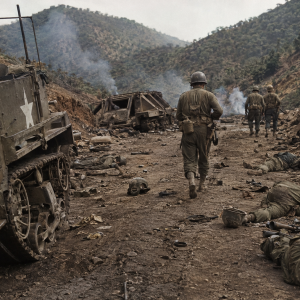
Nevertheless, the Pershing represented a major step forward in American armoured warfare. It addressed many of the shortcomings of earlier U.S. tanks and introduced features that would become standard in post-war designs, including heavier armour, a powerful high-velocity gun and torsion bar suspension. After the war, the Pershing served in occupation duties and later saw combat in the Korean War, where it proved effective against North Korean T-34-85 tanks. Its design also formed the basis for subsequent American tanks such as the M46, M47 and eventually the M48 Patton series.
Although introduced too late to play a decisive role in World War II, the M26 Pershing symbolized the evolution of U.S. tank design from the mass-produced, reliability-focused Sherman to a more heavily armed and armoured vehicle capable of matching enemy heavy tanks.