On this day in military history…
On the night of 29 December 1940 London experienced one of the most devastating air raids of the Second World War, an attack that later became known as the Second Great Fire of London. It was a raid that, in terms of the area affected and the number of historic buildings destroyed, caused damage comparable to, and in some respects greater than, the Great Fire of 1666. What made it especially destructive was not simply the weight of bombs dropped, but the particular combination of tactics, weather conditions, and human endurance that defined that winter night.
The raid came during the height of the Blitz, at a time when Londoners were already exhausted by months of bombing. December 1940 had been particularly severe, with several heavy raids in the days leading up to Christmas. On the evening of the 29th, the Luftwaffe launched a concentrated attack aimed primarily at the City of London, the ancient commercial heart of the capital. Between roughly 6.30 pm and the early hours of the morning, around 130 to 140 German aircraft took part, most of them medium bombers such as the Heinkel He 111 and Junkers Ju 88. While this was not the largest raid in terms of aircraft numbers, it was carefully planned to maximise destruction.
Instead of relying mainly on high-explosive bombs, the Luftwaffe dropped an enormous number of incendiaries, estimated at around 100,000 individual devices. These small magnesium-based bombs were designed to ignite buildings rather than flatten them outright. The City of London, with its dense concentration of old warehouses, timber-framed structures, narrow streets, and paper-filled offices, was acutely vulnerable. To make matters worse, the weather played directly into the attackers’ hands. A strong easterly wind blew that night, fanning flames and carrying sparks across rooftops, allowing small fires to merge rapidly into large, uncontrollable blazes.
Within a short time, hundreds of fires were burning simultaneously. Streets that had stood for centuries were turned into corridors of flame. Churches designed by Christopher Wren, which had survived the Great Fire of 1666, now burned fiercely. Among them were St Lawrence Jewry, St Bride’s Fleet Street, and St Mary-le-Bow, whose bells had famously marked the heart of Cockney London. The medieval Guildhall suffered severe damage, and whole districts east of St Paul’s Cathedral were left as smouldering ruins by morning. In sheer acreage, more of the City was destroyed in this single night than in the fire of 1666, even if the earlier disaster remains more deeply embedded in popular memory.
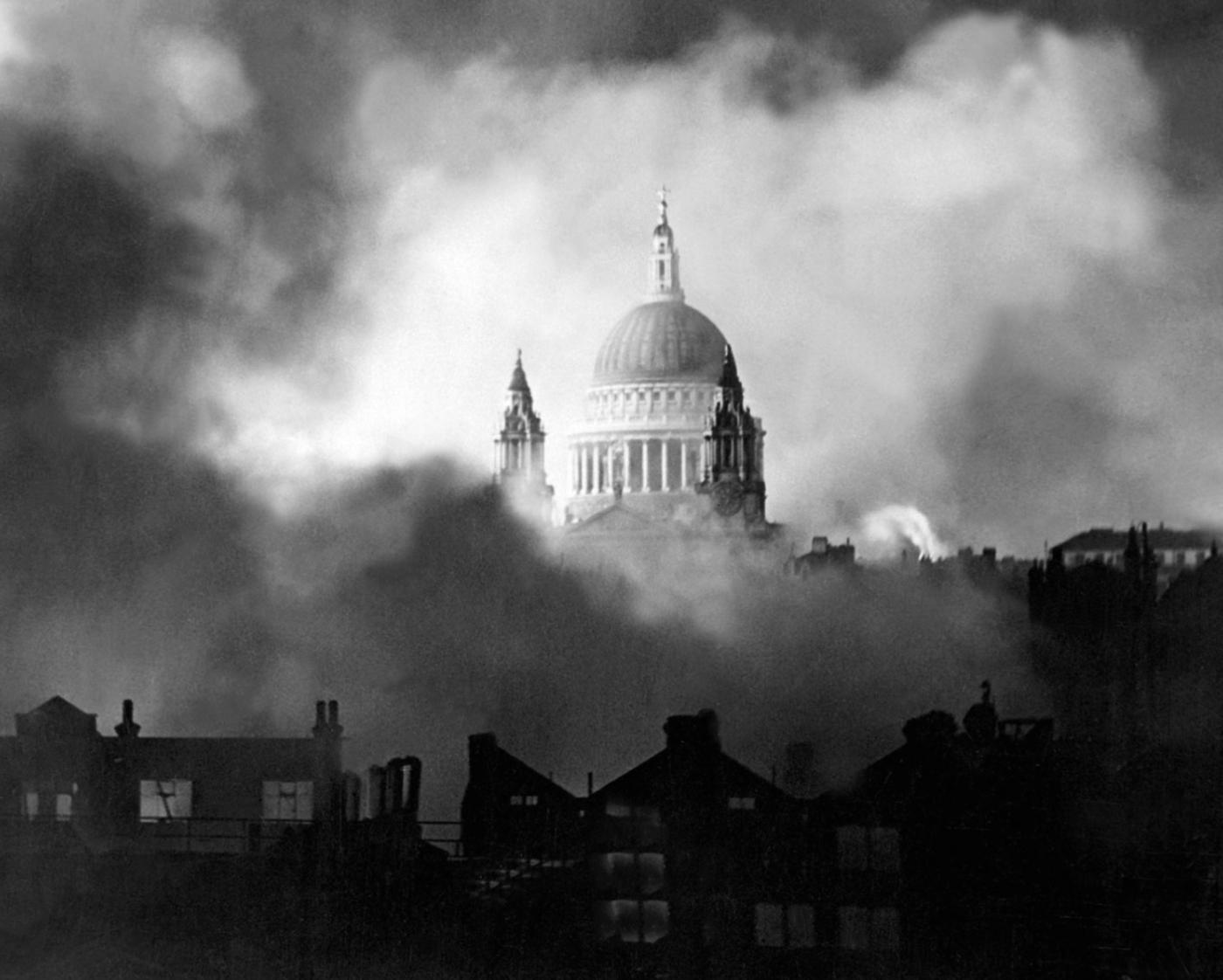
At the centre of the inferno stood St Paul’s Cathedral, its great dome looming above a sea of fire. The cathedral was repeatedly threatened by incendiaries landing on its roof and in the surrounding streets. A direct hit could have caused the dome to collapse, potentially destroying one of Britain’s most important symbols. The survival of St Paul’s became one of the most powerful images of the war, later immortalised in photographs showing the cathedral rising above smoke and flames. Its survival was not a matter of luck alone, but of extraordinary effort.
The London Fire Brigade, reinforced by auxiliary firemen and women and units from surrounding counties, fought the fires with remarkable courage. Many firefighters had already been on duty for days with little rest. On the night of the raid, they faced overwhelming odds. Water mains had been shattered by high-explosive bombs, leaving many hydrants useless. Fire crews were forced to pump water directly from the River Thames, often working in intense heat and thick smoke while bombs continued to fall around them. The noise was constant: exploding bombs, collapsing buildings, roaring flames, and the drone of aircraft overhead.
One of the most effective responses was the use of firewatchers and special squads stationed on rooftops, including those of St Paul’s Cathedral. Armed with stirrup pumps, buckets of sand, and sheer determination, they extinguished incendiaries before they could take hold. At St Paul’s, a dedicated group worked throughout the night, climbing onto the roof and into the dome itself to put out fires started by burning debris. Their actions almost certainly saved the building from destruction.
Civilian volunteers also played a crucial role. Members of the Auxiliary Fire Service, many of whom had little training before the war, worked side by side with professional firefighters. Messengers ran through burning streets to carry orders when telephone lines failed. Ambulance crews rescued the injured under constant danger. Despite the scale of the destruction, the loss of life that night, estimated at around 160 to 200 people, was lower than might be expected, partly because many office buildings in the City were empty after dark.
By dawn on 30 December, the fires were finally brought under control, though many buildings continued to smoulder for days. The City of London was devastated. An estimated two-thirds of it lay in ruins, with thousands of buildings destroyed or badly damaged. Warehouses filled with goods burned out completely, crippling businesses and adding to Britain’s economic strain at a critical point in the war.
The psychological impact of the raid was immense, both in Britain and abroad. The image of St Paul’s standing firm amid the devastation became a symbol of national resilience, used widely in propaganda and morale-boosting publications. For Londoners, the night reinforced both the terror of modern aerial warfare and the extraordinary capacity of ordinary people to endure and resist it.