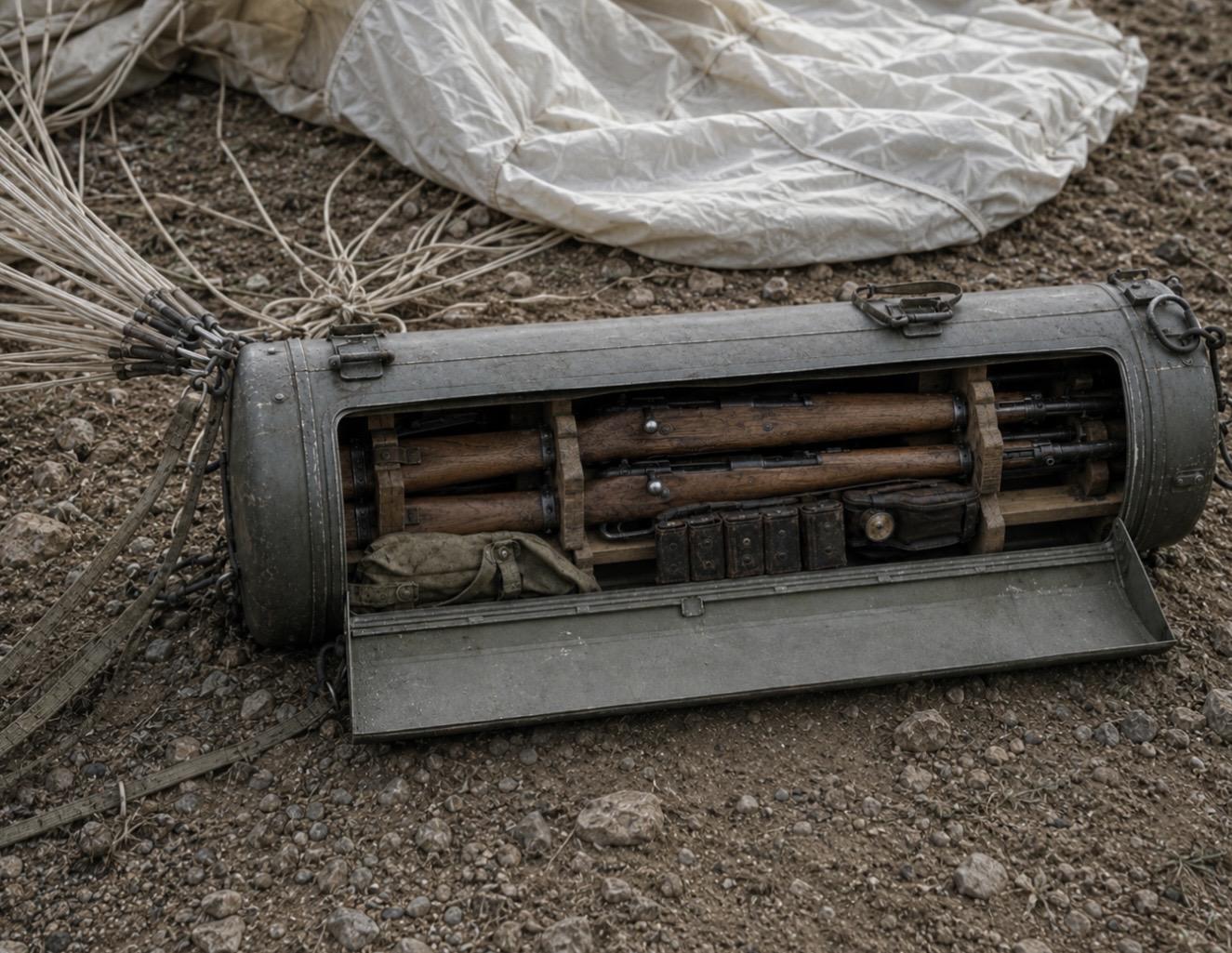
Abwurfbehalter drop container
The German Fallschirmjäger drop container, usually known by the German term Abwurfbehälter, was one of the most distinctive pieces of equipment used by German parachute troops during the Second World War. It was not simply a supply box, but a central part of the whole German method of airborne warfare. Unlike many British and American airborne soldiers, who normally jumped with at least their personal weapon strapped to them or carried in a weapon case, the early German paratrooper often went out of the aircraft with only a pistol, grenades, a fighting knife and his personal kit. His rifle, sub-machine gun, light machine gun, ammunition, explosives, radio equipment, medical stores and heavier weapons were dropped separately in containers. Once he landed, one of his first and most urgent tasks was to find the container, open it, arm himself and then form up with his section.
The reason for this system lay partly in the German parachute and harness. The Fallschirmjäger used a static-line parachute system designed to open quickly at low altitude. This allowed men to be dropped from relatively low-flying Ju 52 transport aircraft and reduced the time they spent drifting in the air. However, the German parachute harness and suspension method gave the jumper little control in the descent and tended to bring him down in a forward, face-first or knees-and-hands landing position. A long rifle, a machine gun or bulky ammunition boxes strapped to the body could easily injure the man on impact. German training therefore placed great emphasis on a fast exit, a hard landing, getting clear of the parachute harness, and then racing for the nearest weapons container.
The container was meant to solve this problem. It allowed the German paratrooper to land without being burdened by a rifle or heavy equipment, while still giving the airborne unit access to the firepower it needed once on the ground. In theory the system was sensible. In practice it could be dangerous, because the men and the weapons did not always land together. Wind, aircraft speed, inaccurate dropping, enemy fire, smoke, confusion, uneven ground and poor visibility could scatter the containers across a wide area. A man might land safely but find that his rifle had come down hundreds of yards away, in a ravine, in an olive grove, on a rooftop, in the sea, or inside ground already covered by enemy fire.
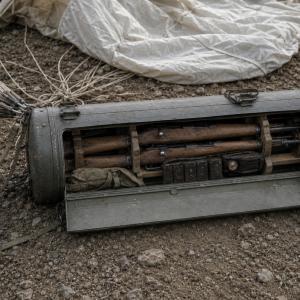
The best-known German airborne container was the long metal drop canister used for weapons and equipment. The Germans also used the term Mischlast-Abwurfbehälter for mixed-load containers, including the 250 kg type. Early versions included more bomb-shaped or bullet-shaped containers, while other types were long, coffin-like or cylindrical metal containers with lids along the side. They were strong enough to protect weapons and equipment during descent and landing, but light enough to be handled by a small group of men. Some containers had internal compartments or removable inserts so that weapons, ammunition and equipment could be packed in an orderly way. A container might carry Kar 98k rifles, MP 38 or MP 40 sub-machine guns, MG 34 machine guns, ammunition belts, grenades, mortar bombs, radio parts, medical stores, food, water cans, demolition charges or specialist equipment for engineers.
A very useful feature on some containers was the provision for small wheels or handles. Once the Fallschirmjäger had recovered the container, wheels could sometimes be fitted so that it could be dragged like a small cart. This mattered because airborne troops were light infantry and had no vehicles immediately available after landing. A container that had brought down ammunition or heavy weapons could become a hand-drawn supply cart. In theory this allowed the troops to move ammunition, machine guns, mortars and other heavy items from the drop zone toward the objective. In reality, under fire, in broken country, or among rocks and terraces such as those found on Crete, dragging a container could be exhausting or impossible.
The containers were usually dropped by parachute from the same transport aircraft that carried the men, or from aircraft following the troop drop. They often had their own parachutes and sometimes used coloured parachutes or markings to help troops identify the contents. Colour coding and stencilling were important because a paratrooper searching for a rifle container did not want to waste time opening a container full of medical equipment or rations. Markings could indicate ammunition, weapons, engineer stores or other supplies. In the noise and confusion of battle, however, even a well-marked container could be difficult to locate. Dust, smoke, enemy fire and the scattered pattern of a parachute drop often ruined the neat order planned before take-off.
The opening moments after landing were the most dangerous. A German paratrooper had to get out of his harness, gather himself after a heavy landing, identify where he was, avoid enemy fire, and then find the container that held his weapon. Until that happened he was badly underarmed. A pistol and grenades might be enough in a close fight, but they were poor weapons against riflemen, machine guns or troops firing from covered positions. This weakness was seen very clearly during the invasion of Crete in May 1941. Many Fallschirmjäger landed among alerted British, New Zealand, Australian and Greek defenders. Some were shot while still hanging in their harnesses or before they could reach their weapons. Others found that the containers had fallen into enemy-held ground, had smashed, had rolled away, or were pinned down by fire.
Crete showed both the usefulness and the danger of the German system. When the containers were recovered quickly, the Fallschirmjäger could become a highly effective fighting force within minutes. They could bring MG 34 machine guns into action, distribute rifles and ammunition, set up mortars, and press forward with the aggressive tactics for which they were trained. When the containers were lost, delayed or unreachable, whole groups of men could be left almost helpless. This was one reason the German casualties on Crete were so severe. The system depended on the drop being accurate and the enemy being shocked or suppressed. If defenders were ready and the ground was difficult, the container system could turn the first minutes of an airborne assault into a race for survival.
The contrast with Allied airborne forces is important, although it should not be exaggerated. British and American airborne troops also used containers and bundles for heavy equipment, radios, mortars, anti-tank weapons, ammunition and supplies. No airborne army could make every man jump with everything he needed for a long fight. The difference was that Allied parachute troops generally tried to land with their individual weapons, or at least with them in weapon cases attached to the jumper or dropped very close with him. American paratroopers, for example, often used weapon bags or jump cases for rifles and carbines, while heavier equipment came down separately. This did not always work perfectly; Allied weapon bags could be torn away, lost or damaged. But the German early-war method created a more serious problem because so many men’s main weapons were deliberately separated from them from the start.
The German decision made sense from a technical point of view. Their parachute equipment made it risky to land with a long weapon. It also reflected the early German belief that surprise, speed and shock action would compensate for temporary weakness at the moment of landing. German airborne assaults in 1940, such as those in Norway, the Netherlands and Belgium, gave some support to this belief. At places where surprise was complete, where glider troops landed directly on objectives, or where defenders were overwhelmed quickly, the container system was less of a handicap. But where the enemy was waiting, as on Crete, the weakness became painfully obvious.
The contents of a drop container were packed carefully. Weapons had to be protected from impact, ammunition had to be kept secure, and the container had to open quickly once recovered. Rifles could be bundled together, machine guns packed with spare barrels and belts, and ammunition stored in boxes or pouches. Containers could be loaded for specific squads or platoons, so that a particular group of men knew which container to find. Some loads were general supply loads, while others were for specialist teams such as machine-gun crews, mortar crews, engineers, signallers or medical orderlies. In airborne operations, seconds mattered. A container that was hard to open or badly packed could delay the whole unit.
The landing of the containers was not gentle. Even with parachutes, they could hit the ground hard, bounce, roll or break open. Rocky ground could damage them. Trees could catch them. Wind could drag them. In water landings they could be lost altogether. The parachute itself could also reveal the container’s position to enemy soldiers. Defenders who saw a weapons container coming down knew exactly where the German paratroopers would try to go. In some cases, Allied troops fired on the containers, captured them, or waited for German paratroopers to run toward them. A container full of German rifles and ammunition was a valuable prize if reached by the defenders first.
The containers also had a psychological effect. For the Fallschirmjäger, seeing the containers land nearby meant survival and fighting power. For the defender, the same containers were targets. A German paratrooper landing with only a pistol might not seem very threatening at first, but if he reached a container with an MG 34 and ammunition belts, the situation could change rapidly. The machine gun was the heart of German infantry tactics, and once the Fallschirmjäger had their machine guns operating, they could lay down heavy fire and begin to fight as organised infantry rather than scattered parachutists.
The use of containers also influenced German airborne tactics after landing. Small groups had to form around weapons rather than simply around the men who had landed together. The first men to reach a container might arm themselves and then throw or pass weapons to others. Leaders had to restore order quickly, gather men from different aircraft, and decide whether to attack the objective, defend the container area, or search for missing equipment. A lost radio container could isolate a unit. A missing ammunition container could leave a machine-gun team useless. A misplaced medical container could mean wounded men had little help. The success of the drop was therefore not just about landing troops, but about landing troops and containers in the same place at the same time.
After Crete, the German airborne arm changed. Large-scale parachute assaults became rarer, partly because the losses in Crete shocked the German high command. The Fallschirmjäger continued to fight with great skill, but increasingly as elite ground troops rather than as parachute assault troops. Later in the war, German parachute equipment and doctrine evolved, and weapons such as the FG 42 were developed partly to give paratroopers more immediate firepower. The FG 42 was intended as a powerful automatic rifle for airborne troops, although it was never produced in enough numbers to transform the whole force. The basic lesson remained clear: an airborne soldier needed to be armed as soon as he hit the ground.
The Abwurfbehälter is therefore an interesting object because it shows both German ingenuity and German vulnerability. It was a clever answer to a real technical problem. It protected weapons during the drop, allowed heavier equipment to be delivered with the parachute troops, and could even serve as a small transport container after landing. At the same time, it created a dangerous gap between landing and fighting. In airborne warfare that gap might last only a minute or two, but a minute under rifle and machine-gun fire could decide the fate of an entire stick of paratroopers.