On this day in military history…
On 16 June 1944, ten days after the D-Day landings, King George VI crossed the English Channel to visit the Allied troops in Normandy. It was a short visit, but it carried great symbolic weight. The King had followed the invasion closely from Britain, not as a distant figurehead but as a wartime monarch who had been briefed on the great operation and understood its dangers. By the time he reached the beachhead, the Allies had secured a foothold in France, but the battle was still far from settled. The front was close, German resistance remained fierce, and the future of the campaign still depended on the courage, endurance and supply of the men fighting inland from the beaches.
George VI had not simply woken up to events after 6 June. In the months before D-Day he had been kept informed of the planning for Operation Overlord, the Allied invasion of Nazi-occupied western Europe. He attended the final senior briefing at St Paul’s School in London on 15 May 1944, where General Montgomery explained the plan to senior officers and political leaders. Montgomery, known universally as Monty, commanded 21st Army Group and was responsible for the Allied ground forces in the assault and the fighting immediately after the landings. The King therefore had a clear understanding of what was at stake: the invasion was not a raid or a gesture, but the opening of the long-awaited western front that would begin the liberation of north-west Europe.
On D-Day itself, 6 June 1944, the King recorded the news in his diary. He noted that the invasion of the continent had begun during the night and that airborne troops had successfully landed and captured their objectives. That detail shows how closely he followed the unfolding battle. He knew that the airborne landings, the naval bombardment, the assault beaches and the movement inland all had to work together. Later that day he broadcast to the nation, calling the invasion a supreme test and asking the people of Britain and the Empire to meet the moment with prayer, resolve and dedication. His words were meant not only for civilians at home, but also for the sailors, soldiers and airmen who were risking their lives in France.
The King had wanted to see the fighting for himself earlier. Both he and Winston Churchill had wished to observe the invasion from a Royal Navy ship, but this was judged too dangerous. There was a real possibility that a ship near the invasion coast might be hit by enemy aircraft, torpedoes, shells or mines. George VI helped prevent Churchill from taking that risk by making it clear that if the Prime Minister went, the King would feel obliged to go too. In effect, the King used his own position to restrain Churchill. He understood that Britain could not afford to lose its Prime Minister at such a critical moment, and that a royal or political disaster at sea would have been a grave blow to national morale.
Once the beachhead was secure enough for a controlled visit, arrangements were made for the King to cross to Normandy. He travelled on the light cruiser HMS Arethusa, a ship already associated with the invasion. Arethusa had taken part in the naval operations off Normandy and had been involved in the bombardment supporting the landings. On 16 June she embarked the King and senior officers for the visit to the invasion beaches. The ship sailed from Portsmouth in the morning, flying the King’s standard, and crossed the Channel towards the crowded waters off the Normandy coast.
The crossing itself was part of the story. The King was not carried quietly to a peaceful harbour. He passed through the immense seaborne machinery of Operation Overlord: landing craft, escort ships, cruisers, destroyers and supply vessels. The waters off Normandy were filled with the evidence of the largest amphibious operation in history. The invasion had involved thousands of ships and landing craft, and by mid-June the build-up was still continuing at an enormous pace. Men, vehicles, ammunition, food, fuel and medical supplies were pouring across the Channel to keep the armies moving.
As HMS Arethusa approached the French coast near the British and Canadian sector, the King transferred from the cruiser to a smaller Fairmile motor launch and then to a DUKW amphibious vehicle for the final journey ashore. The DUKW carried him through the busy beach area, past landing craft and the signs of recent battle. Officers aboard LCT(5) 507 saluted as he passed. The landing itself was made in the Juno Beach area, at Courseulles-sur-Mer and Graye-sur-Mer, where Canadian and British beach organisation units were still working under difficult conditions to keep the flow of men and supplies moving inland.
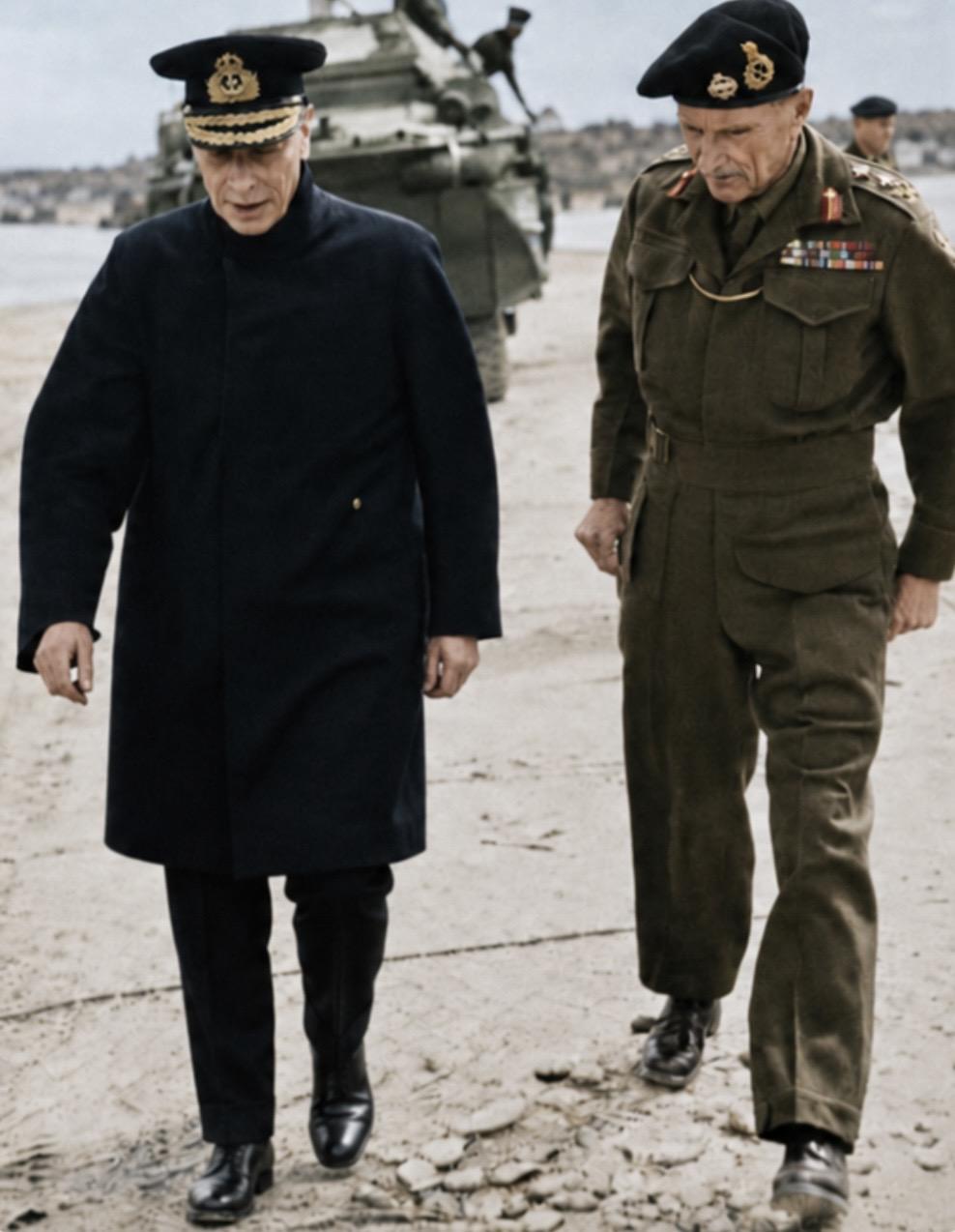
When the King came ashore he was met by General Montgomery. It was a meeting of two very different wartime figures: the quiet, dutiful monarch and the confident, direct commander whose personality had become famous throughout the Army. Montgomery understood the importance of morale, and so did the King. The visit was not meant to interfere with operations, and the King had no wish to distract commanders from military duties. Its purpose was to be seen by the men, to thank them, and to show that the country and Crown recognised what they had done.
Among the personnel present on the beach were men of the Juno Beach party and No. 7 Beach Group. Lieutenant-Colonel W. J. Humphrey, commanding officer of the 8th Battalion, King’s Liverpool Irish, and connected with No. 7 Beach Group, was noted in contemporary film records of the landing. These beach groups were vital but often overlooked. Their work was not as dramatic as the first assault waves, but without them the invasion could not have been sustained. They organised the beaches, controlled traffic, handled supplies, cleared routes and helped turn a hostile shoreline into a functioning military lifeline.
After meeting Montgomery on the beach, the King travelled inland to 21st Army Group headquarters at Creully. He went in Montgomery’s own Humber staff car, famously known as “Old Faithful”. Creully was close enough to the battle to remind everyone that this was still an active campaign, not a ceremonial tour. The King was now in liberated France, but only a short distance from danger. German artillery, aircraft, mines and snipers were still hazards, and the fighting around Caen and the inland villages remained hard and costly.
At Creully, the King saw the headquarters from which Montgomery directed the British and Canadian armies in Normandy. He lunched there and was shown the situation as commanders understood it at that stage of the campaign. This was one reason the visit mattered: George VI was not merely posing for photographs. He had followed the invasion from Britain, had attended the pre-invasion briefings, had watched the first reports come in, and now saw the beachhead and command arrangements for himself. He knew enough to appreciate both the success already achieved and the dangers still ahead.
One of the most important moments of the visit was the investiture ceremony held in the grounds of 21st Army Group headquarters. Assisted by Major-General Francis de Guingand, Montgomery’s Chief of Staff, the King decorated officers and men for gallantry and service. Among those decorated was Major-General R. F. L. Keller, General Officer Commanding 3rd Canadian Division, whose troops had landed on Juno Beach on D-Day. Also decorated were officers and non-commissioned officers attached to Montgomery’s staff, including Major Turner of the Grenadier Guards and Major L. G. S. Sanderson. The ceremony was brief, but in the circumstances it was remarkable: medals were being presented by the King of Britain in a newly won foothold on the soil of France, only ten days after the invasion had begun.
Montgomery, Admiral Sir Bertram Ramsay and Lieutenant-General Miles Dempsey were among the senior commanders present. Ramsay was the Allied Naval Commander Expeditionary Force, responsible for the immense naval side of the landings. Dempsey commanded the British Second Army. Together, these men represented the land and sea forces that had made the invasion possible. The King spoke to some of the decorated men after the ceremony. For soldiers who had come through the landings and the first days of battle, a personal word from the King was a powerful sign that their service had been seen and valued.
The troops at 21st Army Group headquarters gave three cheers for the King, led by Montgomery. The King then inspected men of the headquarters defence company and staff. This was the morale purpose of the visit in its clearest form. George VI had spent the war visiting bombed cities, factories, naval bases, airfields and military units. He understood that presence mattered. In Normandy, his visit told the troops that they were not forgotten, that their families and country stood behind them, and that the struggle on the beachhead was recognised at the highest level.
The King also went on to visit Second Army headquarters, where he was received by Dempsey and senior staff. He then visited the new Admiralty headquarters at Courseulles before returning towards HMS Arethusa. The day had taken him from Portsmouth to the invasion coast, from the beach to Montgomery’s headquarters, from an investiture to army command posts, and finally back through the naval organisation that kept the whole operation alive. It was a compact but carefully arranged tour, designed to let him see as much as possible without placing him or others in unnecessary danger.
The visit lasted only part of the day in Normandy. HMS Arethusa had sailed in the morning and was back at Portsmouth by the evening of 16 June. The King was therefore not in France for long, but the short duration should not make the visit seem minor. In wartime conditions, even a few hours on the beachhead required planning, naval movement, protection, coordination with commanders and acceptance of real risk. The journey was made while the battle was still active and before the Allies had broken out from Normandy.
There are several interesting details that make the visit vivid. The King came ashore not in a grand royal launch, but through the practical machinery of amphibious war: cruiser, motor launch and DUKW. He passed landing craft and invasion vessels rather than ceremonial guards. He met Montgomery almost as soon as he stepped onto the beach. He travelled in Monty’s “Old Faithful”, a vehicle already part of the commander’s legend. He decorated a Canadian divisional commander and staff officers in the grounds of a field headquarters. He heard cheers from soldiers who were living and working within reach of the battle. He saw the naval and army systems that were turning the D-Day landings into a continuing campaign.
The visit also showed George VI’s character. He was not a flamboyant man, and he did not try to become a battlefield commander. His strength was steadiness. He had endured the Blitz with the Queen, stayed in London during air raids, visited damaged towns and military units, and understood the emotional power of simply appearing among people under strain. In Normandy he did the same thing for the Army. He came not to direct the battle, but to encourage those who were fighting it and to honour those who had already proved themselves.
For Montgomery, the visit was useful as well as respectful. Monty was a master of morale. He knew that soldiers drew strength from symbols, from recognition and from the feeling that their sacrifices had a purpose. The sight of the King in Normandy, only ten days after D-Day, helped connect the men at the front with the nation behind them. It showed that the invasion was not merely a military operation, but a national and imperial effort involving sailors, soldiers, airmen, commanders, dock workers, factory workers, medical staff and families waiting at home.
By 16 June the Allies had not yet achieved all they hoped for. Caen had not fallen as quickly as planned, the fighting in the bocage was proving difficult, and the German army was still resisting with skill and determination. Yet the bridgehead existed, reinforcements were arriving, and the great gamble of D-Day had succeeded in its first essential aim. George VI’s visit came at exactly that moment: after the shock of the landing, before the certainty of victory. That timing gave it meaning. He saw the campaign at a stage when morale still mattered intensely and when encouragement from home could strengthen men facing more weeks of danger.