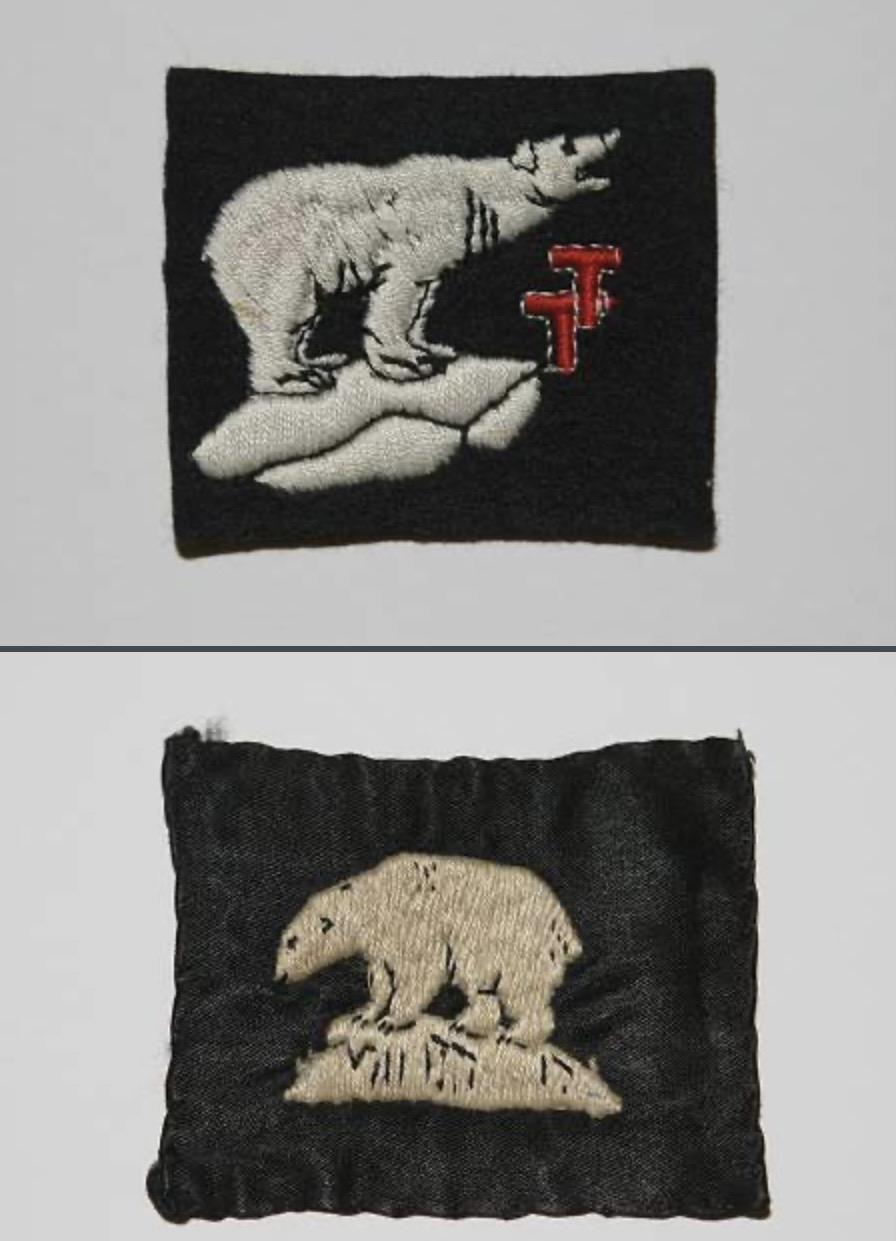
49th Division Polar Bears
The 49th (West Riding) Infantry Division, remembered by many as the “Polar Bears”, carried one of the most distinctive formation signs of the Second World War. The badge, showing a white polar bear on an ice floe, was more than a simple piece of cloth worn on a battledress sleeve. It became a symbol of the division’s identity, its hard service in Iceland, its long preparation for the invasion of Europe, and its bitter fighting from Normandy to the liberation of Holland.
At the outbreak of the Second World War, the 49th Division was a first-line Territorial Army formation based in the United Kingdom, with strong roots in the West Riding of Yorkshire. Like many Territorial formations, it was made up of men who had trained in peacetime and were now called upon for full wartime service. In February 1940, the divisional headquarters became HQ AVONFORCE, a force intended to go to the assistance of Finland during the Winter War against the Soviet Union. That operation never took place because Finland surrendered on 12 March 1940.
The division was then assigned to the campaign in Norway. Its brigades were dispersed and fought as separate groups. The 146th Brigade served as “Mauriceforce” at Namsos, while the 148th Brigade served as “Sickleforce” at Aandalsnes. The 147th Brigade did not deploy to Norway. The campaign was short, difficult and disappointing for the Allies, and by early May 1940 the 146th and 148th Brigades had returned to Britain to re-form and re-equip. The 148th Brigade did not rejoin the division. After a period as an independent brigade group, it later became a training brigade in 1942.
On 8 May 1940, HQ 147th Brigade was redesignated HQ Alabaster Force for the occupation of Iceland. This was a strategically important move. Iceland occupied a vital position in the North Atlantic, and Britain moved quickly to prevent the island from falling under German influence. In June 1940, the headquarters of the 49th Division arrived in Iceland, together with 146th Brigade and 70th Brigade under command. Alabaster Force was later redesignated “Iceland Force” in January 1941 and then “British Troops Iceland” in April 1942. By then, the main responsibility for defending Iceland was gradually passing to the Americans, including United States Marines.
It was during the division’s Iceland period that the polar bear badge first came into being. The first version of the badge was adopted in August 1940 and showed the polar bear with its head lowered. This “head down” bear has sometimes been misunderstood as looking tame or drooping, but according to the divisional history there was a deliberate reason for the design. The original badge was said to have been created with the help of an officer who had once been charged by a polar bear. The explanation was that a polar bear, like a tiger, often carries its head low and, before charging, lowers it very close to the ground. The first design therefore showed not a timid animal, but a bear about to attack.
There is also another explanation for the origin of the emblem. Some have suggested that the bear was based on the wrapper of Fox’s Glacier Mints, whose famous polar bear image would have been familiar to many British soldiers. This version of the story may have appealed because there are no native polar bears in Iceland, although polar bears have occasionally reached Iceland on drifting Arctic sea ice. Whether inspired by a real encounter, a mint wrapper, or a mixture of both, the badge soon became inseparable from the identity of the division.
Before the polar bear was adopted, the 49th Division had used other insignia, including a white metal Yorkshire Rose badge. This older metal badge linked the formation to its Yorkshire origins. The polar bear badge, however, gave the division a new wartime personality. It was usually worn as a cloth formation sign on the upper sleeve: a white bear standing on an ice floe against a dark rectangular background. Collectors and historians now recognise several forms of the badge. The first wartime pattern had the bear with its head lowered. The later and better-known version had the bear’s head raised, roaring. There were also printed cloth examples, embroidered examples, locally made versions, and metal versions or sweetheart-style badges associated with the division’s identity.
The change from the lowered head to the roaring head came after a new divisional commander took over in April 1943. The earlier bear, although intended to show a polar bear preparing to charge, was thought by some to lack the aggressive appearance suitable for a formation being trained and prepared for the invasion of Europe. The new design showed the bear with its head thrown back and mouth open, roaring. It was more dramatic and more warlike, and it fitted the spirit of a division that expected to fight its way across North West Europe. The change was not without criticism. The divisional history pointed out that the original sign had been accurate in its own way: a polar bear about to charge would naturally lower its head, not raise it.
The badge even crossed national lines. While the division was in Iceland, the divisional commander arranged for the United States Marines stationed there to adopt the polar bear patch during their deployment. This unusual sharing of a British divisional sign with American Marines showed how strongly the badge had already become associated with Iceland service and Arctic defence.
After Iceland, the division returned to Britain. Divisional Headquarters and 147th Brigade returned in April 1942, and 146th Brigade followed in August. The division was then prepared for the coming invasion of North West Europe. It trained hard, including in combined operations, and was eventually assigned as a follow-on formation for the invasion rather than one of the first assault divisions on D-Day itself.
The 49th Division entered the campaign in Normandy in June 1944 as part of the 21st Army Group. From 12 June 1944 onward, the Polar Bears fought through the difficult country of North West Europe. Their war was not glamorous. It involved hedgerows, flooded ground, villages, woods, canals, rivers and stubborn German defensive positions. The division fought in the hard battles after D-Day, including the fighting around Rauray, where it faced determined German counter-attacks. The nickname “Polar Bears” became widely known, and under Major-General Evelyn Barker the men were sometimes also called “Barker’s Bears”.
The 49th Reconnaissance Regiment played a particularly important role in the division’s later wartime story. Reconnaissance units were the eyes and ears of an infantry division. They moved ahead of the main body, probed enemy positions, found routes, reported on bridges and roads, and often made first contact with towns and villages. These men needed speed, judgement and courage. They could not simply fight like ordinary infantry, but they also could not avoid battle when they ran into resistance. The 49th Reconnaissance Regiment served with the division during the North West Europe campaign and became closely associated with the liberation of Dutch towns and villages.
After the failure of Operation Market Garden in September 1944, the 49th Division became involved in the difficult fighting around the area known as “The Island”, the low-lying ground between the River Waal and the Lower Rhine. This was the region south of Arnhem and near Nijmegen, a place of dykes, flooded fields and exposed positions. It was a grim and dangerous sector. Patrols, raids, shelling and sniping were constant features of life there. The men of the division held and contested ground that had become strategically important after the airborne operation at Arnhem had failed to secure the bridge.
Although the 49th Division was not one of the airborne formations that fought in Arnhem during Operation Market Garden, it later played an important role in the liberation of Arnhem itself. In April 1945, as the Allies advanced into the Netherlands and Germany, the division formed part of the force that cleared the city. The attack involved river crossings, artillery support, infantry assaults and cooperation with Canadian forces. The fighting was still dangerous, even though Germany was close to defeat. Arnhem had already suffered terribly in 1944, and its final liberation in 1945 was both a military operation and a moment of deep symbolic importance.
The Polar Bears also helped liberate other parts of the Netherlands. The 49th Reconnaissance Regiment was often among the first British troops to enter Dutch towns and villages. In several places, local memory still preserves the name of the Polar Bears with gratitude. The regiment is associated with the liberation of areas including Eerbeek and Loenen, and the wider division is remembered in places such as Arnhem and Utrecht. In Utrecht, the arrival of the Polar Bears became part of the city’s liberation story, and monuments and commemorations continue to connect the 49th Division with the freedom of the Netherlands in 1945.
The division’s route from Iceland to Holland gives the polar bear badge a special meaning. It began as a sign of Arctic service, born from the cold North Atlantic and the occupation of Iceland. It then became the fighting emblem of a Yorkshire Territorial division in Normandy, Belgium, the Netherlands and Germany. The lowered-head bear of 1940 represented a polar bear about to charge. The roaring bear of 1943 represented the more aggressive image wanted for a division preparing to enter Europe. Both designs tell part of the story.
For collectors, veterans’ families and military historians, the badges themselves are fascinating. The early “head down” badge is especially interesting because it represents the Iceland period and the first adoption of the polar bear symbol. The later “head up” or roaring bear badge is the classic wartime version most often associated with the division in North West Europe. Cloth badges varied in manufacture, including printed and embroidered types, and surviving examples sometimes show differences in shape, detail, colour and quality depending on where and how they were made. Metal versions and related insignia also existed, including badges that reflected the division’s Yorkshire identity or were worn informally as keepsakes or commemorative pieces.
After the war, the Territorial Army was reconstituted in 1947, and the division was reformed as a Territorial armoured division. It retained the wartime polar bear badge, showing how deeply the emblem had become part of its identity. The division also added “Midland” to its name, reflecting a wider recruitment area that included parts of the old 46th North Midland and 48th South Midland Divisions. Even as its role changed, the polar bear remained.