
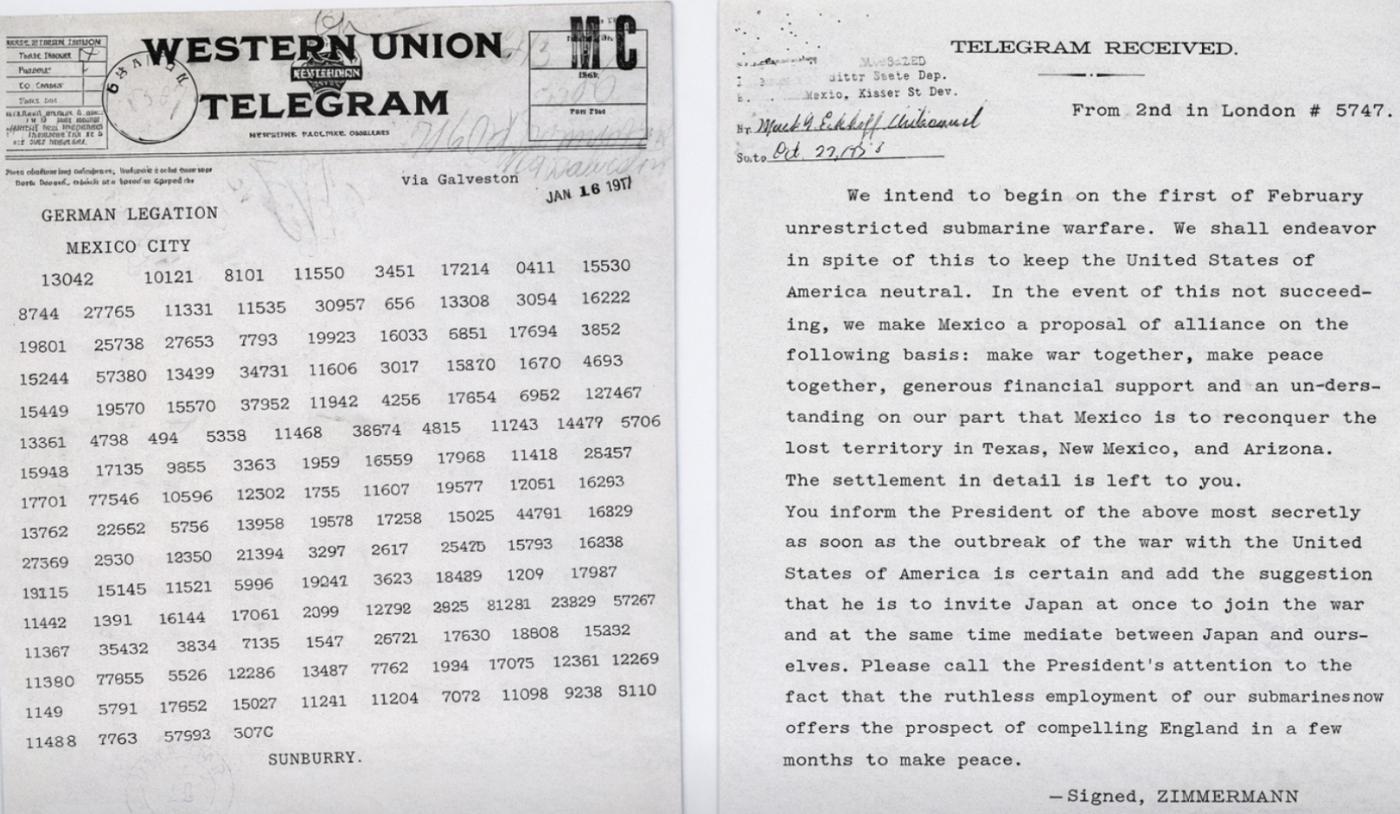
Zimmerman Telegraph
The message that would later become known as the Zimmermann Telegram began its journey in the final, desperate phase of the First World War, when Germany was seeking any advantage that might break the stalemate in Europe. It was sent on 16 January 1917 by Arthur Zimmermann, the German Foreign Secretary, to Heinrich von Eckardt, Germany’s ambassador in Mexico City. What makes the story remarkable is not just the contents of the message, but the unlikely path it took and the quiet intelligence work that turned it into one of the most consequential intercepts in modern history.
Germany at the time had decided to resume unrestricted submarine warfare, meaning its U-boats would attack any ship approaching Allied ports, including those of neutral nations. This policy was certain to anger the United States, which had so far remained officially neutral. Zimmermann understood that this move might bring America into the war, and so the telegram proposed a contingency plan. If the United States entered the conflict against Germany, Mexico would be invited to join the war on Germany’s side. In return, Germany promised financial support and assistance in reclaiming territory lost to the United States decades earlier, specifically Texas, New Mexico, and Arizona.
Ironically, the telegram did not travel by a purely German route. Because British naval forces had cut Germany’s transatlantic cables earlier in the war, Germany relied on neutral or even Allied communication lines. The message was transmitted from Berlin to Washington using diplomatic channels that passed through Britain, then forwarded onward to Mexico. This reliance on foreign cables opened the door to British interception.
British intelligence, particularly the codebreaking unit known as Room 40, had been quietly intercepting and attempting to decipher German communications for some time. The Zimmermann Telegram was captured as it passed through British-controlled cables. Within Room 40, the task of decoding fell largely to cryptanalysts including Nigel de Grey and William Montgomery. German diplomatic codes were complex, but British intelligence had already made significant progress in breaking them. By late January 1917, they had successfully decrypted the message.
The contents were explosive. The idea that Germany was actively encouraging Mexico to wage war against the United States, with promises of regaining lost territory, was a direct threat to American sovereignty. However, the British faced a dilemma. If they revealed the telegram outright, Germany would realise its codes had been broken, and Britain would lose a valuable intelligence advantage. Additionally, it would expose the fact that Britain was intercepting communications on cables used by neutral nations, including the United States.
To solve this, British intelligence devised a careful plan. They obtained a second version of the telegram from a telegraph office in Mexico, allowing them to claim it had been intercepted there rather than from sensitive transatlantic cables. This provided a plausible cover story. On 24 February 1917, the British passed the decoded message to the United States government.
Initially, there was scepticism in America. Some believed the telegram might be a British forgery intended to draw the United States into the war. But this doubt was dramatically erased when Arthur Zimmermann himself publicly confirmed the authenticity of the message on 3 March 1917. His admission stunned many, as it removed any lingering uncertainty about Germany’s intentions.
The impact on American public opinion was immediate and profound. Combined with ongoing anger over German submarine attacks on American shipping, the telegram helped shift the mood decisively in favour of entering the war. What had once been a distant European conflict now appeared as a direct threat to the United States. Just over a month later, on 6 April 1917, the United States declared war on Germany, formally joining the Allied powers in World War I.
The Zimmermann Telegram stands as a striking example of how intelligence, communication, and diplomacy can intersect to alter the course of history. It revealed not only Germany’s strategic desperation but also the growing importance of signals intelligence in modern warfare. A single intercepted and decoded message helped tip the balance of global power, drawing a previously neutral nation into one of the most devastating conflicts the world had ever seen.