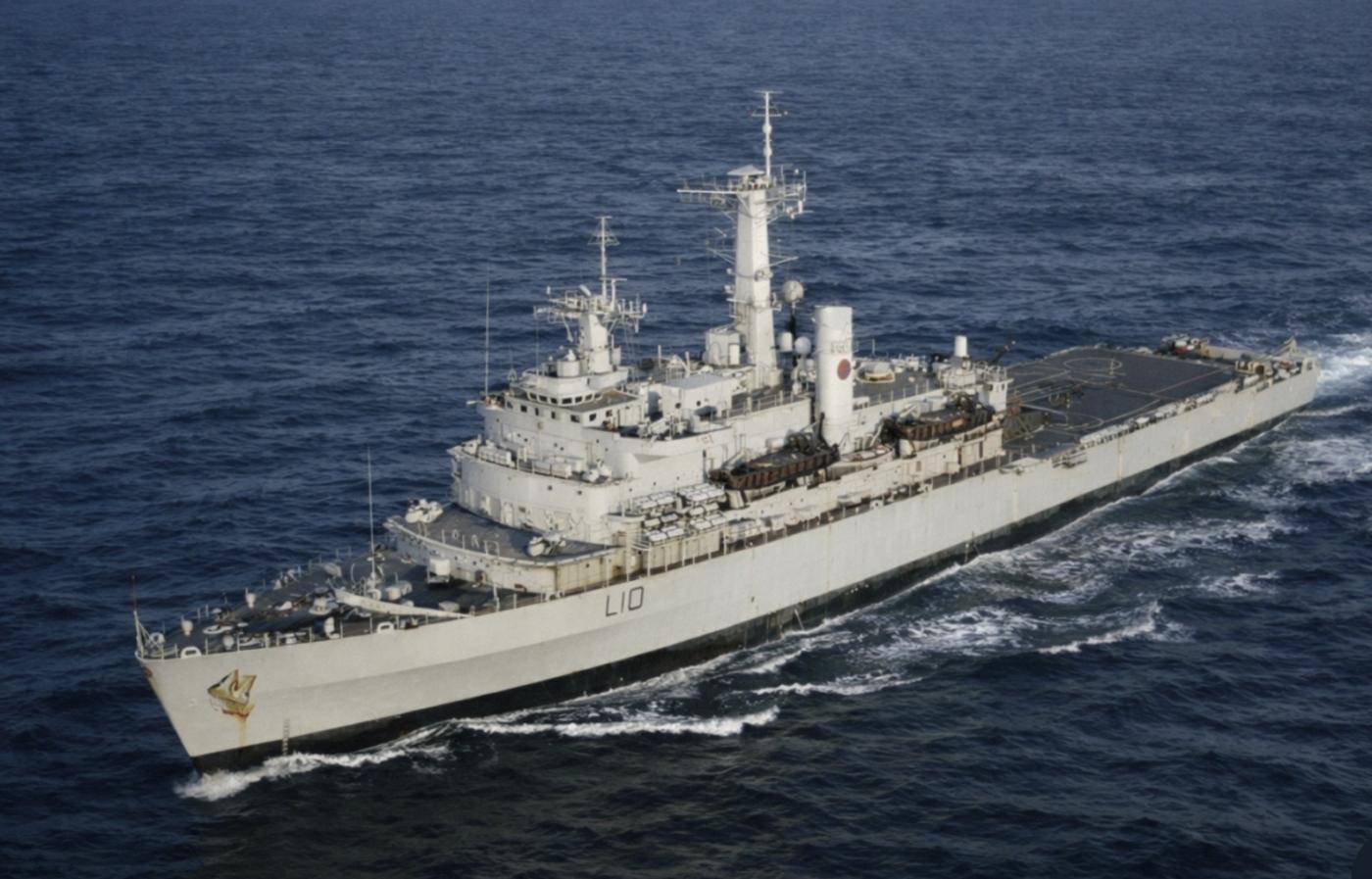
HMS Fearless
HMS Fearless was one of the most important amphibious assault ships ever operated by the Royal Navy, and she played a central role in the Falklands War of 1982. She was designed from the keel up for one purpose: to carry soldiers, vehicles and equipment across the sea and land them directly onto hostile shores without needing a port.
She was built in Belfast by Harland and Wolff in the early 1960s, launched in 1963 and commissioned into service in 1965. At the time, she represented a major leap forward in naval thinking. Instead of relying on separate transport ships and landing craft operating independently, Fearless brought everything together into one highly specialised vessel.
Her most distinctive feature was her internal dock, known as a well dock, located at the stern. This could be flooded with seawater, allowing landing craft to float in and out of the ship. Troops, vehicles and supplies could be loaded inside the hull, then sent ashore quickly and efficiently once the dock was opened. This meant she could operate in places where there were no harbours, which was exactly the situation faced in the Falklands.
She also had a large flight deck, allowing helicopters to operate from the ship. This gave commanders the ability to land troops by air as well as by sea, creating a flexible and fast-moving assault force. The combination of landing craft and helicopters made Fearless a true centrepiece of amphibious warfare.
In terms of size, she was a substantial ship. She measured about 158 metres in length and displaced roughly 12,000 tons when fully loaded. Powered by steam turbines, she could reach speeds of around 21 knots. Her crew numbered over 500 sailors, and she could carry hundreds more Royal Marines on board.
Her carrying capacity made her extremely valuable in combat. She could transport around 400 troops in normal conditions, or significantly more for short periods. Alongside the soldiers, she could carry heavy vehicles including tanks, trucks and artillery. Inside her dock she carried several large landing craft capable of moving vehicles, as well as smaller craft for transporting troops. On top of this, she could operate multiple helicopters at once, allowing rapid deployment inland.
Although she was not designed to be a front-line combat warship, HMS Fearless still carried a range of defensive weapons to protect herself and the troops she carried, especially from air attack, which was one of the greatest threats during the Falklands War.
Originally, her main anti-aircraft defence was the Sea Cat missile system. This was an early surface-to-air missile designed to shoot down attacking aircraft. It was manually guided by an operator who kept the missile on target using a joystick, which made it less effective against fast-moving jets but still an important layer of defence at the time she was built.
Alongside the missile system, she was fitted with several Bofors 40 mm guns. These rapid-firing anti-aircraft guns were capable of engaging low-flying aircraft and incoming threats at short range. They were simple, reliable and widely used, forming a key part of her close-in defence.
She also carried general-purpose naval guns, typically 20 mm and similar light weapons, which could be used against aircraft, small boats or targets close to the ship. These weapons gave her a final line of defence if anything managed to get through the outer layers.
By the time of the Falklands War, it had become clear that modern jet aircraft posed a much greater threat than earlier weapons had been designed to handle. During the conflict, Fearless relied heavily not just on her own weapons, but also on escorting warships equipped with more advanced air defence systems to provide protection.
In later years, her defensive armament was upgraded. The outdated Sea Cat missiles were removed and replaced with the Phalanx close-in weapon system. This was a highly advanced, radar-guided Gatling gun capable of firing thousands of rounds per minute. It was designed to automatically detect and destroy incoming missiles and aircraft at very short range, dramatically improving her survivability.
These layers of defence reflected her true role. Fearless was not meant to fight enemy ships directly, but to survive long enough to deliver her troops and equipment into battle. Her weapons were there to protect herself and her mission, not to seek out combat.
During the Falklands War, this balance was tested to the extreme. As she operated in San Carlos Water, Argentine aircraft repeatedly attacked the British fleet. While other ships took heavy damage, Fearless continued to operate as the command centre of the landings, coordinating the movement of troops and equipment under constant threat.
Her landing craft worked continuously, ferrying soldiers and vehicles ashore, while her crew remained at action stations, ready to defend the ship at any moment. She also played a role in rescue operations, sending her boats to recover survivors from damaged ships during the fighting.
Her role in the campaign was crucial. She acted as a floating headquarters, a transport ship and an assault platform all at once. Without ships like Fearless, the British would have struggled to land and sustain a force on the islands.
After the war, she continued to serve for many years, undergoing upgrades to improve her defensive systems and extend her operational life. She remained one of the Royal Navy’s key amphibious ships until she was finally decommissioned in 2002, marking the end of an era for steam-powered warships.
After leaving service, she was laid up for several years before eventually being sold for scrap. In 2007 she was towed away and broken up the following year.
HMS Fearless left behind a significant legacy. She proved the effectiveness of modern amphibious assault ships and demonstrated their importance in real combat. Her performance in the Falklands showed how a single well-designed ship could influence the outcome of an entire campaign, combining mobility, command capability and just enough defensive firepower to survive in a dangerous war zone.