WW2 Shipbuilding
When the United States entered the war, it quickly became clear that ships were not simply another category of weapons but the factor that governed everything else. Troops, tanks, trucks, aircraft, fuel, and food all depended on ships to reach distant fronts, while German submarines were sinking merchant tonnage faster than traditional shipbuilding could replace it. The American response was to abandon the slow, craft-based approach to ship construction and instead treat shipbuilding as a mass-production problem. Ships were no longer seen as individual projects but as units in a continuous industrial flow, with speed, repetition, and output taking priority over refinement.
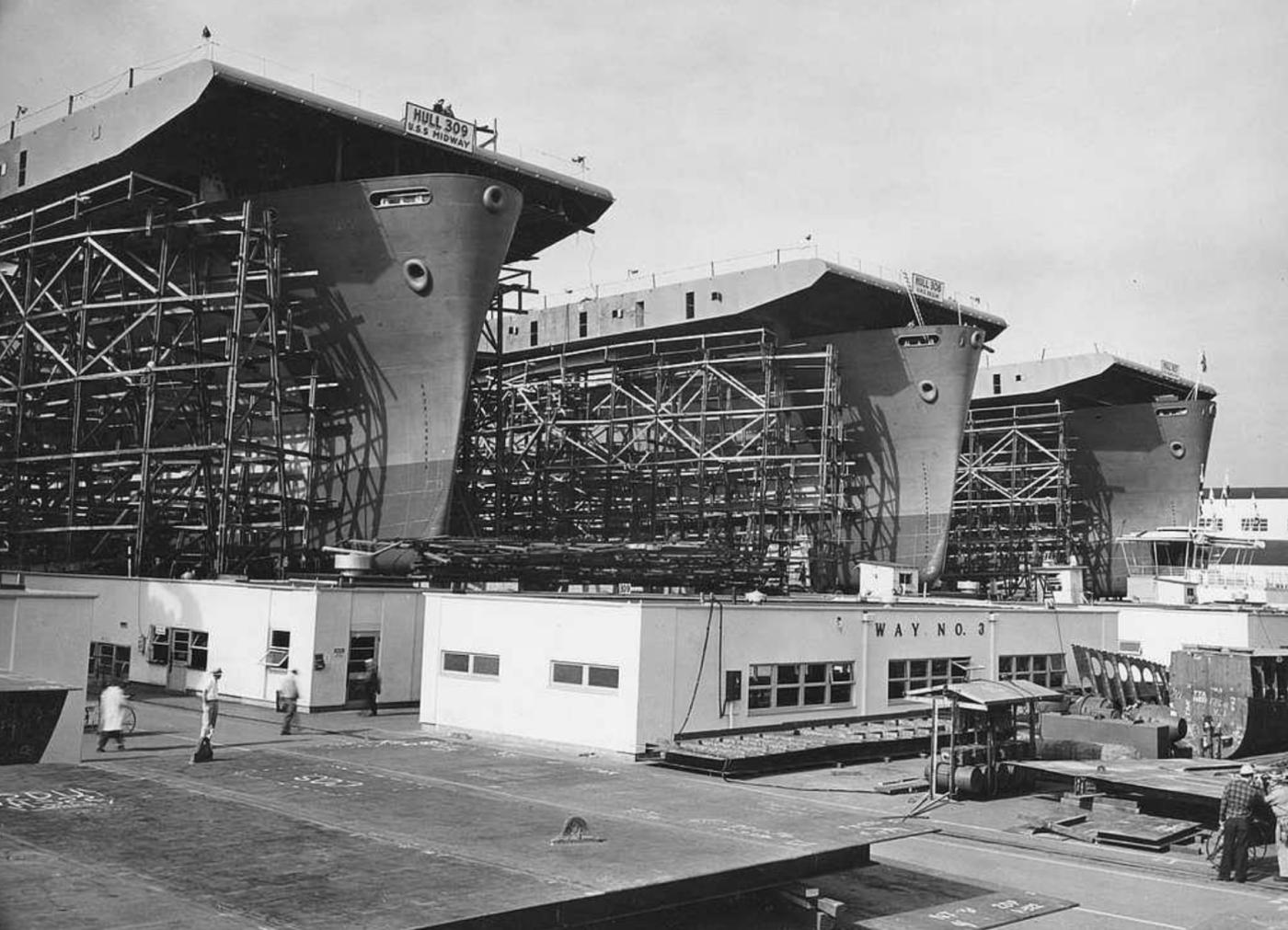
Before the war, the U.S. shipbuilding industry was relatively small and fragmented. In the mid-1930s there were only a handful of yards capable of building large oceangoing ships, and output was modest. Wartime necessity transformed this almost overnight. The federal government funded and coordinated a massive expansion through agencies such as the Maritime Commission, creating dozens of new “emergency” shipyards alongside the old ones. By 1943 there were more than 80 wartime shipbuilding yards operating across the country, with over 300 active shipways. These yards were spread along the Atlantic, Gulf, and Pacific coasts, as well as on major rivers and inland waterways, allowing production to continue even if one region was disrupted.
Inside the yards, work was reorganized to resemble a production line rather than traditional shipbuilding. Hulls were broken down into large prefabricated sections that could be built simultaneously in different shops, then lifted into place by cranes and welded together. Welding largely replaced riveting because it required fewer skilled specialists and could be taught more quickly to new workers. Standardized designs meant that parts, procedures, and tools could be reused again and again, reducing delays and mistakes. The Liberty ship was the clearest expression of this philosophy: a simple, robust cargo ship designed specifically to be built fast by semi-skilled labor. Early Liberty ships took well over six months to complete, but as methods improved, average construction times fell dramatically, eventually reaching only a few weeks from keel-laying to launch in the most efficient yards.
Henry J. Kaiser became the most famous symbol of this new approach. Coming from outside the traditional shipbuilding world, he applied industrial management techniques borrowed from construction and manufacturing. His yards on the West Coast, particularly at Richmond, California, gained worldwide attention for their speed. While record-breaking ships built in just a few days were largely publicity demonstrations, they showed how far the system had been pushed. Across the war, Kaiser shipyards alone produced well over 1,500 ships, a significant fraction of total American wartime output, proving that shipbuilding could be scaled up like any other heavy industry if designs and processes were simplified enough.
Landing craft production showed the same industrial logic applied to a wide range of vessels. Amphibious warfare required enormous numbers of specialized craft, from small boats to large oceangoing ships capable of beaching themselves. Designs such as the Higgins landing craft were deliberately kept simple so they could be built in factories that had never produced ships before. Tens of thousands of these boats were turned out, making amphibious operations possible on a scale never before attempted. Larger landing ships, such as tank landing ships, were also produced in the hundreds, sometimes at the expense of other naval construction. In at least one case, work on an aircraft carrier was halted so that a shipyard could switch urgently to landing ship production, showing how ruthlessly priorities were enforced.
This vast industrial effort depended on an equally vast workforce. Shipyard employment exploded after 1941 as the government poured money into construction and training. At its peak in late 1943, total shipyard employment in the United States reached around 1.7 million workers. This included roughly 1.4 million in private shipyards and over 300,000 in Navy yards. Many of these workers had never worked in heavy industry before. Women entered shipyards in large numbers, along with migrants from rural areas and regions far from the coasts. The production-line approach made this possible, as jobs were broken down into specific, repeatable tasks that could be learned quickly rather than relying solely on long apprenticeships.
Steel was the essential material that made or broke the entire system. Ships consumed enormous quantities of plate, beams, and structural shapes, and shortages threatened to slow production just as output targets were rising. To prevent this, steel was placed under strict allocation and priority controls. Shipbuilding programs received some of the highest priority ratings, ensuring that mills delivered plate and shapes to shipyards ahead of civilian needs. Even so, shortages persisted, and in some cases alternative materials were used for non-critical vessels, including wooden or concrete barges. The fact that steel had to be so carefully rationed underlines how central shipbuilding was to the entire war economy.
In total, the United States produced an extraordinary number of ships during the war. Under Maritime Commission contracts alone, nearly 5,800 oceangoing merchant and auxiliary ships were completed. This figure does not include thousands of smaller naval vessels, patrol craft, tugs, barges, and landing craft, which added many more hulls to the overall total. The result was not just numerical superiority but logistical dominance. By the later years of the war, American shipyards were producing vessels faster than enemies could sink them, allowing the United States and its allies to move men and material across the globe at will.
The most remarkable aspect of wartime American shipbuilding is how quickly it was created and how completely it changed the character of the industry. In the space of a few years, shipbuilding was transformed from a slow, skilled craft into a mass-production system capable of astonishing output. This industrial surge did not merely support the war effort; it reshaped the balance of the war itself by ensuring that supply, movement, and reinforcement were never the limiting factors for American strategy.