WW1 Footpowder
During the First World War, the health and endurance of soldiers in the trenches depended not only on weapons and ammunition but also on basic hygiene supplies. Among the most important of these was foot powder, a simple but vital commodity that helped British troops avoid debilitating foot conditions caused by constant damp, mud, and poor sanitation. The British Army’s supply system recognised early in the conflict that foot care was directly linked to combat effectiveness, and large quantities of foot powder were procured and distributed to soldiers on the Western Front and in other theatres of war.
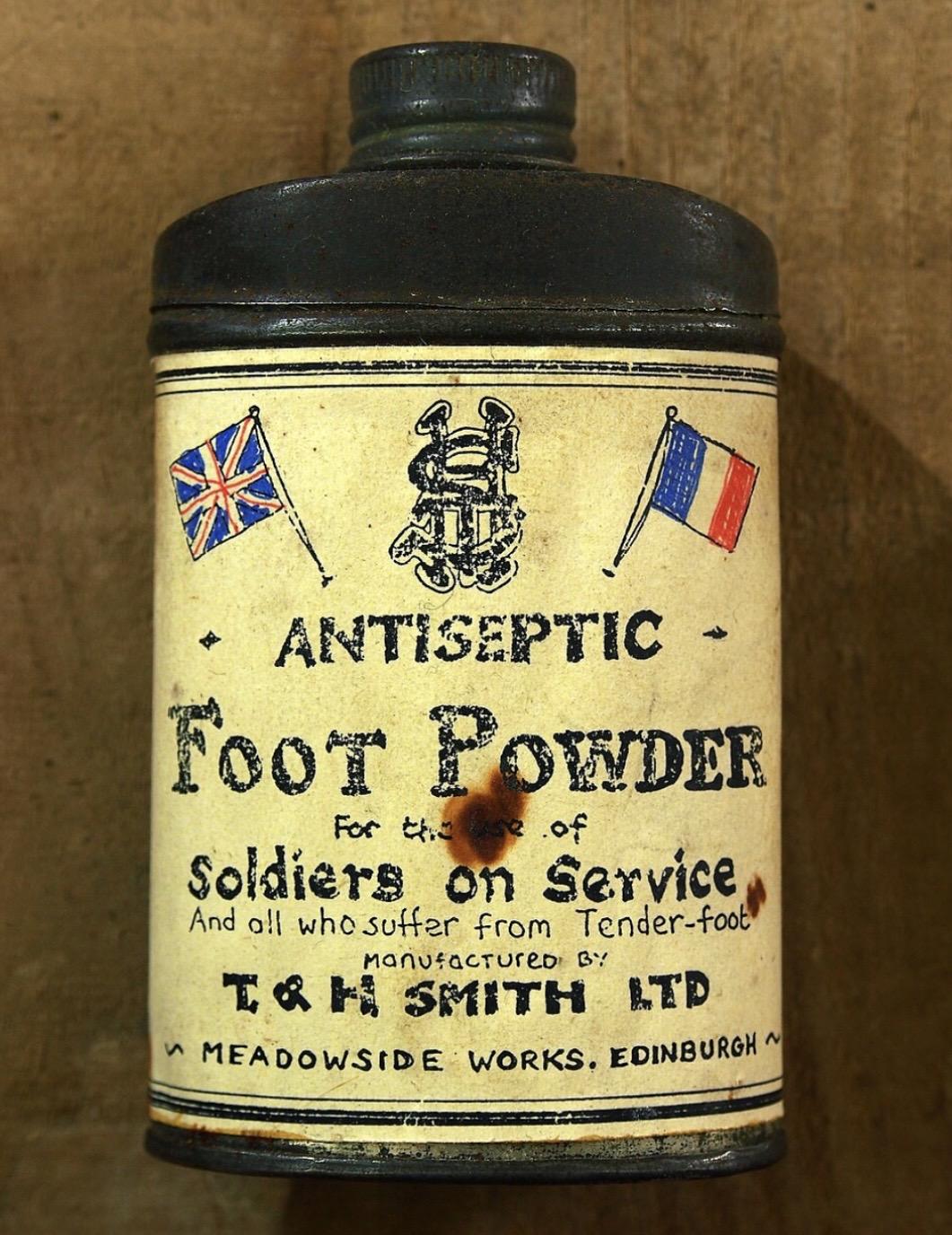
One of the companies that played a significant role in supplying foot powder to British troops was T & H Smith of Edinburgh. This firm produced foot powder packaged in small metal tins that were durable enough to withstand the harsh conditions of military transport and trench warfare. The decision to supply the powder in tins rather than paper packets or glass containers was practical and deliberate. Tins were resistant to moisture, which was crucial in the waterlogged trenches where paper would quickly disintegrate and glass could easily break. The metal containers could also be resealed after use, protecting the contents from contamination and damp. Many tins were designed to fit easily into a soldier’s kit or pocket, allowing the powder to be applied regularly without difficulty.
The importance of foot powder cannot be overstated when considering the widespread problem of trench foot. This painful condition developed when soldiers’ feet were exposed for long periods to cold, wet conditions. Boots and socks often remained soaked for days, and circulation in the feet was reduced by constant standing in mud and water. Without proper care, feet would swell, blister, and in severe cases develop infections that could lead to gangrene. Thousands of men were rendered unfit for duty due to trench foot, and in extreme cases amputation was necessary. Preventing this condition became a priority for army medical services, and foot powder formed a central part of prevention.
Foot powder worked by absorbing moisture and reducing friction inside boots. Soldiers were instructed to dry their feet whenever possible, apply powder liberally, and change into clean socks. Army orders emphasised the importance of daily foot inspections, and officers could be disciplined if they failed to ensure that their men followed proper foot care routines. Foot powder helped keep the skin dry, discouraged fungal growth, and reduced the likelihood of blisters and sores forming during long marches or while standing in wet trenches. It also provided a degree of comfort, helping men endure the harsh conditions.
In terms of supply, foot powder was distributed through the British Army’s vast logistical network, which included depots in Britain, supply bases in France, and transport units delivering goods to the front lines. Companies like T & H Smith manufactured large quantities that were shipped in bulk to military stores before being broken down into smaller consignments for battalions. Each infantryman was typically issued foot powder as part of his personal hygiene kit, and additional supplies were kept at unit level. While exact figures varied depending on unit size and operational conditions, a battalion of roughly 1,000 men might require several hundred tins each month. Individual soldiers could go through one small tin in a few weeks if applying it regularly, especially in wet weather. Over the course of the war, this translated into millions of tins being produced and distributed.
The packaging itself often carried simple printed labels and instructions. Some tins bore the name of the manufacturer, while others were marked for government use. Surviving examples show that the design was straightforward and functional, reflecting the urgency and scale of wartime production. The tins could sometimes be reused by soldiers for storing small personal items once empty, which made them even more practical.
Foot powder remained a standard part of military hygiene long after the First World War ended. Its effectiveness in preventing foot problems ensured that it continued to be issued during the Second World War and in later conflicts. Today, foot powder is still widely used by both military personnel and civilians. Modern formulations are commonly applied by athletes, hikers, and workers who spend long hours on their feet. The basic principle remains the same as it was during the trench warfare of 1914–1918: keeping the feet dry and reducing friction helps prevent discomfort and infection.
Traditional foot powders used during the First World War were often made from ingredients such as talc, boric acid, and sometimes zinc oxide or starch. Talc served as the main absorbent, drawing moisture away from the skin. Boric acid acted as a mild antiseptic and antifungal agent, helping to prevent infections. Zinc oxide soothed irritated skin and provided additional protection against moisture. Some formulations also included fragrance to counteract odour, though this was secondary to the powder’s practical function.
Modern foot powders have evolved but still rely on similar principles. Many now use alternatives to talc, such as cornstarch or other absorbent minerals, combined with antifungal agents to prevent athlete’s foot and related conditions. Some include menthol for a cooling effect or antibacterial compounds to reduce odour. Despite advances in materials and manufacturing, the essential purpose remains unchanged: to keep feet dry, comfortable, and healthy.