Invasion of Fishguard
The Battle of Fishguard, fought on 22 February 1797, holds a unique place in British history as the last time an invading force set foot on mainland Britain with hostile intent. This curious and often overlooked episode occurred during the long struggle between Britain and Revolutionary France, a period marked by fear of invasion, political upheaval, and daring military schemes. What happened in the small Welsh coastal region around Fishguard was both dramatic and strangely anticlimactic, combining military action with confusion, improvisation, and even a touch of comedy.
By the late 18th century Britain and France were bitter enemies. The French Revolution had transformed France into a republic determined to spread revolutionary ideas across Europe, and Britain stood as one of its most powerful opponents. French leaders believed that Britain might be weakened by internal unrest, especially in Ireland and Wales, where they assumed there was dissatisfaction with British rule. The French Directory therefore supported plans to land forces on British soil, stir rebellion, and destabilise the country from within.
In early 1797 a small French expedition was assembled under the command of Colonel William Tate, an Irish-American officer in French service. The force was not a grand invasion army but rather a mixed and somewhat unreliable collection of around 1,400 men. Among them were regular French soldiers, Irish rebels who hoped to spark an uprising, and a large contingent drawn from French prisons. Many of these prisoners were described as unruly and poorly disciplined, more interested in looting than fighting. The expedition set sail in four ships from Brest in western France with the intention of landing in Britain and causing disruption.
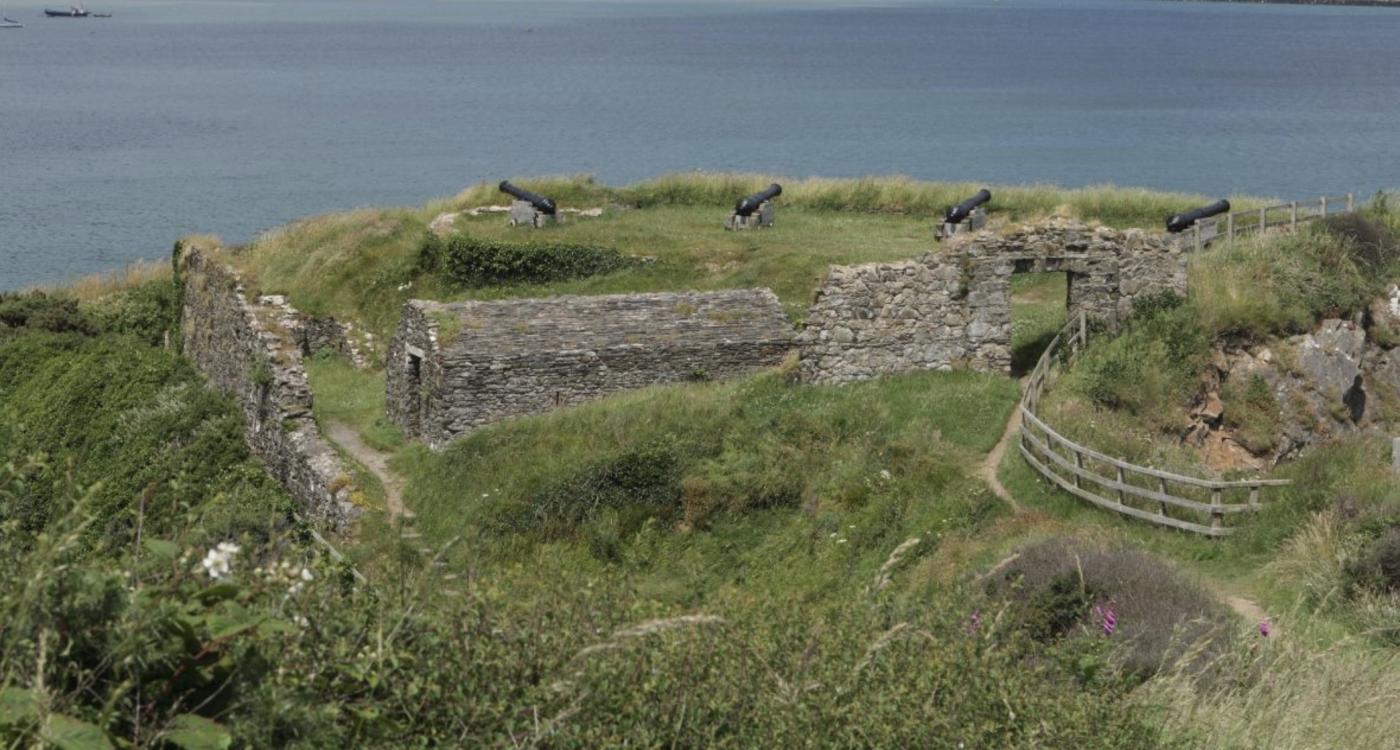
Their original target was Bristol, an important port city, but poor weather and navigation difficulties forced a change of plan. On 22 February 1797 the French flotilla reached the Welsh coast near Fishguard in Pembrokeshire. Instead of a major port or industrial centre, they found themselves landing in a quiet rural area. Around 1,200 French troops successfully came ashore at a rocky inlet called Carregwastad Head, just west of Fishguard. The landing itself was largely unopposed, as local defences were minimal and the arrival took many by surprise.
Once ashore, however, the invasion quickly began to unravel. The local population was alarmed but not entirely helpless. News spread rapidly across the countryside, and local militia units and volunteers began to gather. These included the Pembroke Yeomanry Cavalry and various militia companies, though their numbers were small and they were not heavily equipped. One of the most important figures in the British response was Lord Cawdor, a local landowner who quickly took command of the defensive effort. With determination and organisational skill, he assembled a force of roughly 600 men, including militia, sailors, and volunteers.
Meanwhile the French troops encountered immediate problems. Discipline broke down as many of the former prisoners abandoned their positions to loot nearby farms and houses. They found stores of food and, crucially, alcohol. Large quantities of wine and spirits were seized, and many of the invaders became drunk and disorderly. Instead of advancing inland or fortifying their landing site, they dispersed across the countryside, plundering and creating confusion within their own ranks. Colonel Tate struggled to maintain control over his force, and the opportunity to mount a serious offensive slipped away.
Local civilians played a remarkable role in resisting the invasion. Welsh women in traditional red cloaks and tall black hats gathered on nearby hills to watch events unfold. From a distance, their distinctive clothing reportedly made them look like ranks of red-coated soldiers. According to popular legend, this contributed to the French belief that they were facing a much larger British force than actually existed. Although historians debate how decisive this visual effect was, it certainly added to the uncertainty among the invaders.
Skirmishes occurred over the following day as British forces probed French positions. The most notable action took place near Fishguard itself, where British troops confronted French detachments. Casualties were minimal, with only a few killed or wounded on each side. The situation became a standoff, but the French position was deteriorating rapidly. Their troops were scattered and demoralised, supplies were uncertain, and they faced a growing local resistance. Moreover, their naval support had withdrawn offshore, leaving them effectively stranded.
Realising the hopelessness of his situation, Colonel Tate entered into negotiations. On 24 February 1797 he agreed to surrender his entire force to Lord Cawdor. The formal surrender took place at Goodwick Sands near Fishguard. Around 800 French soldiers laid down their arms and became prisoners of war. The invasion had lasted just two days and ended without a major battle, yet it secured its place in history as the last invasion of mainland Britain.
Several fascinating details surround the aftermath. The captured French troops were marched through Wales and England to various prison camps. Some later joined British forces as part of foreign regiments, while others eventually returned to France. The invasion also left behind stories and artefacts, including French weapons and equipment that became local curiosities.
One enduring legend involves Jemima Nicholas, a local cobbler’s wife often referred to as the “Welsh heroine.” According to tradition, she single-handedly captured a group of French soldiers by tricking them into surrendering and then marched them into Fishguard. While the exact details may be embellished, she became a celebrated figure and symbol of local resistance.
The Battle of Fishguard has since entered folklore as much as military history. It is remembered for its odd mixture of seriousness and farce: a grand French plan undone by poor discipline, drunkenness, and determined local defence. Every year the event is commemorated in Fishguard with reenactments and displays, celebrating the moment when ordinary people helped repel an invasion.
Though small in scale, the events of February 1797 had a lasting psychological impact. They reminded Britain of its vulnerability but also reinforced confidence in local militias and civilian readiness. In a wider sense, the failed invasion demonstrated the difficulties France faced in projecting power across the Channel against the Royal Navy and British coastal defences.
Today the Battle of Fishguard remains a unique chapter in British history. It stands as the last time foreign troops invaded the mainland United Kingdom with hostile intent, a brief and unusual conflict in which local initiative, chance, and human frailty played as much a role as military strategy.