Worlds first 4 engined plane
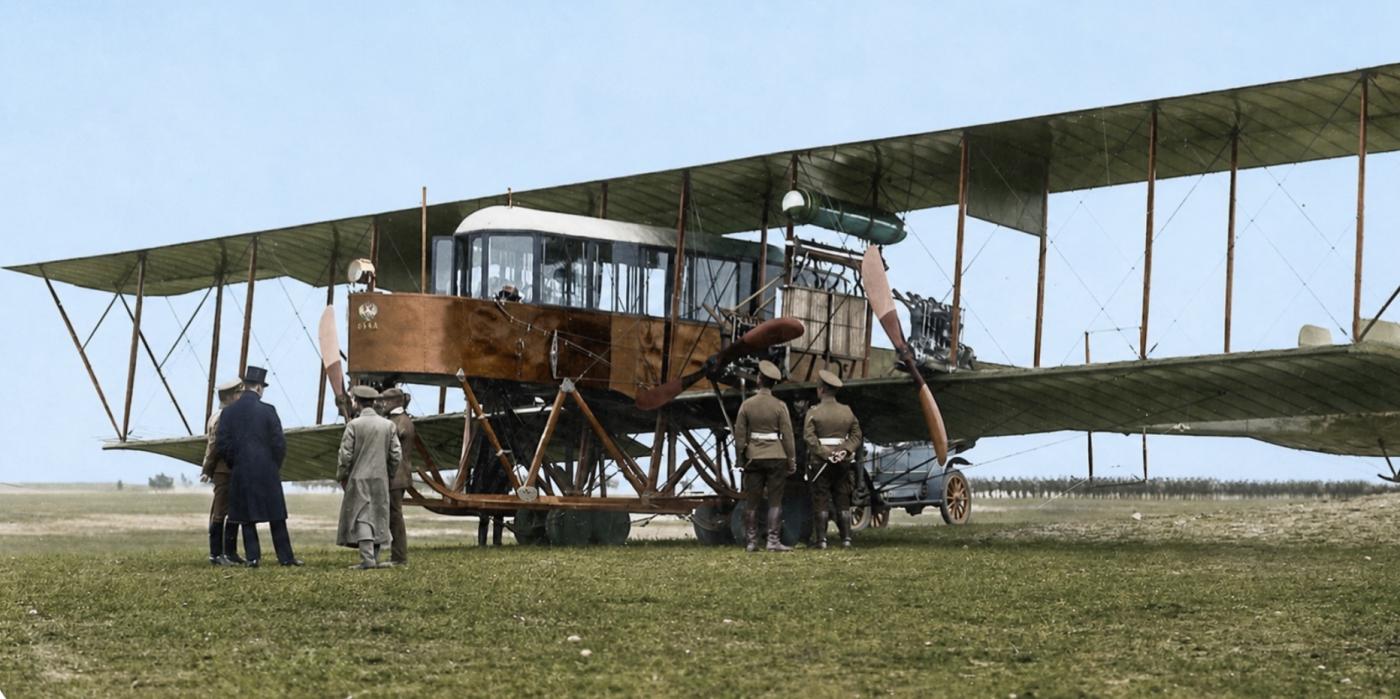
In the spring of 1913, on an airfield outside Saint Petersburg, a gigantic machine rolled across the grass and changed aviation forever. It was called the Sikorsky Russky Vityaz, meaning “Russian Knight,” and it was unlike anything the world had ever seen. At a time when most airplanes were flimsy wood-and-fabric contraptions barely capable of carrying a pilot, the Russky Vityaz was a four-engined giant with an enclosed cabin, passenger compartments, electrical lighting, and enough internal space for people to walk around during flight. Many experts believed it was impossible. Yet it flew successfully, becoming the world’s first practical four-engine aircraft and laying the foundations for modern heavy aviation.
The man behind this extraordinary aircraft was Igor Sikorsky, one of the great visionaries in aviation history. Born in Kiev in 1889, Sikorsky became fascinated with flight as a child after reading the works of Leonardo da Vinci and Jules Verne. By his early twenties he was already designing aircraft in the Russian Empire, and unlike many aviation pioneers of the period, he was obsessed not simply with speed or aerobatics, but with practicality and safety. He believed airplanes should carry passengers comfortably and continue flying even if an engine failed. This belief would eventually lead him toward multi-engine designs.
In 1912 Sikorsky became chief engineer of the aircraft division of the Russian Baltic Railroad Car Works, known by its Russian initials RBVZ. Despite the name, this company did much more than build railroad cars. It was one of Imperial Russia’s largest industrial firms and manufactured automobiles, machinery, and aircraft. The Russky Vityaz was designed and built there in Saint Petersburg, with Sikorsky leading a team of engineers and craftsmen who were attempting something no one else had dared attempt successfully.
The origins of the aircraft went through several stages and names. Sikorsky first imagined the concept in 1911, when the global payload record for aircraft was only around 600 kilograms. Most airplanes of the era had one engine and very limited lifting power. Sikorsky reasoned that if one engine could only do so much, multiple engines could lift larger aircraft while also providing redundancy. His earliest concept was known as “Le Grand.” It evolved into “Bolshoi Baltisky,” or “Great Baltic,” before reaching its final and most famous form as the Russky Vityaz.
The airplane itself was astonishing for 1913. It was a huge biplane with a wingspan of approximately 27 meters across the upper wing. The fuselage resembled a railway carriage more than a conventional aircraft. Covered in plywood and fabric, it contained a fully enclosed cockpit, passenger cabins, a storage compartment, and even a lavatory — something virtually unheard of in aviation at the time. Some versions of the aircraft also featured electric lighting and upholstered seating. The idea that passengers could travel in comfort rather than simply cling to an exposed seat in the wind was revolutionary.
Another remarkable detail was the aircraft’s open observation deck at the front of the fuselage. In military configuration it could carry a searchlight and machine gun. Sikorsky was already thinking beyond civilian transport and imagining large aircraft that could serve military purposes as reconnaissance and bombing platforms. This foresight would soon reshape warfare during the First World War.
The engines were arranged in an unusual way during early testing. Initially the aircraft used tandem engine pairs, with one engine pulling and another pushing behind it. Sikorsky soon realized this arrangement produced poor airflow and reduced efficiency. He redesigned the machine so all four engines were mounted in line along the leading edge of the lower wing as tractor engines. This dramatically improved performance and gave the Russky Vityaz its definitive appearance.
When news spread that Sikorsky was building a four-engined airplane, many newspapers and aviation specialists mocked the project. Some declared it physically impossible for such a large aircraft to leave the ground. Others dismissed the reports as exaggeration or fantasy. Aviation in 1913 was still primitive, and many people believed large airplanes would simply collapse under their own weight. Yet Sikorsky pressed ahead.
On 10 May 1913, the impossible happened. The Russky Vityaz successfully flew. Witnesses watched the giant aircraft rise into the air after a takeoff run of about 700 meters. It proved stable and controllable despite its enormous size. During later flights, passengers moved around inside the cabin while airborne without upsetting the aircraft’s balance. Sikorsky even demonstrated that the airplane could continue operating safely with engines stopped on one side. These experiments were critical in proving the viability of multi-engine aviation.
One particularly famous flight occurred on 2 August 1913, when Sikorsky flew for nearly two hours carrying eight people aboard. At a time when many aircraft struggled to carry a single passenger, this was an astonishing achievement. The Russky Vityaz completed fifty-three flights in total, an impressive number considering the fragility of aircraft technology at the time.
Only one Russky Vityaz was ever built. Although the aircraft had demonstrated great promise, its career ended abruptly and bizarrely. While parked on the ground in June 1913, another airplane — a Morane-Saulnier monoplane — suffered catastrophic engine failure during landing. Its engine detached in midair and crashed directly onto the Russky Vityaz, severely damaging the giant aircraft beyond practical repair. Rather than rebuild it, Sikorsky chose to move on to an even more ambitious design.
That next aircraft became the legendary Sikorsky Ilya Muromets, which expanded upon the Russky Vityaz concept and became the world’s first successful four-engine bomber during the First World War. The Ilya Muromets inherited many features pioneered by the Russky Vityaz, including enclosed cabins, passenger comfort, and multi-engine reliability. In many ways, the Russky Vityaz was the direct ancestor of every large airliner and strategic bomber that followed.
The influence of the Russky Vityaz extended far beyond Russia. At the time, aircraft designers in Europe and America were focused on making airplanes lighter and faster, usually with only one engine. Sikorsky’s work demonstrated that the future also belonged to large aircraft capable of carrying passengers, cargo, and military loads over long distances. His success inspired later generations of engineers who would eventually create giant flying boats, transcontinental airliners, and massive wartime bombers.
Igor Sikorsky himself would go on to have one of the most remarkable careers in aviation history. After the Russian Revolution he emigrated to the United States, where he founded the Sikorsky Aircraft Company. There he became famous once again, this time as the pioneer of practical helicopters. Yet despite his later achievements, Sikorsky often regarded the Russky Vityaz as one of his proudest accomplishments because it proved that large aircraft were not only possible, but practical.