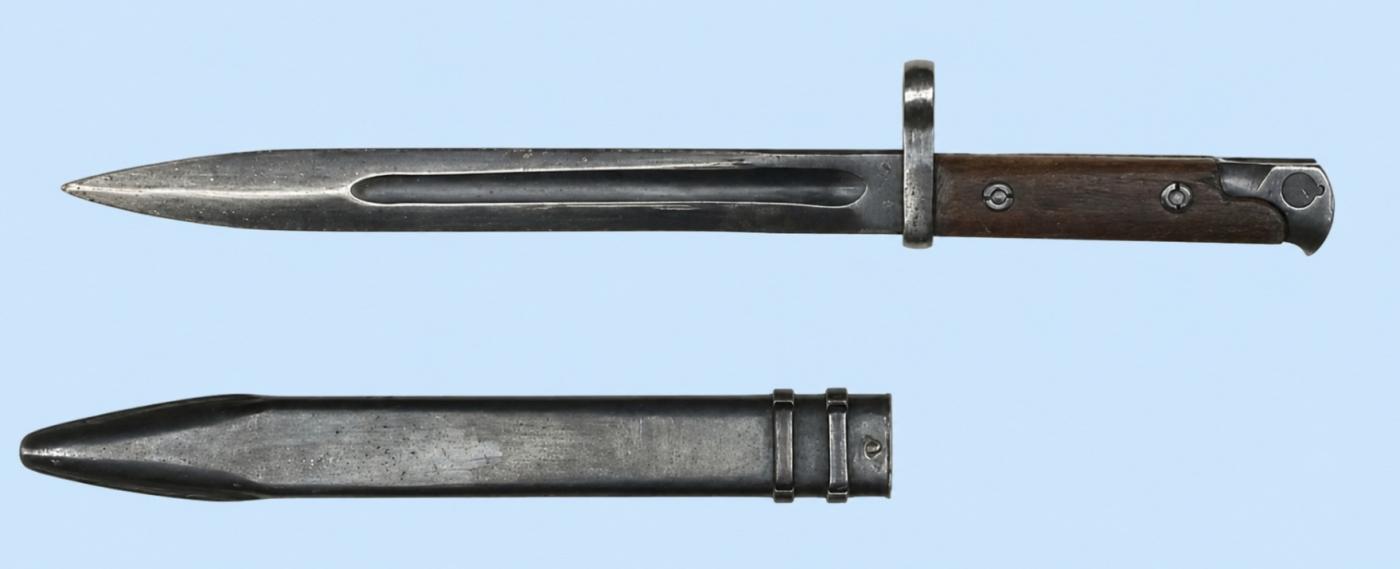
Russian m1940 Bayonet
The Soviet M1940 bayonet was one of the most recognizable edged weapons of the Second World War and became closely associated with the Red Army’s SVT-40 self-loading rifle. Officially adopted in 1940, it reflected decades of Russian and Soviet military thinking regarding infantry combat, rifle handling, and battlefield doctrine. Though simple in appearance, it embodied Soviet industrial priorities, wartime necessity, and a military culture that still regarded the bayonet as an essential weapon even in the age of mechanized warfare.
The bayonet was designed specifically for the SVT-40 rifle developed by Fyodor Tokarev. Earlier Tokarev rifles such as the SVT-38 already used a sword-style bayonet, but combat experience during the Winter War against Finland revealed serious shortcomings. Soviet troops found the original pattern too long and awkward for trench fighting and forest combat, leading to the adoption of a shorter and more practical design in 1940.
Unlike the cruciform spike bayonets traditionally associated with Russian rifles, this new pattern used a knife-style blade. This followed an international trend during the 1930s and 1940s as many armies abandoned pure thrusting spikes in favor of multipurpose knife bayonets that could also serve as utility tools and fighting knives.
The blade was approximately 240 millimeters long with a spear-point tip and a fuller on each side to reduce weight while preserving strength. Total length was about 360 millimeters. Finish quality varied considerably depending on the period of manufacture. Early examples were generally well machined and carefully finished, while wartime production became rougher and more simplified as Soviet industry struggled under the pressure of the German invasion.
Wooden grip panels were attached to the tang with screws or rivets, and the pommel incorporated a press-button locking mechanism that secured the bayonet beneath the rifle barrel. Unlike the permanently attached spike bayonets of the Mosin–Nagant rifle, it was detachable and carried in a steel scabbard with a leather hanger.
The main manufacturers were Tula Arsenal and Izhevsk Mechanical Plant, two of the Soviet Union’s most important weapons factories. Both produced huge quantities of rifles and edged weapons throughout the war. Factory markings from Tula and Izhevsk are still used by collectors today to identify production origins and dates.
Soviet military doctrine continued to place great emphasis on aggressive bayonet combat even as firearms became increasingly lethal. Manuals encouraged soldiers to keep bayonets fixed during combat whenever possible. This philosophy carried over from Imperial Russian military traditions, where close-quarter assaults with cold steel were considered vital to offensive spirit and morale.
The redesign from the earlier SVT-38 pattern reflected practical battlefield lessons learned in Finland. Long bayonets proved clumsy in forests, trenches, and urban fighting, while the shorter pattern improved handling and maneuverability without sacrificing effectiveness in close combat.
Although intended solely for the SVT-40 family, soldiers occasionally improvised field modifications for use with other rifles, though this was never official practice. It was not compatible with the Mosin–Nagant series or later Soviet weapons such as the SKS or AK-pattern rifles.
The German invasion of the Soviet Union in 1941 had a major impact on production quality. Soviet factories were evacuated eastward beyond the Ural Mountains, and wartime emergency manufacturing led to rough machining, simplified fittings, and inconsistent finishes. These crude characteristics are now part of the weapon’s historical identity and illustrate the enormous pressures faced by Soviet industry during the Great Patriotic War.
Original examples are relatively scarce today compared with the number of rifles produced. The SVT-40 itself gradually fell out of favor because it was expensive and mechanically more complicated than the simpler Mosin–Nagant. Huge battlefield losses during 1941 and 1942 also reduced survival numbers. As a result, matching rifles and bayonets are highly desirable among collectors.
Large numbers were captured by Finnish and German forces during the war. Finnish troops generally appreciated the rifle’s firepower but found it sensitive to dirt and harsh winter conditions. Some captured bayonets received Finnish property markings and were reissued for limited use. German forces designated captured SVT-40 rifles as Selbstladegewehr 259(r), and some captured bayonets were used alongside them.
Collectors carefully study surviving examples for arsenal markings, serial numbers, and refurbishment details. Many were renumbered, reblued, or repaired in Soviet arsenals after the war. Electro-pencil serial numbers and replacement grips are common on refurbished examples.
Today the bayonet remains an important artifact of Soviet military history. It represents a transitional period between traditional rifle-and-bayonet warfare and the later era dominated by submachine guns and assault rifles. Closely tied to the brutal fighting of the Eastern Front, it remains one of the most historically significant Soviet edged weapons of the Second World War.