
Colonel General Hans-Von Arnim
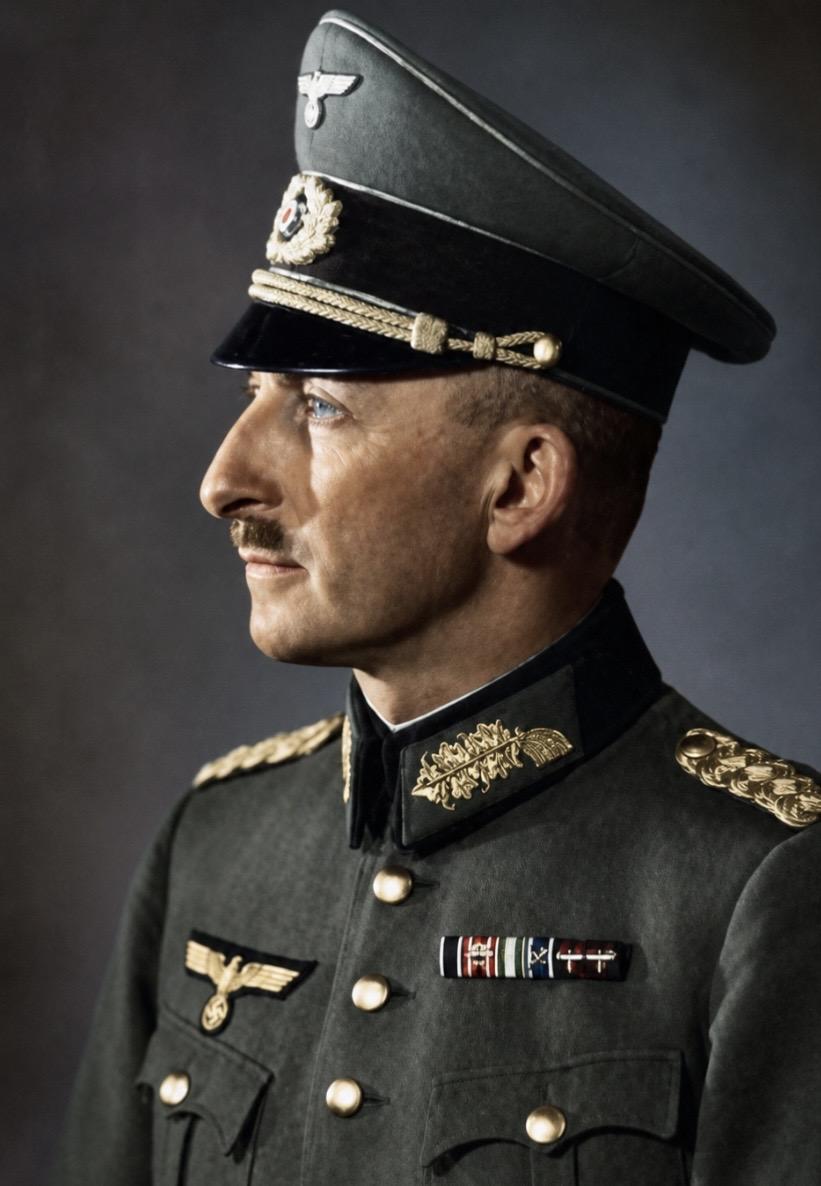
Hans-Jürgen von Arnim was one of Germany’s highest-ranking military commanders during the Second World War and the final German commander in North Africa before the complete collapse of Axis forces there in 1943. Although he never achieved the legendary fame of Erwin Rommel, he was considered a highly capable and professional officer, respected for his discipline, organizational skill, and experience in armored warfare. His life reflected the rise and fall of Germany itself, beginning in the old aristocratic military culture of Imperial Prussia and ending in defeat, captivity, and obscurity after the war.
He was born on 4 April 1889 in Ernsdorf in Silesia, then part of the German Empire. Von Arnim came from an old Prussian aristocratic family with a long military tradition. His father was already a general in the German Army, and military service was considered both a duty and an honor within the family. Growing up in that environment shaped his personality from an early age. Discipline, loyalty, obedience, and professionalism were central values in the Prussian officer class, and young Hans-Jürgen absorbed them completely.
As a boy he was educated in military academies designed to prepare future officers for service in the Imperial Army. Germany before the First World War placed enormous prestige on military achievement, and ambitious young aristocrats often entered the army as their natural career path. In 1907 von Arnim joined the elite 4th Guards Infantry Regiment in Berlin as an officer cadet. The Guards regiments were among the most prestigious units in the German Army, closely tied to the royal court and the Prussian military elite.
He became a lieutenant in 1909 and spent the years before the war developing his skills as a professional officer. When the First World War erupted in August 1914, he entered combat as a young junior officer in one of the deadliest conflicts Europe had ever seen. During the war he served on both the Western Front and the Eastern Front, gaining wide-ranging battlefield experience. He commanded infantry units, worked on staff assignments, and participated in major operations during the brutal trench warfare that consumed Europe.
Von Arnim proved to be courageous and highly competent under fire. He was wounded three separate times during the war, showing how often he served near the front lines rather than remaining safely behind them. His performance earned him several decorations, including both classes of the Iron Cross and the Knight’s Cross of the Royal House Order of Hohenzollern with Swords, a prestigious award for bravery and leadership.
By the end of the war in 1918 he had reached the rank of captain. Germany’s defeat and the collapse of the Kaiser’s empire created chaos throughout the country. The Treaty of Versailles drastically reduced the German military, and only a small number of officers were allowed to remain in the new Reichswehr. Von Arnim was selected to stay, which demonstrated how highly he was regarded within military circles. Many capable officers lost their careers, but he remained part of the small professional core that would later form the backbone of Hitler’s expanding Wehrmacht.
In the violent years after the war, von Arnim briefly served with Freikorps formations, paramilitary groups made up largely of former soldiers who fought communist uprisings and political unrest across Germany. Like many future German generals, he gained experience during these chaotic internal conflicts before returning fully to the regular army.
Throughout the 1920s and early 1930s he steadily advanced through the ranks of the Reichswehr. Germany’s military during this period was small but extremely professional, and promotions came slowly. Von Arnim earned a reputation as a disciplined, intelligent, and dependable officer. He served in command positions and staff roles and eventually commanded the prestigious 68th Infantry Regiment in Berlin. By the early 1930s he had risen to lieutenant colonel and then colonel.
When Adolf Hitler came to power and began rebuilding Germany’s armed forces, opportunities for advancement increased dramatically. Von Arnim was part of the new generation of senior officers who benefited from Germany’s rapid rearmament. Unlike some Nazi commanders, he was not known as a committed political fanatic. He belonged more to the traditional Prussian military establishment than to Hitler’s ideological inner circle. Even so, he served the Nazi regime loyally and continued rising through the ranks.
In 1938 he was promoted to major general, and when the Second World War began in 1939 he commanded the 52nd Infantry Division during the invasion of Poland. His division later fought in the campaign against France in 1940, where Germany achieved one of the most stunning military victories in modern history. Von Arnim performed effectively during both campaigns and was promoted to lieutenant general.
A major turning point in his career came in 1940 when he was given command of the 17th Panzer Division. Germany’s panzer divisions were the elite spearhead units of the Wehrmacht, combining tanks, infantry, artillery, and mobile support units into fast-moving offensive formations. Commanding one was a major sign of trust from the German High Command.
During Operation Barbarossa, the invasion of the Soviet Union in June 1941, von Arnim’s panzer division participated in the rapid German advance deep into Soviet territory. His forces fought in massive encirclement battles that destroyed large Soviet formations during the opening phase of the campaign. German armored warfare at this stage appeared unstoppable, and von Arnim became recognized as a skilled panzer commander.
Only days after the invasion began, however, he was seriously wounded near Stolpce. Despite the injury, his leadership during the campaign earned him the Knight’s Cross of the Iron Cross, one of Germany’s highest military decorations. After recovering, he returned to service and was promoted to command the XXXIX Panzer Corps later that year. This corps took part in major operations on the Eastern Front, including battles around Kiev and Bryansk.
In December 1941 he was promoted to General der Panzertruppe, a rank equivalent to full general specializing in armored forces. His rise was impressive because the German officer corps was highly competitive, and relatively few men advanced so rapidly.
Late in 1942 his career entered its most famous phase when he was sent to North Africa. After the Allied landings during Operation Torch, Germany rushed reinforcements into Tunisia to prevent total collapse in the Mediterranean. Von Arnim was appointed commander of the Fifth Panzer Army in Tunisia, placing him alongside the already famous Field Marshal Erwin Rommel.
The relationship between the two generals was tense from the beginning. Rommel was bold, aggressive, and often acted independently, while von Arnim was cautious, methodical, and deeply rooted in traditional Prussian military thinking. They frequently disagreed over strategy and priorities, and their rivalry weakened German coordination during the North African campaign.
In December 1942 von Arnim was promoted to colonel general, one of the highest ranks in the German Army. A few months later, after Rommel left Africa because of illness and exhaustion, von Arnim became commander of Army Group Africa, taking overall control of all remaining German and Italian forces in Tunisia.
By then, however, the situation was nearly hopeless. Allied forces from Britain, the United States, and the Commonwealth steadily closed in on Tunisia from multiple directions. German supply lines were collapsing under constant Allied air attacks, fuel and ammunition shortages grew severe, and evacuation was impossible. Despite local resistance and occasional counterattacks, the Axis position continued to deteriorate.
In May 1943 the final collapse came. Hundreds of thousands of German and Italian troops were trapped in northern Tunisia with no escape route. On 12 May 1943 von Arnim himself was captured by British forces. The surrender in Tunisia became one of Germany’s greatest military disasters of the war, involving over 250,000 Axis prisoners. It effectively ended Axis hopes in Africa forever.
Von Arnim was one of the highest-ranking German officers captured alive by the Western Allies. After his capture he was taken to Britain, where he was imprisoned in facilities used for senior German officers. Unknown to the prisoners, British intelligence secretly recorded many of their conversations in hopes of gathering military information and insights into German thinking.
Later he was transferred to the United States and held in prisoner-of-war camps alongside other senior German commanders. Compared to conditions faced by German prisoners in the Soviet Union, captivity in Britain and America was relatively humane. He spent the remainder of the war as a prisoner.
After Germany’s defeat in 1945, von Arnim was eventually released from captivity. Unlike some German commanders, he was never prosecuted for war crimes. He returned to civilian life in a defeated and divided Germany, far removed from the powerful military world in which he had spent almost his entire life.
The postwar years were quiet and largely private. He never regained public prominence and rarely attracted the same attention as figures like Rommel, Guderian, or Manstein. Historians generally describe him as a highly professional traditional officer rather than a charismatic or politically influential figure. He represented the old Prussian military tradition more than the ideological fanaticism associated with many Nazi leaders.
Hans-Jürgen von Arnim died on 1 September 1962 in Bad Wildungen in West Germany at the age of seventy-three. His life spanned the rise and destruction of Imperial Germany, two world wars, the collapse of the Nazi regime, and the disappearance of the old Prussian officer class that had once dominated German military history.