On this day in military history…
The surrender of the Axis forces in Tunisia on 13th May 1943 marked one of the greatest defeats suffered by Germany and Italy during the Second World War. The collapse of the Axis position in North Africa ended nearly three years of fighting across the deserts of Libya, Egypt, Algeria, and Tunisia, and opened the way for the Allied invasion of Sicily and later mainland Italy. Historians often compare the defeat in Tunisia to the German disaster at Stalingrad because of the enormous number of prisoners captured and the strategic consequences that followed.
The final phase of the North African campaign began after the Allied landings in Morocco and Algeria during Operation Torch in November 1942. The Anglo-American landings threatened the Axis position in North Africa from the west while the British Eighth Army under General Bernard Montgomery pushed westward from Egypt after its victory at El Alamein. The Axis armies retreated steadily across Libya into Tunisia, where German and Italian forces attempted to establish a defensive bridgehead around Tunis and Bizerte.
The overall Axis commander in Tunisia was Colonel General Hans-Jürgen von Arnim, who commanded Army Group Africa after the departure of Field Marshal Erwin Rommel to Europe because of illness and disagreements with Hitler over the hopeless military situation. The Italian First Army was commanded by General Giovanni Messe, later promoted to Field Marshal. Messe was regarded as one of Italy’s finest military commanders and tried to organise a final defensive stand in Tunisia even after defeat had become inevitable.
By early May 1943 the Allies possessed overwhelming superiority in men, tanks, aircraft, artillery, and supplies. Allied forces under General Dwight D. Eisenhower, General Harold Alexander, and Montgomery launched coordinated offensives against the shrinking Axis pocket in northern Tunisia. On 7th May 1943 British troops entered Tunis while American forces captured Bizerte, the last major Axis port in North Africa. These victories eliminated any realistic chance of evacuation or reinforcement for the trapped Axis armies.
The Axis armies rapidly collapsed after the fall of Tunis and Bizerte. German and Italian troops were compressed into a small coastal area facing the Mediterranean Sea. Fuel, ammunition, food, and medical supplies were nearly exhausted. Allied aircraft dominated the skies and attacked any ships attempting to bring reinforcements or evacuate troops to Sicily. Thousands of Axis vehicles, guns, and tanks were abandoned because they could no longer be supplied or repaired.
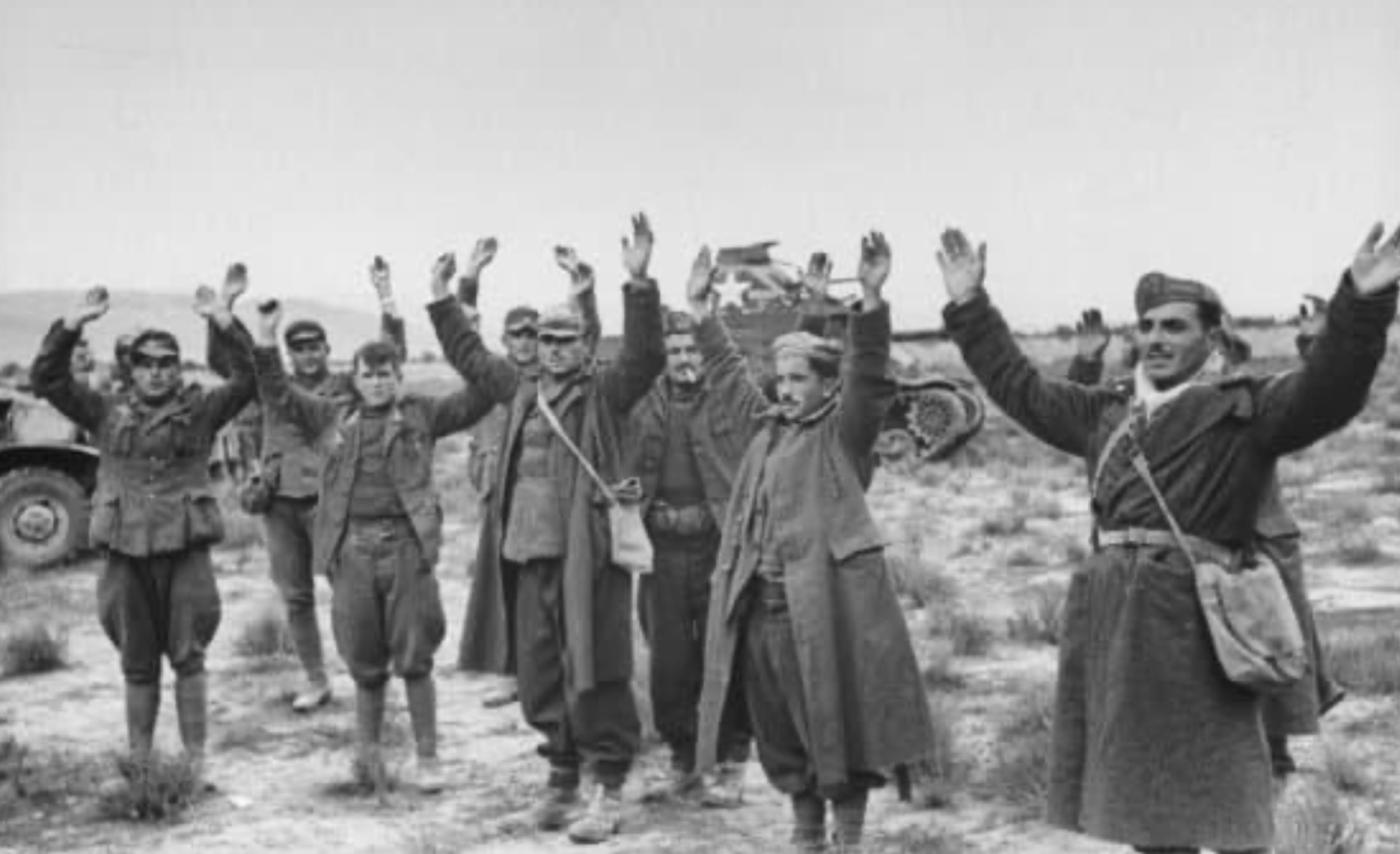
On 13th May 1943 the remaining Axis forces surrendered unconditionally. Hans-Jürgen von Arnim was captured by British troops after his headquarters was surrounded, while Giovanni Messe surrendered shortly afterwards. In a final gesture intended to preserve Italian honour, Benito Mussolini promoted Messe to the rank of Field Marshal only hours before the surrender, because no Italian field marshal had previously surrendered in battle.
The number of Axis prisoners taken in Tunisia was enormous. Between 250,000 and 275,000 German and Italian troops were captured by the Allies, with many estimates placing the figure at approximately 267,000 prisoners. Roughly half were Germans and the remainder Italians. This was one of the largest mass surrenders of the entire war and involved more prisoners than were taken at Stalingrad. In addition to the prisoners, tens of thousands of Axis troops had already been killed or wounded during the Tunisian campaign.
The amount of military equipment lost was catastrophic. Hundreds of tanks, armoured vehicles, artillery pieces, aircraft, and thousands of trucks were either captured intact or destroyed. The Germans lost large numbers of Panzer III and Panzer IV tanks as well as several of the feared Tiger tanks. Italian armoured units lost their M13/40 tanks and Semovente self-propelled guns. Huge stocks of ammunition, fuel, engineering equipment, and transport vehicles also fell into Allied hands. Virtually the entire Axis military force in North Africa ceased to exist.
The surrender in Tunisia had enormous strategic implications for the Second World War. First, it completely ended the North African campaign and removed the Axis powers from Africa forever. Since 1940 Germany and Italy had threatened British control of Egypt, the Suez Canal, and the Middle Eastern oil fields. Their defeat removed this danger permanently.
Second, Allied control of North Africa reopened the Mediterranean shipping routes. Axis aircraft and submarines operating from North African bases had threatened Allied convoys travelling through the Mediterranean. After Tunisia fell, Allied ships could move far more safely between Britain, the Middle East, and Asia.
Third, Tunisia became the launching ground for the Allied invasion of Sicily in July 1943. With North Africa secure, the Allies could begin direct attacks on southern Europe. The invasion of Sicily soon led to the collapse of Mussolini’s Fascist government and Italy’s eventual surrender later in 1943.
The defeat also dealt a severe blow to German prestige. Until Tunisia, German land forces had often appeared almost unstoppable. The surrender of more than a quarter of a million Axis troops demonstrated that Germany could suffer massive defeats outside the Eastern Front as well. For many Allied soldiers and civilians, the victory in Tunisia proved that the balance of the war had shifted decisively in favour of the Allies.
For Italy the consequences were especially serious. The destruction of the Italian First Army weakened confidence in Mussolini’s leadership and exposed Italy’s increasing dependence on Germany. Morale inside Italy deteriorated rapidly after the Tunisian defeat, and opposition within the Fascist regime grew stronger.
The campaign also provided valuable military experience for the United States Army. American forces had initially performed poorly against experienced German troops during battles such as Kasserine Pass in February 1943. However, by the end of the Tunisian campaign American forces had improved greatly in leadership, tactics, logistics, and coordination with British forces. These lessons would prove essential during later operations in Sicily, Italy, and Normandy.
The surrender of the Axis armies in Tunisia on 13th May 1943 therefore represented far more than the end of a desert campaign. It destroyed an entire Axis army group, secured the Mediterranean, removed Germany and Italy from Africa, prepared the way for the invasion of Europe, and marked a major turning point in the Second World War.