West Spring Grenade
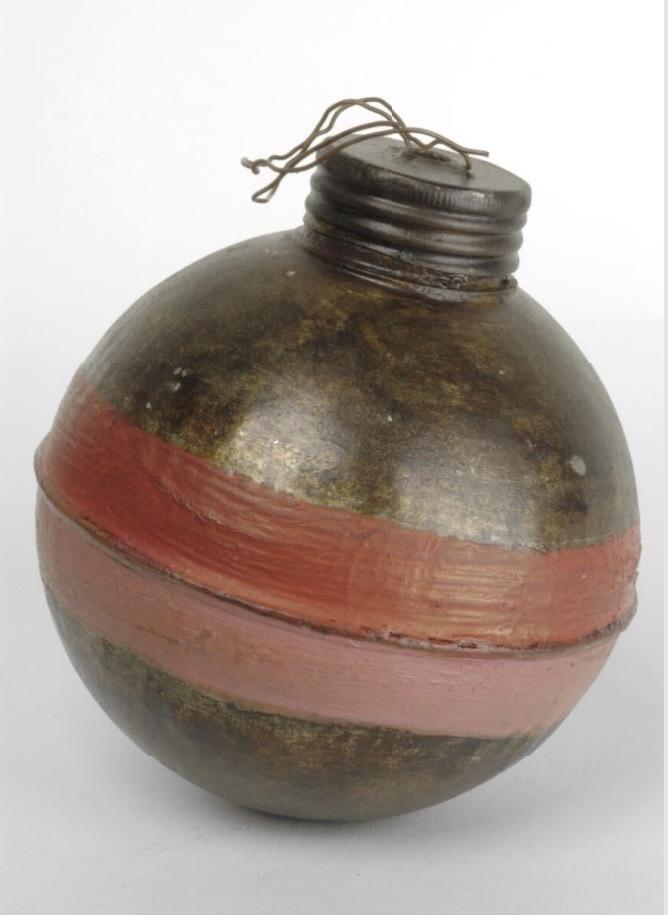
The British No. 68 anti-tank grenade, often referred to as a British “west spring” grenade because of its use of a powerful internal spring mechanism in the firing system, was introduced early in the Second World War during the period when Britain faced the threat of German invasion and needed an emergency anti-tank weapon for infantry and Home Guard units.
Development began in 1940 after the evacuation from Dunkirk left Britain short of effective anti-tank weapons. The War Office requested a simple grenade that could be launched from a standard rifle to give infantry a means of engaging lightly armoured vehicles. The design work was carried out at the Royal Small Arms Factory at Enfield and associated government design departments under the Ministry of Supply. Engineers there focused on creating a shaped-charge explosive device that could be launched using a rifle grenade cup discharger fitted to the muzzle of a standard Lee-Enfield rifle.
The key feature of the grenade’s mechanism was its internal spring-loaded striker assembly, sometimes colloquially referred to in training and documentation as a “west spring” type action because of its orientation within the tail and fuze assembly. This spring was compressed during preparation for firing and released upon impact, driving the striker into a percussion cap that detonated the explosive charge. The fuze design had to be robust enough to withstand the shock of being launched from a rifle but sensitive enough to function on impact with armour.
Manufacture began in late 1940 and continued into 1942–43. Production took place across a network of British factories, including Royal Ordnance Factories and private engineering firms contracted by the Ministry of Supply. Components such as the grenade body were cast or machined in various metalworking plants, while explosive filling and final assembly occurred at specialised ordnance filling factories for safety reasons. Exact totals vary by source, but several million No. 68 grenades were produced during the war. Estimates commonly place total production between 7 and 10 million units, reflecting its status as a standard early-war anti-tank grenade.
The grenade used a shaped-charge warhead filled primarily with pentolite, a mixture of PETN (pentaerythritol tetranitrate) and TNT. Pentolite was chosen because it produced a powerful, focused explosive jet capable of penetrating armour when used in a hollow-charge configuration. Early versions typically contained around 6.5 ounces (approximately 180 grams) of pentolite. When detonated correctly against armour at near-perpendicular impact, the shaped charge could penetrate roughly 50 mm of steel armour, which was sufficient against early-war German light and some medium tanks.
Operational use involved placing the grenade into a cup discharger attached to a Lee-Enfield rifle. A special blank cartridge was fired, launching the grenade toward the target. The grenade’s tail fins stabilised it in flight. Upon striking the target, inertia drove the internal spring-loaded striker into the detonator, initiating the shaped charge. Because it relied on correct impact angle and sufficient velocity, effectiveness varied with range and firing conditions.
The effective range for aimed fire was generally around 50 to 75 yards, though maximum range could be greater. Accuracy and penetration were best at shorter distances. The lethal radius against personnel was relatively limited compared with fragmentation grenades because the No. 68 was designed as an anti-armour weapon rather than an anti-personnel one. However, the explosive blast and metal fragments could still cause serious casualties within several metres. Against armoured vehicles, the main killing effect was through armour penetration followed by spalling and blast inside the vehicle, potentially killing or injuring crew and igniting ammunition or fuel.
As the war progressed and more advanced anti-tank weapons such as the PIAT (Projector, Infantry, Anti-Tank) were introduced, the No. 68 gradually became less important on the battlefield. Nevertheless, in 1940–41 it represented one of the few immediately available anti-tank measures for British forces and Home Guard units and played a significant role in Britain’s emergency defensive preparations during the early years of the Second World War.