Executive order 9066
In February 1942, in the tense aftermath of the attack on Pearl Harbor, President Franklin D. Roosevelt signed Executive Order 9066, a sweeping directive that fundamentally altered the lives of Japanese Americans and reshaped the meaning of civil liberties in the United States during wartime. The country was gripped by fear, anger, and uncertainty, and political leaders faced immense pressure to demonstrate decisive action against what was portrayed as an internal security threat along the West Coast.
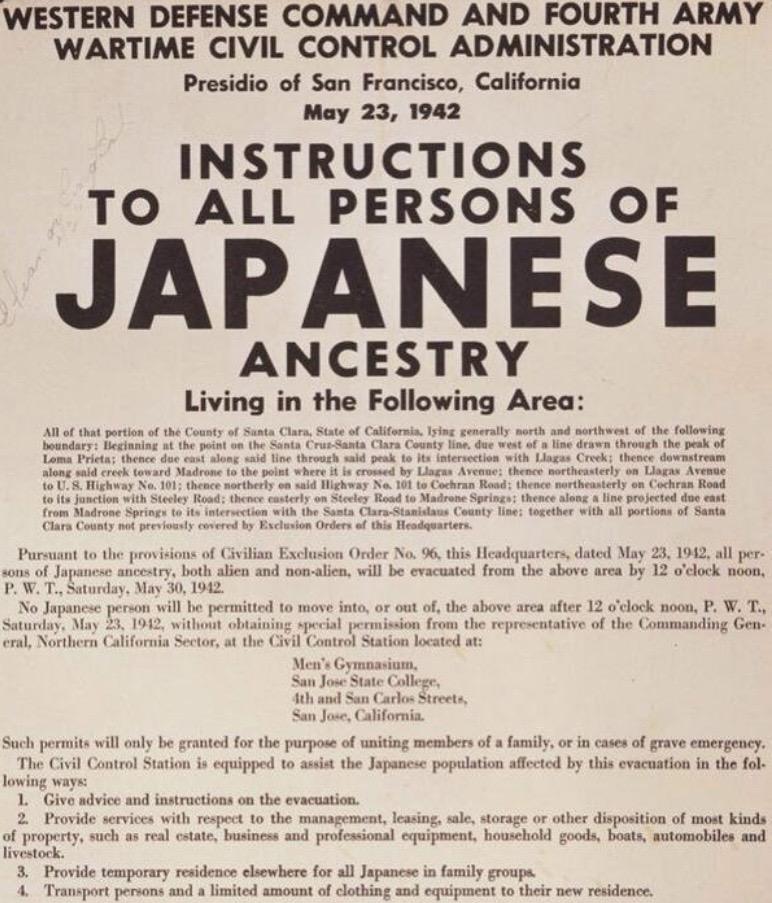
Roosevelt announced the policy behind the order from the White House, though it was framed less as a dramatic public proclamation and more as a military necessity quietly embedded within wartime governance. Signed on February 19, 1942, Executive Order 9066 authorized the Secretary of War and military commanders to designate military areas from which “any or all persons may be excluded.” While the language did not explicitly mention Japanese Americans, its intent and application were clear almost immediately. It laid the legal foundation for the forced removal of people of Japanese ancestry from large portions of the West Coast.
At the time, the United States government argued that the order was essential to national security. Military leaders, politicians, and much of the media claimed, without credible evidence, that Japanese Americans posed a risk of espionage or sabotage. Racial prejudice that had existed for decades, especially in California, Oregon, and Washington, merged with wartime hysteria to create a climate in which mass exclusion was not only tolerated but often openly supported by the public. Newspapers ran inflammatory headlines, and politicians capitalized on fear to push for harsher measures.
The consequences were enormous. Approximately 120,000 Japanese Americans were affected by the order, the majority of whom were U.S. citizens by birth. Families were given little notice to leave their homes, sell their businesses, or dispose of their property. Many were forced to sell farms, shops, and houses at a fraction of their value or abandon them entirely. They were first sent to temporary assembly centers, often located at fairgrounds or racetracks, before being transferred to more permanent incarceration camps in remote inland areas.
Life in the camps was marked by harsh conditions and profound injustice. Families lived in overcrowded barracks with little privacy, surrounded by barbed wire and armed guards. Despite having committed no crime, they were effectively imprisoned for years. Daily life involved long lines for food, inadequate medical care, and the psychological toll of confinement. While some internees attempted to create a sense of normalcy through schools, newspapers, and community activities, the loss of freedom and dignity was constant.
The order also had broader ramifications for American society. It set a precedent that civil liberties could be suspended on the basis of race during a national emergency. Legal challenges were mounted, most notably in cases brought before the Supreme Court, but at the time the Court largely upheld the government’s actions, reinforcing the legitimacy of the policy. These decisions would later be widely criticized as grave failures of constitutional judgment.
As the war progressed and evidence mounted that Japanese Americans did not pose a security threat, public opinion slowly began to shift. In 1944, the government started to relax restrictions, and by 1945 the camps were closed. However, release did not mean restoration. Many former internees returned to communities where their homes were gone, their livelihoods destroyed, and hostility still present. The economic and emotional damage persisted for decades.
In the years that followed, Japanese American activists and civil rights organizations worked to ensure that the injustice of Executive Order 9066 was neither forgotten nor repeated. In the 1970s and 1980s, a national movement emerged demanding an official apology and reparations. This effort culminated in the Civil Liberties Act of 1988, in which the U.S. government formally apologized for the internment and provided financial compensation to surviving victims. The act acknowledged that the policy was driven by “race prejudice, war hysteria, and a failure of political leadership.”
Executive Order 9066 remains one of the most sobering examples of how fear can erode democratic principles. Its legacy continues to shape discussions about national security, racial profiling, and the balance between safety and civil rights. For many years, the order cast a long shadow over American history,