On this day in military history…
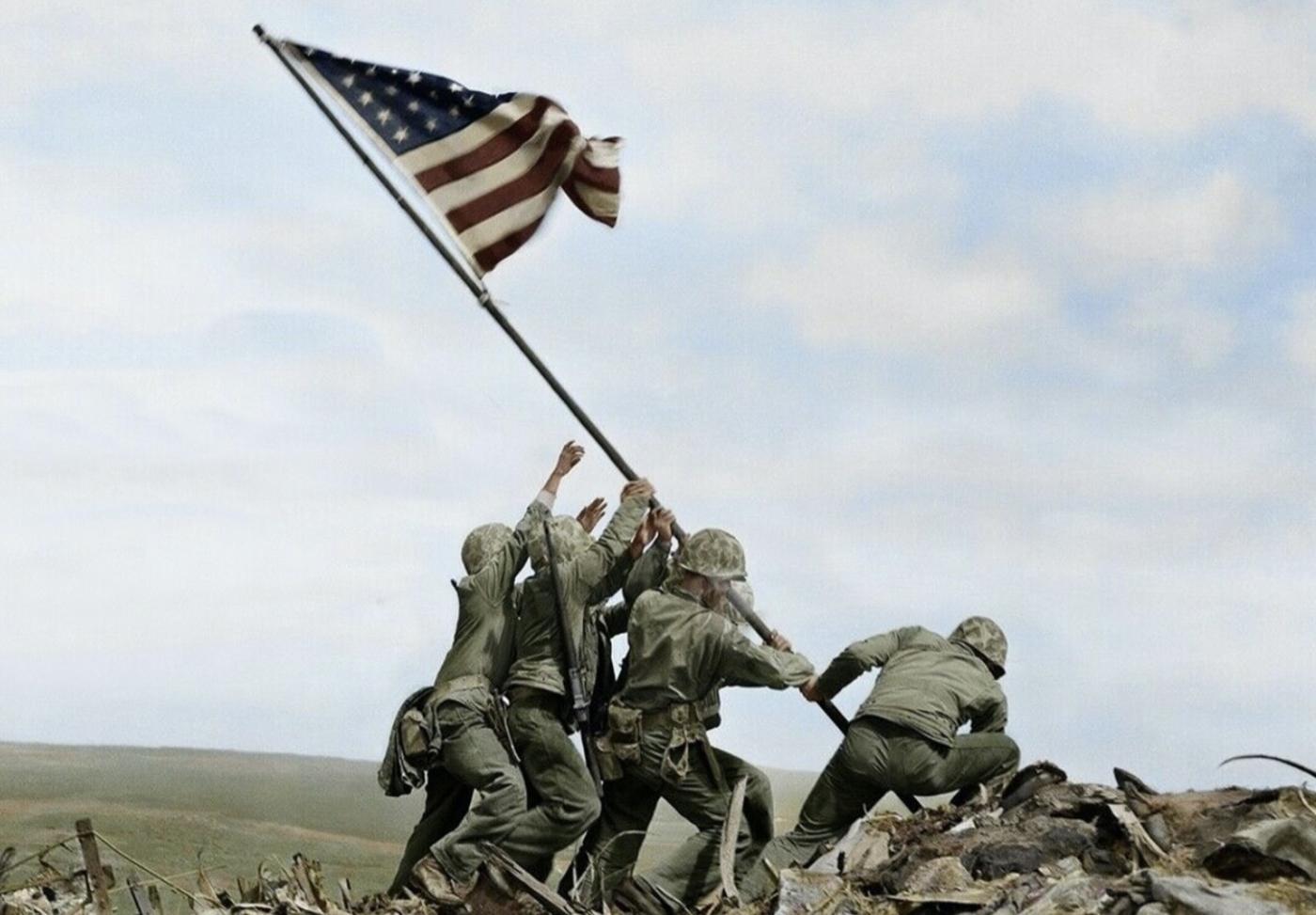
The landing of U.S. troops on Iwo Jima during World War II was one of the most brutal amphibious assaults in American military history and took place on 19 February 1945 as part of Operation Detachment, the U.S. plan to seize the island as a base for fighter escorts and emergency landing fields for B-29 bombers attacking Japan. Iwo Jima was a small volcanic island roughly eight square miles in size, but its strategic position halfway between the Mariana Islands and the Japanese home islands made it a critical objective.
The overall operation was under the command of Admiral Chester W. Nimitz, with ground operations directed by Lieutenant General Holland Smith of the U.S. Marine Corps. Tactical command of the landing forces on the island itself was held by Major General Harry Schmidt. The assault force consisted primarily of three Marine divisions: the 4th Marine Division landing on the eastern beaches, the 5th Marine Division landing near Mount Suribachi at the southern end of the island, and the 3rd Marine Division held in reserve offshore, later committed as casualties mounted.
Approximately 70,000 U.S. Marines were assigned to the operation, with about 30,000 going ashore on the first day. In the days leading up to the landing, the U.S. Navy conducted one of the heaviest naval bombardments of the Pacific War, with battleships, cruisers, destroyers, and carrier aircraft pounding the island. Despite this, the bombardment failed to neutralize much of the Japanese defense, largely because of how those defenses were constructed.
When the Marines began landing shortly after 9:00 a.m. on 19 February 1945, they initially encountered an eerie lack of resistance. The first waves came ashore using Higgins landing craft (LCVPs) and tracked amphibious vehicles known as LVTs, or “amtracs,” which were designed to carry troops directly from ship to beach. Instead of firm sand, they found loose volcanic ash that made movement exhausting and prevented vehicles from gaining traction. Marines sank ankle-deep under fire, struggled to dig foxholes, and found themselves dangerously exposed.
The apparent quiet was deliberate. The Japanese garrison of roughly 21,000 troops, commanded by Lieutenant General Tadamichi Kuribayashi, had abandoned the traditional tactic of resisting the landing at the water’s edge. Instead, Kuribayashi ordered his men to hold fire until the beaches were crowded. Once the Marines were densely packed and vulnerable, Japanese artillery, mortars, heavy machine guns, and rockets opened up from concealed positions.
What the Americans faced was a defense system unlike anything they had previously encountered in the Pacific. Kuribayashi had transformed Iwo Jima into a fortress, carving more than 11 miles of tunnels into the volcanic rock. These tunnels connected bunkers, pillboxes, command posts, and artillery positions, allowing Japanese troops to move unseen, reoccupy positions thought destroyed, and launch deadly ambushes. Gun emplacements were carefully camouflaged and sited to create overlapping fields of fire across the landing beaches.
By the end of the first day, U.S. forces had established a tenuous beachhead about 1,500 yards deep in places and had cut across the island at its narrowest point, partially isolating Mount Suribachi. However, the cost was staggering. On 19 February alone, U.S. casualties were approximately 2,400, including around 550 killed and nearly 1,900 wounded. Entire companies were pinned down or wiped out in minutes, and progress inland was measured in yards rather than miles.
Among the more striking details of the first day was the psychological shock experienced by many Marines who realized that the preparatory bombardment had done far less damage than expected. Japanese soldiers often remained underground during shelling, emerging afterward to fight. Flamethrowers, demolition charges, and tanks equipped with flamethrowers soon became essential tools, as conventional infantry assaults were often ineffective against fortified positions.
The landing on Iwo Jima marked the beginning of a 36-day battle that would ultimately cost the United States nearly 26,000 casualties, including almost 7,000 dead, making it the bloodiest battle in Marine Corps history. The ferocity of the resistance on the first day foreshadowed the brutal, grinding combat to come and offered a grim preview of what an invasion of the Japanese home islands might have looked like.