U.S Army Ranger Beret
The beret and cap badge associated with the United States Army Rangers are relatively modern symbols when compared with older European military traditions, yet they carry a dense concentration of heritage, identity, and carefully controlled symbolism. Their development reflects both American military practicality and a conscious effort to link modern Rangers with elite light infantry units stretching back to the Second World War.
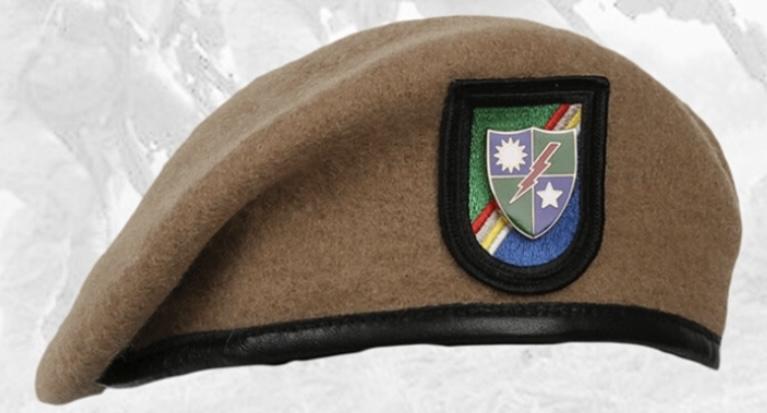
The modern Ranger beret was formally adopted in 2001 by the United States Army Rangers, specifically the 75th Ranger Regiment. Its distinctive tan colour was selected to set Rangers apart from other Army units and to evoke associations with historical light infantry and frontier soldiers, as well as the sandy, arid environments in which Rangers had frequently operated in the late twentieth century. Before this official adoption, Rangers did not have a unique beret and instead relied on shoulder insignia, tabs, and lineage to identify themselves.
The decision to introduce the tan beret came during a period when the wider US Army was re-evaluating headgear and unit identity. While the black beret was briefly issued Army-wide, the Rangers were deliberately exempted and instead granted the tan beret to preserve their elite distinction. This decision followed internal debate and resistance from Ranger leadership, who were concerned about maintaining exclusivity and tradition. The tan beret therefore became not only a uniform item but also a visible marker of earned status, worn only by those who had passed Ranger selection and training.
The design of the Ranger cap badge worn on the beret is rooted in much older symbolism. The badge consists of a metal scroll bearing the word Rangers, often worn above or in conjunction with the distinctive Ranger flash. The scroll design itself echoes the curved banners used in European and early American military heraldry. While no single individual is credited with its creation, the design was developed by US Army heraldry specialists working under the Institute of Heraldry, drawing on earlier Ranger insignia used during the Second World War.
The Ranger scroll traces its lineage to the World War II Ranger battalions, whose members fought in North Africa, Italy, and Normandy. Those early units used shoulder patches and informal insignia rather than standardized headgear badges, but the word Rangers in a scroll format became a recurring motif. The modern cap badge therefore represents a formalization of a symbol that had existed in various unofficial forms for decades.
In terms of colour variations, the most significant distinction lies in the beret itself. The tan beret is unique to the Ranger Regiment and has remained consistent in colour since its introduction. There have been slight variations in shade depending on manufacturer and era, ranging from lighter sand tones to deeper tan hues, but these differences are considered manufacturing tolerances rather than official variants. Earlier experimental or privately purchased berets in the 1980s and 1990s sometimes appeared in brown or khaki shades, though these were never officially sanctioned.
The beret flash, the cloth shield behind the badge, adds further layers of symbolism and colour. The Ranger flash combines red, white, and blue, reflecting national identity, with design elements that differ slightly between battalions. These flashes are carefully regulated, and their colours are standardized, though fading and wear in operational environments can subtly alter their appearance over time. Unlike some Commonwealth forces, the US Rangers do not use different beret colours to denote rank or role within the regiment.
Production of the tan beret began in earnest in 2001, with contracts issued to American manufacturers to meet strict specifications. Early production runs were closely inspected after concerns arose about shape retention and colour consistency, leading to refinements in wool quality and dye processes. Rangers often shape and form their berets carefully, a practice inherited from airborne and special operations traditions, giving each beret a slightly individual character while still conforming to regulation.
An interesting aspect of Ranger headgear history is the continued symbolic importance of other identifiers alongside the beret. The Ranger tab, worn on the shoulder, predates the tan beret by many decades and remains one of the most respected qualifications in the US Army. This means that the beret does not replace earlier symbols but rather complements them, reinforcing the layered nature of Ranger identity.
Another notable detail is that Rangers remove their berets in combat environments, reverting to patrol caps or helmets, underscoring that the beret is primarily a garrison and ceremonial symbol rather than a battlefield necessity. This practical approach aligns with Ranger ethos, which prioritizes function over display, even while maintaining strong visual traditions.