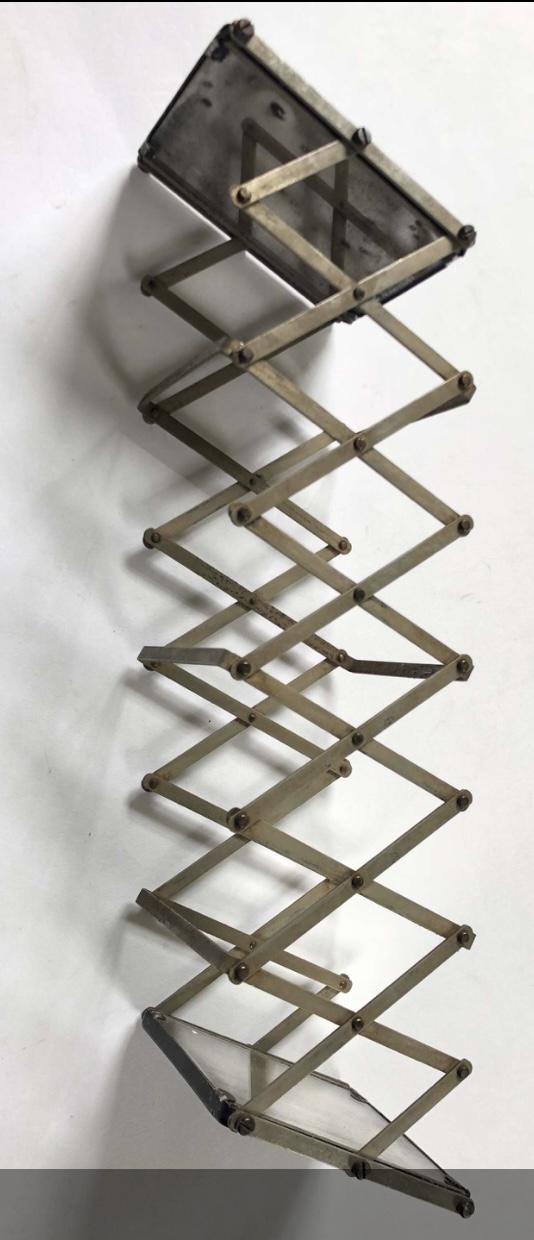
Trench periscope mirror
The trench periscope was one of the simplest yet most valuable tools issued to British forces in the First World War, and among the many patterns produced was a collapsible, concertina-style version often associated with Manchester’s engineering industry. It was not a single officially standardized model, but rather one of several practical designs created as the realities of trench warfare became clear. Its purpose was straightforward: allow a soldier to see over the parapet without exposing himself to sniper fire.
Early straight periscopes were usually fixed wooden boards with mirrors set at forty-five degrees, useful but awkward. Their length forced a man to stand higher in the trench than he wanted, and they were difficult to carry. The folding Manchester-made design solved those problems. Its sectional body concertinaed down for storage and extended only when needed, letting a soldier keep himself safely lower while still raising the upper mirror above the parapet. The adjustable length also suited trenches of different depths and firing steps.
Most surviving examples consist of a lightweight metal or hardwood frame divided into hinged sections, often covered with fabric or thin sheet metal to keep mud and debris out. The mirrors were simple silvered glass plates rather than expensive prisms, allowing fast, economical production. Many periscopes were issued with plain canvas or leather cases, emphasizing their role as everyday infantry items rather than delicate optics.
Identifying a single designer is difficult because several small Manchester engineering firms appear to have developed similar folding patterns at the same time. The War Office frequently approved small variations from different contractors, and records usually list companies rather than individuals. What is clear is that by 1915 Manchester’s combination of optical workshops and machine shops made it a major contributor to periscope production.
As for numbers, exact figures for the folding Manchester pattern do not survive, because they were not recorded separately from other periscopes. However, trench periscopes in general were produced in large quantities—many tens of thousands—and photographs and memoirs from 1916 and 1917 show the folding type in common use by infantry across the Western Front. They served not only for basic observation but also for checking wire, watching patrols, or monitoring artillery effects, all without exposing the user.
An interesting aspect of the concertina periscope is how clearly it reflects the improvisational nature of early trench warfare. Before large-scale production stabilized, batches were made by small firms, and soldiers often made minor adjustments themselves, such as inserting shims behind mirrors to improve alignment. The folding type became especially popular because it could be tucked into a pack, extended cautiously above the parapet in seconds, and withdrawn just as quickly.
Although far less famous than inventions such as the periscope rifle or the Mills bomb, the Manchester-style folding periscope shows how industrial cities adapted their skills to meet urgent frontline needs.