L-39 Lahti
The Finnish L-39 20 mm anti-tank rifle was a heavy infantry weapon developed in the late 1930s to give Finnish forces a means of combating armored vehicles with organic ground troops. It was designed by Aimo Lahti, Finland’s leading small-arms engineer, during a period when light and medium tanks still had armor thin enough to be defeated by large-caliber kinetic projectiles. Development began around 1938, and the weapon was officially adopted in 1939 under the designation 20 mm pst kiv/39.
Manufacture was carried out primarily by the Finnish state arms factory Valtion Kivääritehdas at Jyväskylä, with production running from 1939 through the early 1940s. Total production is generally estimated at approximately 1,900 to 2,000 rifles. Finland’s limited industrial capacity and the rapidly changing nature of armored warfare prevented larger-scale manufacture.
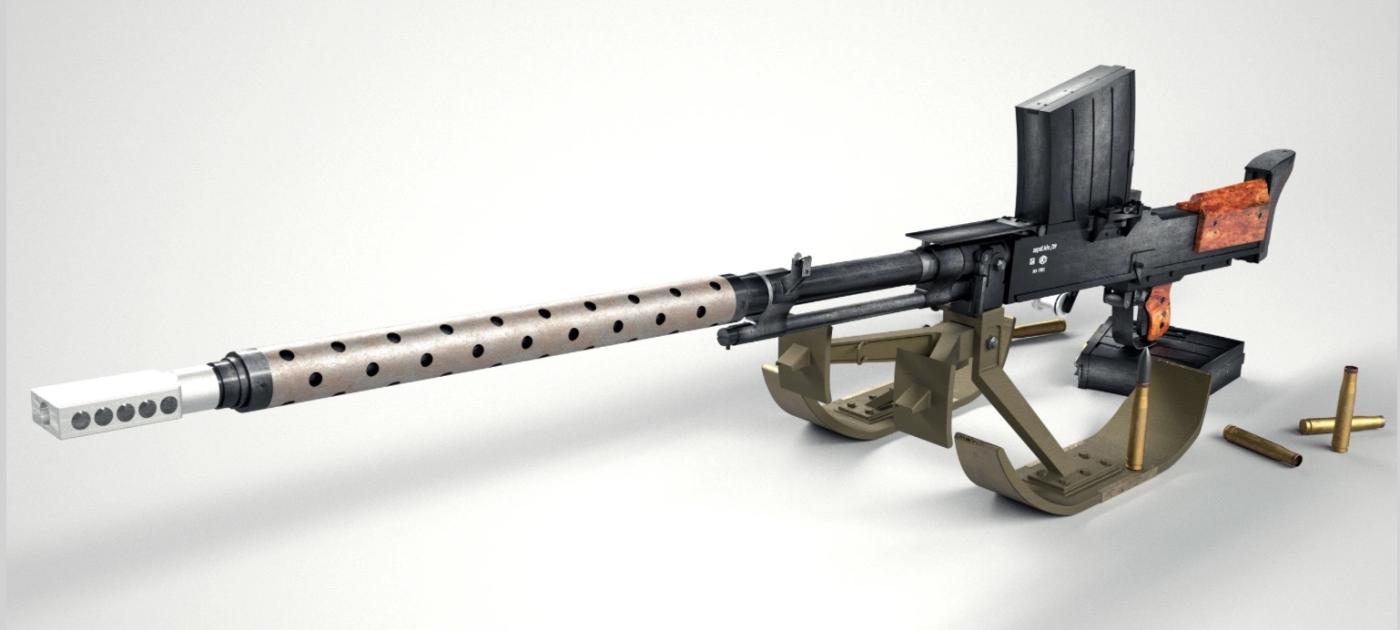
The L-39 was a semi-automatic, recoil-operated rifle fed from a 10-round detachable box magazine. It was extremely large and heavy, weighing roughly 49 kilograms unloaded and measuring more than 2.2 meters in length. Because of its mass and recoil, it was issued with a large muzzle brake and a robust bipod, and in practice it was operated by a two- or three-man crew. Despite its official classification as a rifle, it functioned more like a light cannon in infantry service.
Its intended role was the destruction or disabling of enemy light tanks, armored cars, and fortified positions. Early-war Soviet vehicles such as the T-26 and BT series were vulnerable to its fire, particularly at close to medium ranges. As armor thickness increased during the war, the L-39 became less effective as a true anti-tank weapon but remained useful for engaging weak points such as tracks, optics, and firing ports.
The rifle fired the 20×138B cartridge, a powerful round more commonly associated with autocannons. Ammunition types used by Finland included armor-piercing, armor-piercing incendiary, high-explosive, and training rounds. Armor-piercing projectiles could penetrate approximately 20 to 30 millimeters of armor at around 100 meters, depending on impact angle and ammunition type.
Effective anti-armor range was typically considered to be about 300 meters, though accurate fire against stationary or exposed targets could be delivered at greater distances. Muzzle velocity was approximately 800 meters per second, contributing to a flat trajectory and good accuracy for a weapon of its size. Maximum ballistic range exceeded 7 kilometers.
In service, the L-39 earned the nickname “Norsupyssy,” meaning “elephant gun,” due to its size and power. Finnish troops valued it for its accuracy and destructive effect, even as its original anti-tank role diminished. After the war, the rifle was retained in storage for some time before being declared obsolete. Today, the L-39 is remembered as one of the largest and most powerful anti-tank rifles ever fielded and as a distinctive example of Finnish weapons engineering during the Second World War.