Training of Filipinos
Before the Second World War, Filipinos occupied a deeply contradictory position in relation to the United States. The Philippines had been an American colony since 1898, and Filipinos were legally classified as U.S. nationals rather than aliens, yet they were not citizens. This ambiguous status placed them in a space where they owed allegiance to the United States but were denied many of the rights and protections enjoyed by Americans. In the decades leading up to the war, Filipinos living and working in the United States were widely treated as second-class people. They faced segregation, discriminatory laws, exclusion from citizenship, limits on employment, and in some states were barred from marrying white Americans or owning land. This unequal treatment stood in sharp contrast to the role they would soon be asked to play when war came to the Pacific.
Large numbers of Filipinos had migrated to the United States during the 1920s and early 1930s, particularly to Hawaii and the West Coast, where they worked mainly as agricultural laborers, cannery workers, and service staff. Despite their legal status as U.S. nationals, anti-Filipino sentiment was strong. They were excluded from many unions, subjected to racially motivated violence, and targeted by restrictive laws. The Tydings–McDuffie Act of 1934 further reduced their status by reclassifying Filipinos as aliens for immigration purposes and sharply limiting future migration. By the late 1930s, Filipinos in the United States were politically marginalized and socially segregated, with little expectation that they would ever be treated as equals.
Everything changed after December 1941, when Japan invaded the Philippines within hours of the attack on Pearl Harbor. The islands were a critical strategic possession, and the defense and eventual liberation of the Philippines became a major American war aim. Suddenly, Filipinos were no longer seen merely as colonial subjects or cheap labor, but as essential allies with local knowledge, cultural familiarity, and a powerful personal stake in defeating the Japanese. The U.S. military moved quickly to organize, train, and deploy Filipino soldiers, both those already in uniform in the Philippines and those living in the United States.
At the outbreak of war, approximately 120,000 Filipinos were serving in the Philippine Commonwealth Army, which had been federalized into U.S. service under the command of General Douglas MacArthur. These troops were trained and equipped under American supervision, though often inadequately supplied, and fought alongside U.S. Army units during the disastrous defense of Bataan and Corregidor. After the surrender in 1942, thousands of Filipino soldiers escaped capture and formed guerrilla units throughout the islands. These guerrillas, eventually numbering well over 200,000 by some estimates, became a vital part of the Allied war effort, gathering intelligence, sabotaging Japanese operations, and supporting the American return in 1944.
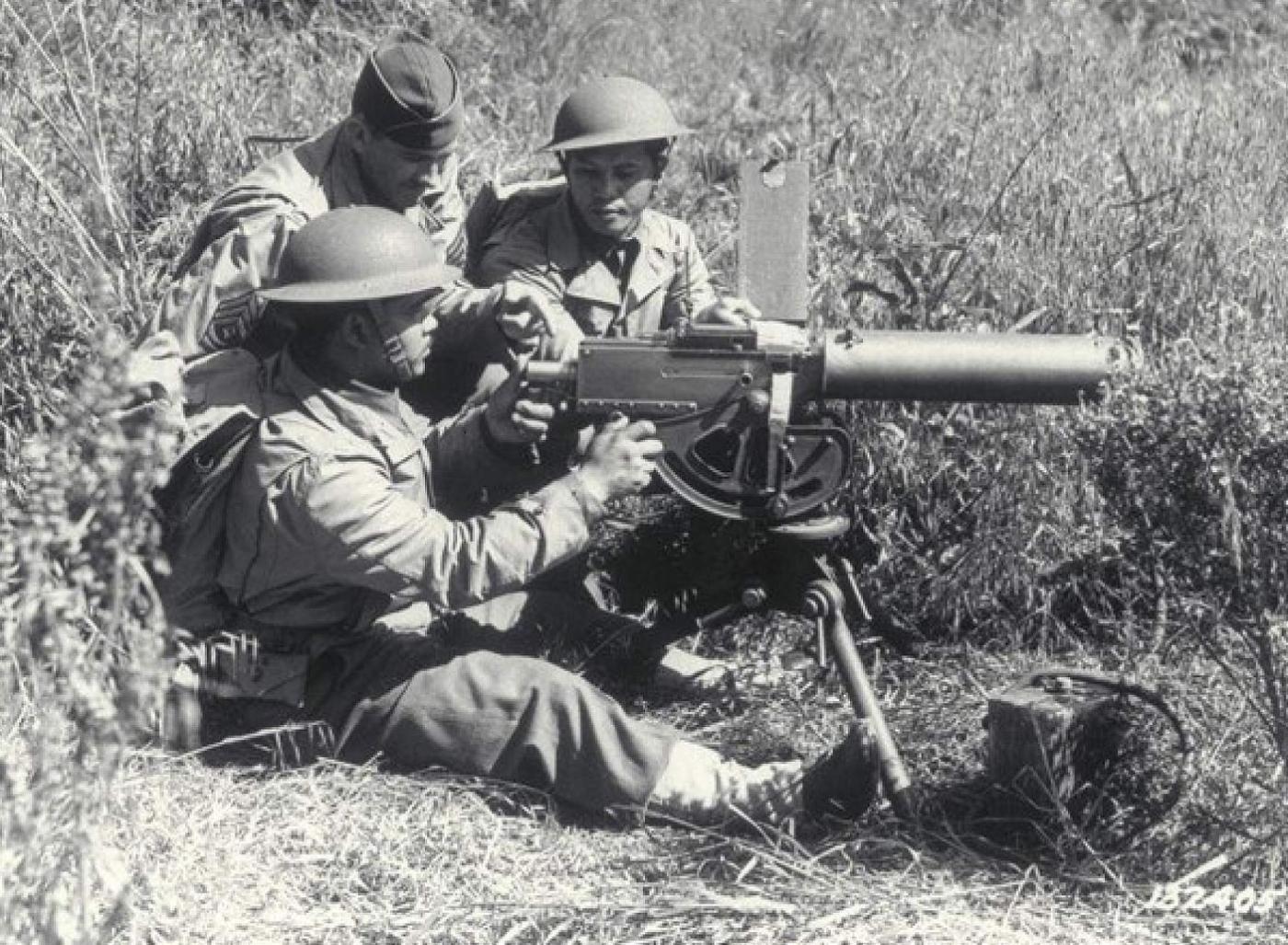
In the United States itself, Filipinos were increasingly drawn into formal military training programs. Filipino men living in America were allowed and encouraged to enlist in the U.S. armed forces, something that carried both symbolic and practical significance given their prior exclusion from full civic participation. Many joined the U.S. Army, Navy, and Coast Guard, while others were trained for specialized roles connected to the Pacific war. Training camps across the continental United States played a central role in this process. Filipino recruits trained at major Army installations such as Camp San Luis Obispo in California, Fort Ord, Camp Beale, and later Camp Stoneman, which served as a key staging area for troops heading to the Pacific. In Hawaii, where a large Filipino population already existed, training facilities were expanded rapidly, and Filipino soldiers trained alongside other American units under conditions that reflected the urgent demands of wartime mobilization.
One of the most significant and lesser-known aspects of Filipino training in the United States involved the formation of specialized units designed to support operations in the Philippines. Filipino Americans and Philippine-born Filipinos were recruited for intelligence, reconnaissance, and liaison roles because of their language skills and cultural knowledge. Some were trained at Camp Ritchie in Maryland, a center for military intelligence training, where linguists and intelligence specialists were prepared for service behind enemy lines. Others were trained by the Office of Strategic Services, the forerunner of the CIA, for covert operations in the Philippines. These men would later parachute into occupied territory to link up with guerrilla forces and coordinate resistance efforts.
Command of Filipino forces remained firmly in American hands. General MacArthur exercised overall authority over Filipino troops in both the early defense and the later liberation of the islands. American officers commanded most major Filipino units, although Filipino officers increasingly assumed leadership roles as the war progressed. The structure reflected the colonial relationship between the two nations, even as Filipino soldiers demonstrated discipline, courage, and effectiveness equal to their American counterparts.
As Filipinos proved their value on the battlefield, attitudes within the United States began to shift. Their service made it increasingly difficult to justify the legal and social discrimination they faced at home. Filipino soldiers fought and died under the American flag, endured imprisonment, torture, and execution as prisoners of war, and played a decisive role in undermining Japanese control of the Philippines. Their contribution was no longer abstract; it was visible, measurable, and essential.
This recognition led to concrete changes. In 1946, shortly after the war ended and as the Philippines gained full independence, the United States passed the Luce–Celler Act, granting Filipinos the right to naturalize as U.S. citizens and establishing a small immigration quota. While limited, this marked a dramatic reversal from decades of exclusion. Filipino veterans in particular were seen as deserving of recognition, even though many would later face injustice when promised benefits were denied or delayed.
The training of Filipinos in the United States during the Second World War thus represents more than a military story. It reflects a moment when necessity forced the United States to confront the contradiction between its democratic ideals and its treatment of a colonial people. Filipinos who had once been barred from full participation in American society were suddenly trained, armed, and entrusted with the defense of a vital theater of war. Their service did not erase discrimination overnight, but it permanently altered how Filipinos were perceived and laid the groundwork for future struggles for equality and recognition.