Thompson Machine Gun
The Thompson machine gun, better known to many soldiers as the Tommy Gun, became one of the most recognisable weapons of the Second World War and was used by British forces including commandos, airborne troops and the early Special Air Service. It was heavy, expensive and rather old-fashioned compared with the simpler Sten gun, but in the hands of aggressive raiding troops it had one great advantage: at close range it delivered a frightening weight of fire. For the SAS, whose work in the desert and later in Europe often meant sudden attacks, ambushes, vehicle raids and close-quarter fighting, it was a weapon that suited a certain type of war. It was not a rifleman’s weapon for careful shooting across open ground. It was a hard-hitting close-combat gun designed to pour .45 calibre bullets into an enemy position before the enemy could properly react.
The weapon had been developed after the First World War through the work of retired American General John T. Thompson, who wanted to create a lightweight automatic weapon for trench fighting. The original idea came too late for the First World War, but the gun found fame during the interwar years with police forces, bodyguards and gangsters in America. By the time Britain was fighting for survival in 1940, it was no longer just a gangster’s weapon. Britain urgently needed submachine guns, and before the Sten was available in quantity, large numbers were ordered from the United States for British and Commonwealth use.
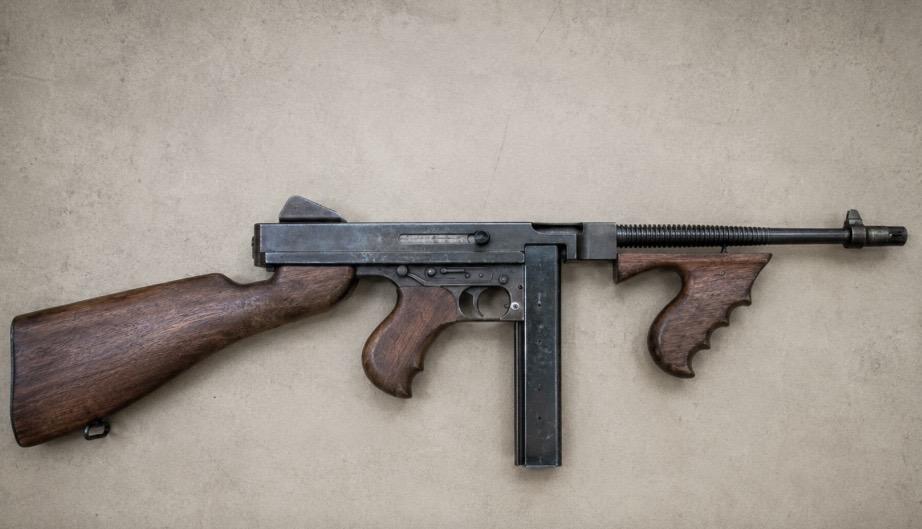
The early examples used by British troops were mainly the Model 1928 and 1928A1. These were handsome, strongly made weapons with a finned barrel on many examples, a Cutts compensator on the muzzle, a top-mounted cocking handle and, in some versions, the ability to take either box magazines or drum magazines. The later wartime M1 and M1A1 models were simplified for faster production. They lost some of the earlier refinements, including the complex Blish-lock system, barrel fins and drum-magazine compatibility, but they were easier and cheaper to build in large numbers. The main wartime manufacturers were Auto-Ordnance and Savage Arms in the United States, with more than 1.5 million produced during the Second World War.
The gun fired the .45 ACP cartridge, a large, heavy pistol round. This gave it excellent stopping power at close range, especially compared with lighter pistol-calibre weapons. A man hit by a burst at short distance was very unlikely to continue fighting. Its usual magazines were 20-round and 30-round box magazines, though earlier models could also use 50-round drums. British troops did receive and use drum magazines, but for raiding and field work the box magazine was usually more practical. Drums were heavy, bulky, noisy if not properly packed, slower to change and less convenient for soldiers moving fast in vehicles or on foot. For SAS patrols operating behind enemy lines, spare magazines, speed and reliability mattered more than the glamour of the round drum seen in films.
In SAS service it fitted naturally into the brutal close-range character of their early war operations. The original SAS was formed in North Africa under David Stirling, and its men carried out raids deep behind Axis lines against airfields, aircraft, fuel dumps, transport columns and supply points. On these operations they used a mixture of British, American, captured and improvised equipment. The American-made submachine gun was especially useful when a patrol had to rush an airfield, shoot up tents and workshops, clear a building, cover a withdrawal or deal with enemy troops at short range. It could be fired from the shoulder, from the hip in emergency, from a jeep, or while moving through a target area where seconds mattered.
The SAS became famous for mounting multiple machine guns on jeeps, especially Vickers K guns, but personal weapons were still vital. A raiding column could not rely only on vehicle-mounted guns. Men needed weapons for sentry work, ambushes, foot patrols, escape and close protection if a jeep broke down or a raid collapsed into confusion. A Tommy Gun in the hands of an SAS trooper gave immediate close-range firepower, and its heavy .45 round was useful against unarmoured vehicles, aircraft ground crews, fuel parties and troops caught in the open. It was also a reassuring weapon in the dark, where most fighting took place at distances far shorter than ordinary infantry rifle range.
It was not light. A wartime example weighed roughly 10 to 11 lb empty depending on model, and once loaded with magazines it became a burden. This was one of its great weaknesses. In desert operations, every extra pound mattered because men already carried water, ammunition, explosives, rations and survival equipment. The gun was also long and solid compared with later submachine guns. The Sten was crude, cheaper and lighter, and for many British units it became the natural replacement. Even so, many soldiers preferred the feel and confidence of the American weapon. It was beautifully made, strong and had a reputation for reliability when properly maintained.
Its rate of fire varied by model. The 1928A1 could fire very fast, often around 700 to 800 rounds per minute in practical wartime form, though some figures vary depending on ammunition and exact model. The later M1 and M1A1 were generally around 600 to 700 rounds per minute. This meant that a 20-round magazine could disappear very quickly if a man simply held the trigger down. Experienced soldiers fired short bursts, often two to five rounds, because this kept the weapon controllable and preserved ammunition.
Its effective range was usually around 50 to 100 yards for realistic combat shooting. Official figures sometimes gave longer maximum ranges, but in real fighting this was a close-range weapon. The .45 ACP bullet was heavy and hard-hitting but slow compared with a rifle round. It dropped quickly and was not designed for accurate long-range fire. At close distance it was excellent; beyond 100 yards it became much harder to use effectively, especially on moving targets. A good shot could hit further away using single shots or very short bursts, but its real strength was not long-range precision. It was the ability to dominate a doorway, trench, vehicle halt, aircraft dispersal point or enemy post at short distance.
Accuracy was better than many people assume. Because the gun was heavy, it absorbed recoil well, and when fired from the shoulder in short bursts it could be controlled. The Cutts compensator on the 1928 model helped reduce muzzle climb. The weapon also had decent sights for a submachine gun, although most wartime close fighting did not allow careful sight picture shooting. Its weight, which was disliked on long marches, actually helped when firing. It did not jump around like some lighter weapons. The problem was that the high rate of fire and heavy ammunition meant a careless soldier could waste ammunition very quickly.
For the SAS in North Africa, the advantages were obvious. Raids often depended on surprise, speed and violence. A patrol might approach an airfield in darkness, cut through wire, place Lewes bombs on parked aircraft and then fight its way out as the alarm was raised. In that sort of situation, a weapon that could instantly produce a burst of heavy automatic fire was extremely valuable. The sound alone was distinctive and intimidating. It had a deep, hammering note, very different from the sharper sound of 9mm weapons. In close combat it gave the impression of overwhelming force.
The same weapon also had value in occupied Europe after the desert war. SAS units operating in France, Italy and later north-west Europe needed compact automatic arms for ambushes, sabotage and work with resistance forces. By that stage the Sten was far more common in British service, especially because it was easier to carry, easy to suppress in some versions and available in huge numbers. Even so, the American .45 submachine gun remained in use where available, particularly when men wanted a more rugged and hard-hitting weapon. American supply also meant that .45 ammunition and spare parts were available through Allied channels, though 9mm was generally more convenient for British and resistance operations.
One of its less glamorous problems was cost. It was a finely machined weapon at a time when nations needed arms by the million. The British Sten existed largely because Britain could not rely on expensive American-made guns forever. This weapon was too costly and too slow to make compared with stamped-metal designs. Its engineering belonged more to the craftsmanship of the 1920s than the desperate mass production of the 1940s. The simplified M1 and M1A1 models reduced this problem, but it was still more expensive than many newer submachine guns.
Another issue was ammunition weight. The .45 ACP cartridge was powerful, but a soldier could carry fewer rounds for the same weight compared with 9mm ammunition. SAS patrols had to think carefully about what they carried. On a long-range desert raid, ammunition was only one part of the load. Water, fuel, explosives and vehicle spares might decide whether the patrol came home. A gunner carrying this weapon could not simply spray ammunition without thought. Controlled fire was essential.
Its reputation among British troops was mixed but generally respectful. Some loved it because it felt solid and dependable. Others disliked the weight and preferred the Sten because it was lighter and handier. Commandos and special troops often appreciated it more than ordinary infantry because their fighting was more likely to be at close range. In a trench, building, truck convoy, airfield raid or night ambush, it made sense. On a long infantry advance across hills or fields, its limitations were more obvious.
The appearance of the gun also helped create its legend. With its wooden furniture, thick receiver and heavy barrel, it looked like a weapon built to last. The early vertical foregrip and drum magazine gave it a dramatic look, while the later M1 and M1A1 had a plainer military style. British soldiers often called it the Tommy Gun, a name that already carried fame before the war. Photographs of Winston Churchill handling one added to its public image, making it one of the symbols of defiance during the darkest years of the conflict.
In SAS hands, it was not just a firearm but part of the early raiding culture of special forces warfare. The SAS did not fight like conventional infantry. Its men were expected to move fast, improvise, strike at weak points and vanish before a larger enemy force could respond. The Tommy Gun fitted that world well. It was not subtle, not especially light and not cheap, but it was devastating at the ranges where many SAS fights happened. When an airfield sentry appeared out of the dark, when an enemy truck halted too close, or when a patrol had to break contact at speed, it could settle the matter in seconds.
By the end of the war this famous American submachine gun was already being overtaken by simpler and cheaper weapons, but it never lost its reputation. The Sten, the American M3 Grease Gun and other wartime submachine guns were more economical answers to the same battlefield need. Yet few had the same authority in the hands of the men who carried them. For the British SAS of the Second World War, it was a close-range hammer: heavy to carry, hungry for ammunition, but immensely reassuring when the shooting started.