Armstrong Whitworth Albemarle
The Armstrong Whitworth Albemarle was one of those British wartime aircraft that never became famous like the Lancaster, Dakota or Halifax, yet it filled an important gap at a time when Britain needed aircraft quickly, cheaply and in large numbers. It began life not as a transport aircraft, but as a proposed medium bomber, designed to meet an Air Ministry requirement for a machine that could be built using wood and steel rather than large amounts of scarce light alloy. This was important in the late 1930s, when Britain was preparing for the possibility of war and aircraft production had to be spread across factories that did not always have traditional aircraft-building experience. The result became the Armstrong Whitworth A.W.41, with the design work carried out under John Lloyd, the company’s chief designer, whose team produced a strong but rather unusual machine for the Royal Air Force.
Although Armstrong Whitworth designed it, much of the production was handled by A.W. Hawksley Ltd, a company connected with Gloster Aircraft and set up to build the type. This was very much a wartime shadow-factory aircraft, with parts and sub-assemblies being made by many firms outside normal aircraft manufacture. Companies better known for cars, furniture and engineering work helped produce sections of the forward fuselage, wings and tail. This was one of the most interesting things about the project, because it showed how Britain was trying to turn every available industrial skill towards aircraft production. By the time manufacturing ended in December 1944, just over 600 had been built.
The first flight took place on 20 March 1940, but by the time the aircraft entered RAF service the war had already changed the role it was expected to perform. As a bomber it was not good enough to compete with the newer and more capable types coming into service. It was not especially fast, it did not have the bomb load or performance of the best front-line bombers, and it was soon clear that its future would not be as a main bombing aircraft. Instead, it found its real wartime use as a special transport, glider tug, parachute aircraft and general utility machine. In that role it became far more useful, especially with 38 Group RAF, which specialised in airborne operations.
Power came from two Bristol Hercules XI engines, each producing around 1,590 horsepower. These were 14-cylinder, two-row, air-cooled sleeve-valve radial engines, a powerful and reliable British engine also associated with other important wartime aircraft. They drove three-bladed de Havilland Hydromatic propellers, giving the aircraft a top speed of roughly 265 to 270 mph depending on version and load. Its normal service ceiling was around 17,000 feet, while its range varied according to fuel and role, but was commonly around 1,300 miles, with some figures giving over 2,000 miles under favourable or ferry conditions.
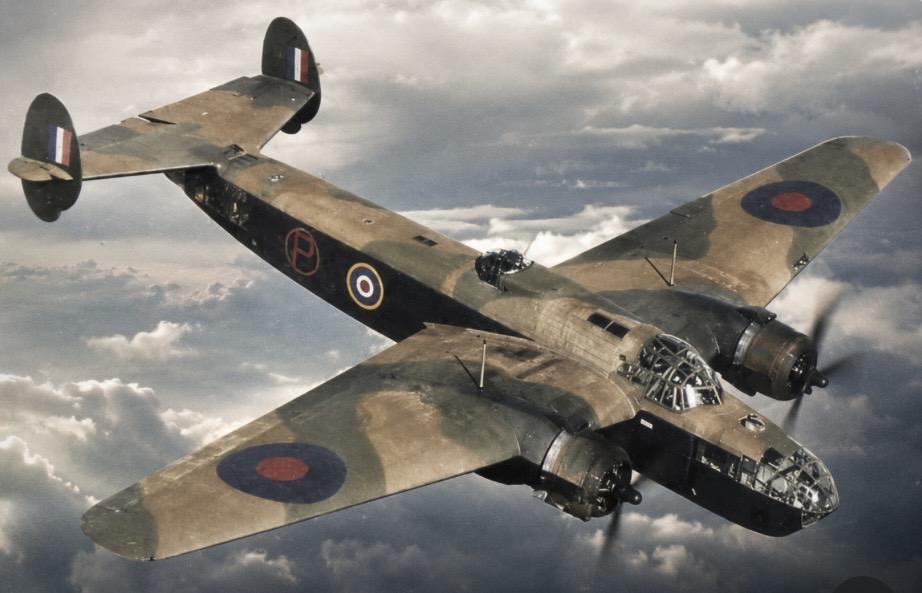
One of its most distinctive features was the tricycle undercarriage, with a nose wheel rather than the more familiar tailwheel layout used by many British aircraft of the period. This gave it a more modern stance on the ground and made it one of the first British military aircraft of its kind to be produced in quantity with a retractable nose-wheel arrangement. It was a mid-wing monoplane with twin fins and rudders, and its construction was deliberately broken into sections so that damaged parts could be replaced and so that factories could build components away from the final assembly line. The structure used welded steel tubing, plywood covering and wooden wing sections, making it rugged but also rather heavy.
In its original bomber form it could carry a bomb load, but only a small number were actually completed as bombers, and the type was not used operationally in that role. The early bomber version had a crew of around six, including pilots, navigator, wireless operator and gunners. Defensive weapons could include a Boulton Paul dorsal turret with four Browning .303 machine guns and, on early examples, a ventral gun position. As the aircraft moved into the transport and airborne role, much of this armament was reduced or removed, depending on the version and task. In transport service the normal crew was usually four, and the space that had once been intended for bombs and equipment was adapted for men, stores or towing gear.
As a paratroop aircraft, it could carry around ten fully equipped airborne troops. It was fitted with a side loading door and a dropping hatch, allowing men or supplies to be dispatched. It was not as roomy or as well loved as the Douglas Dakota, but it played its part in the development and training of British airborne forces. Aircraft like this helped crews and parachute troops gain experience in night flying, formation work, supply dropping and glider operations, all of which became vital as the Allies prepared for the invasion of occupied Europe.
Its work as a glider tug was especially important. The aircraft was used to tow Airspeed Horsa gliders, which could carry airborne soldiers, jeeps, anti-tank guns or other heavy equipment into battle. In this role it became part of Britain’s growing airborne capability. The tug aircraft had to lift off with a large glider behind it, climb steadily, hold formation, fly often at night and then release the glider close enough to the landing zone for the pilots to make their silent final approach. It was demanding work, and although the machine was not glamorous, it was strong enough to do the job.
The type took part in airborne operations connected with the invasion of Sicily and later operations in north-west Europe. It was used by RAF squadrons including Nos. 296 and 297 Squadrons, both closely linked with airborne support. These aircraft towed gliders, moved personnel, carried stores and helped prove the methods that would be used on a much larger scale by Allied airborne forces. They also served in training, helping crews and airborne troops prepare for the dangerous business of flying low, slow and often in darkness towards enemy-held territory.
Its carrying ability depended on the role and version. As a special transport it could carry a small load of troops or cargo, while as an airborne aircraft it could carry about ten paratroopers. As a tug, its most valuable cargo was often not inside the fuselage at all, but behind it, in the form of a Horsa glider full of men and equipment. This made the aircraft part of a wider airborne system rather than a stand-alone transport. It was a machine designed in one role, adapted into another, and then used wherever its strength, range and towing ability could be put to work.
It was not regarded as a great aircraft by many who flew or maintained it. It was heavy, its performance was modest, and it arrived at a time when better transports and bombers were becoming available. Yet this should not hide its value. It was born from a desperate wartime requirement to save strategic materials and spread aircraft production across Britain’s wider industry. It helped train and support the airborne arm, towed gliders, carried parachute troops and supplies, and served in a variety of quiet but necessary duties. Small numbers were also supplied to the Soviet Union, showing that even this lesser-known British aircraft had a wider wartime story.
In many ways the Armstrong Whitworth Albemarle was a compromise from the start. It was designed as a bomber but became a transport. It was built from wood and steel to avoid using precious alloy. It was manufactured by a web of firms, many of which were not traditional aircraft builders. It lacked the fame of the Dakota and the power of the heavy bombers, but it still belonged to the story of Britain’s airborne war. For the parachute troops and glider crews who depended on aircraft to get them into battle, machines like this formed part of the dangerous bridge between Britain and occupied Europe. It may never have been loved, but it was used, and in wartime that mattered.