Landstorm Nederland
At the beginning of the Second World War, the Waffen-SS was still mainly a German force. That changed as the war continued. Germany needed more men, especially after the invasion of the Soviet Union in 1941. The SS began recruiting volunteers from occupied and allied countries across Europe. Foreign legions, brigades and divisions appeared in increasing numbers. There were formations for Flemish, Walloon, French, Scandinavian, Baltic and Balkan recruits. Their military value differed greatly. Some became experienced frontline units. Others existed mainly on paper or were created too late to become effective.
The Netherlands also supplied thousands of volunteers. Most were sent to the Eastern Front, where they served in units such as the Volunteer Legion Netherlands and the SS Division Wiking. The main Dutch formation later became the 23rd SS Volunteer Panzergrenadier Division Nederland.
In the final phase of the war, a second mainly Dutch Waffen-SS division was formed. This was Landstorm Nederland. It was unusual because it had not been created for service in the Soviet Union. Its men were recruited to remain in the Netherlands and defend the country against an Allied invasion. That promise eventually became reality. In 1944 and 1945, Dutch Waffen-SS soldiers fought British, Canadian and Polish troops on Dutch soil.
Landstorm Nederland should not be confused with the Nederlandsche Landwacht. Their names were similar, and both recruited mainly from Dutch National Socialist circles. Yet they were different organisations. The Landwacht was an armed auxiliary police force. It searched houses, guarded buildings and helped hunt resistance members and people in hiding. Landstorm Nederland was a military formation within the Waffen-SS.
Its origins went back to March 1943. By then the Germans were finding it increasingly difficult to recruit Dutchmen for the Eastern Front. The early victories were over, and reports of heavy losses had reached the Netherlands. The war against the Soviet Union no longer looked like a quick campaign. Service on the Eastern Front had become far less attractive. The Germans therefore offered a different type of service. Men joining the new formation would remain in the Netherlands. They would guard military sites, protect important roads and railways, and help defend strategic areas.
The physical requirements were less demanding than those for frontline service in the Waffen-SS. This allowed the unit to recruit older men and volunteers who would not have been accepted for frontline duty in the east. Some had already served in Dutch or German organisations. Others had little military experience. Their motives varied. Some were committed National Socialists. Some wanted food, pay or regular work. Others hoped that military service would protect them from compulsory labour in Germany. Membership could also bring status and security within the collaborationist community.
The formation was first called Landwacht Nederland. This name caused confusion with the Dutch auxiliary police force. In October 1943, it was renamed Landstorm Nederland. The new title stressed its role as a territorial military force.
Training took place at several locations in the Netherlands. The unit was closely connected to Vught, where the Waffen-SS had barracks and training facilities. The men received basic infantry training. They learned weapons handling and German military discipline. Their instructors tried to turn a mixed group of NSB members, older volunteers and inexperienced youths into soldiers. The results were uneven. Some men had served in the pre-war Dutch army or in other German units. Others had barely handled a rifle before joining. The formation also lacked much of the heavy equipment needed for modern warfare.
During 1943 and the first half of 1944, most Landstormers carried out guard duties. They protected bridges, railways, military buildings and other important sites. They could also be used against the resistance. This gave the unit a double role. It was officially intended to fight an Allied invasion, but it also helped maintain the German occupation. Its men were soldiers, but their duties often brought them into contact with Dutch civilians.
The situation changed after the Allied landings in Normandy in June 1944. German forces were driven out of France, and the front moved quickly towards Belgium and the Netherlands. In early September, Allied armies entered Belgium. The German retreat became chaotic. On 5 September, rumours spread that the Allies had already reached the Netherlands. The day became known as Dolle Dinsdag, or Mad Tuesday. Dutch collaborators panicked. NSB members packed their belongings and fled east. German offices destroyed documents. Many believed that the occupation was about to end.
For Landstorm Nederland, the invasion it had been created to resist had finally arrived. Parts of the unit were sent south towards Belgium. Landstorm troops were deployed near Hasselt and the Albert Canal as British forces advanced. Their first serious fighting exposed their weaknesses. Many men had little combat experience. They were badly equipped and were caught in the confusion of the German retreat. Some were captured, while others deserted or withdrew towards the Netherlands.
On 17 September 1944, the Allies launched Operation Market Garden. American, British and Polish airborne troops landed near Eindhoven, Nijmegen and Arnhem. Their objective was to capture a series of bridges and open a route into northern Germany. The Germans reacted by sending almost every available formation into battle. Landstorm Nederland was also used. The 3rd battalion was moved towards the Arnhem area. On 20 September, the battalion was attached to the 9th SS Panzer Division Hohenstaufen, which was resisting the Allied landings around Arnhem. Some were sent south of the Rhine after Polish paratroopers landed near Driel. Their task was to help contain the Polish troops and prevent them from reaching the British airborne forces at Oosterbeek.
Landstorm Nederland did not play a leading role in the German victory at Arnhem. Experienced German armoured and infantry units were far more important. Yet its presence was still significant. Dutch SS men were fighting British and Polish troops inside the Netherlands.
After Operation Market Garden failed, the front remained in the country. The area between Arnhem and Nijmegen became a battlefield. Villages were evacuated, farms were damaged and large areas were flooded. Landstorm Nederland remained near the front in the Betuwe. Its men occupied positions along rivers and dykes. Much of the fighting consisted of artillery fire, patrols and small attacks rather than major battles.
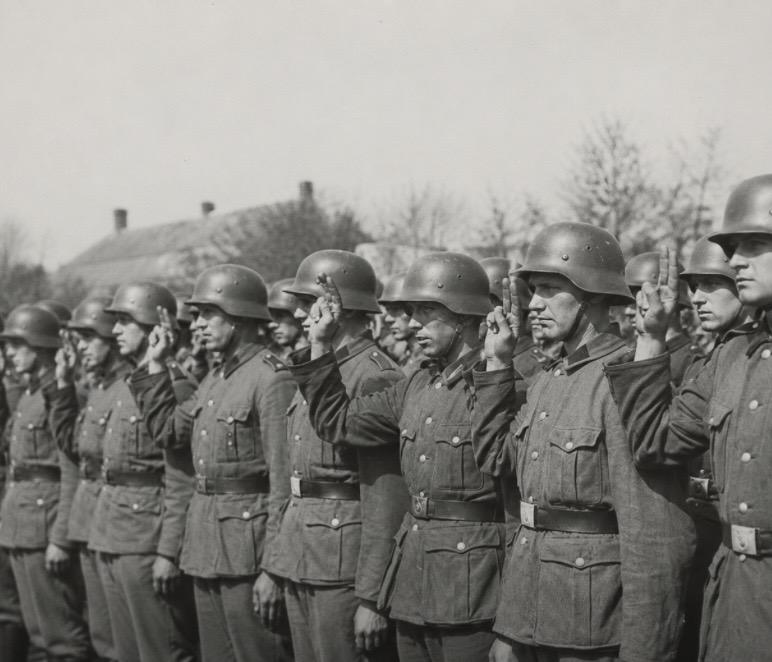
The Landstormers could sometimes find themselves facing other Dutchmen. The Princess Irene Brigade fought on the Allied side. It was made up of Dutch troops loyal to Queen Wilhelmina and the government in exile. This created an unusual situation. Dutch soldiers stood on both sides of the front. One group fought with the Allies to liberate the country. The other had sworn loyalty to Hitler and served the German occupation.
In November 1944, Landstorm Nederland was expanded into the SS Volunteer Grenadier Brigade Landstorm Nederland. More men were added from Dutch collaborationist organisations. Its numbers increased, but its military quality remained mixed. In February 1945, the formation received its final title. It became the 34th SS Volunteer Grenadier Division Landstorm Nederland. The title sounded more impressive than the unit really was. A normal German infantry division required thousands of trained men, artillery, transport, engineers and communication units. Landstorm Nederland had serious shortages in almost every area. It probably had around 6,000 men near the end of the war. This made it closer to a brigade than a full division. Many of its soldiers were only partly trained, and some of its sub-units existed mainly on paper.
This was common in the final months of the Third Reich. New divisions were created and given impressive names, even when the men and equipment were not available. The titles helped hide how weak the German armed forces had become. Discipline inside Landstorm Nederland also began to collapse. Some men remained committed National Socialists, but many understood that the war was lost. Desertion became a serious problem.
Leaving the unit was dangerous. The SS treated desertion as treason and could punish it with death. In March 1945, SS-Standartenführer Michael Lippert, commander of SS Volunteer Grenadier Regiment 83, uncovered a planned mutiny among men of Landstorm Nederland. Four of the men were executed on 9 March 1945.
By April 1945, British and Canadian forces were advancing through the eastern and northern Netherlands. German positions were breaking apart. Landstorm Nederland was used in the final attempts to stop the Allied advance. Its men fought in the area between the Veluwe and the IJsselmeer. They faced better-equipped Allied troops supported by tanks, artillery and aircraft. The Landstormers could delay the advance in some places, but they could not stop it. The division suffered losses and became increasingly disorganised. Some units continued fighting until the general German surrender in the Netherlands. Others broke apart before then.
For Dutch Waffen-SS men, surrender was more complicated than it was for ordinary German soldiers. They were not only enemy troops. In the eyes of most Dutch people, they were also collaborators and traitors. Some threw away their uniforms and tried to return home unnoticed. Others surrendered in organised groups. Many were placed in improvised prisoner camps together with NSB members, Landwachters, German troops and other collaborators.
Conditions in these camps were often poor. The Dutch authorities had to deal with large numbers of prisoners in a short time. Barracks, factories and even former stables were used as temporary detention centres. After the war, members of Landstorm Nederland were investigated by the Dutch authorities. Their sentences depended on their actions and the length of their service. Many former Landstormers received prison sentences. Some also lost their Dutch citizenship or civil rights.
Landstorm Nederland ended the war as a division in name, but never became one in practice. Its men had been recruited to defend the Netherlands, yet they fought under German command against the armies that came to liberate it. When the occupation collapsed, the unit disappeared with it, leaving its members to face imprisonment and the lasting charge of collaboration.
Credit: Tom Dankers, Historian - Arnhems Oorlogsmuseum 40-45