They won’t be Forgotten
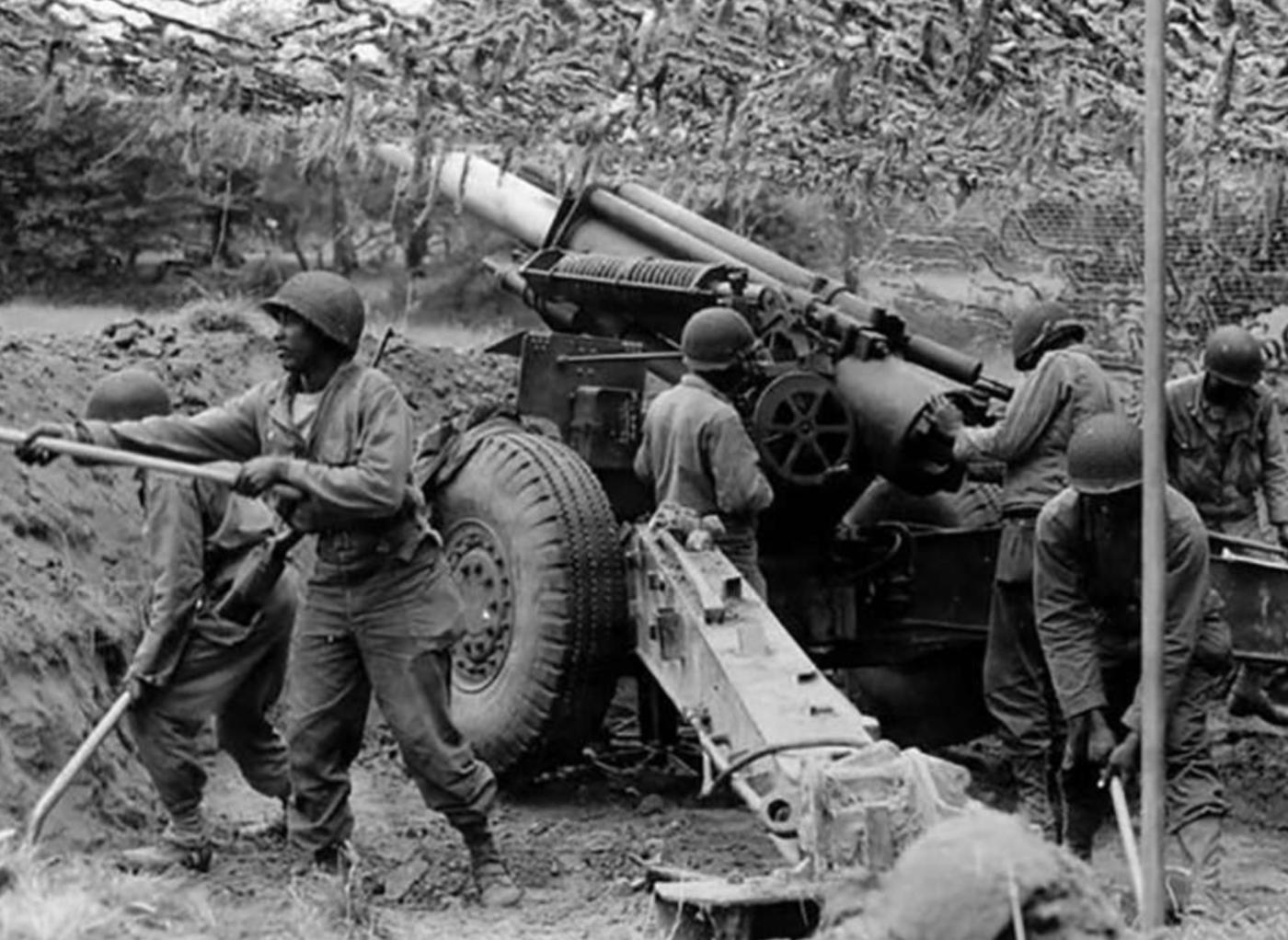
In December 1944, as the German Ardennes offensive exploded into what would become known as the Battle of the Bulge, a small group of Black American soldiers found themselves performing one of the most dangerous and least acknowledged tasks of the entire campaign. They were members of the 333rd Field Artillery Battalion, a segregated unit equipped with 155mm howitzers, ordered to hold their ground and provide covering fire for retreating American forces as German armor and infantry surged through the snow-covered forests of Belgium. Their mission was clear and brutally simple: slow the enemy advance long enough for others to escape, even if that meant isolation and near-certain capture.
The 333rd had already earned a reputation for discipline and technical skill. Many of its men were experienced artillerymen who understood the precision required to operate heavy howitzers in winter conditions, often under air attack and counter-battery fire. When German forces broke through American lines near St. Vith, several batteries of the 333rd were overrun or forced to withdraw. Eleven soldiers became separated from their unit during the chaotic retreat. Lightly armed, exhausted, and moving through deep snow, they attempted to evade capture and reach friendly lines.
On 17 December 1944, near the small Belgian village of Wereth, the eleven soldiers sought shelter at a farmhouse owned by the Langer family. They were hungry, cold, and already wounded from earlier fighting. Despite the enormous risk, the family offered them food and a place to rest. Within hours, their presence was discovered, either through betrayal or routine German patrol activity. Soldiers of the 1st SS Panzer Division Leibstandarte Adolf Hitler, the same formation responsible for the Malmedy massacre, arrived and took the Americans into custody.
What followed was not a lawful act of war, but a deliberate atrocity. The eleven soldiers were tortured and murdered in a field near the village. When their bodies were recovered weeks later, after the area was liberated, the evidence was unmistakable. Fingers were broken, likely to extract information. Bayonet wounds were visible. Some had been shot at close range. Others showed signs of blunt-force trauma. All had been stripped of boots and winter clothing, left to die in freezing conditions. Their names were Staff Sergeant Thomas Forte, Staff Sergeant Ruben Rivers, Sergeant James Aubrey, Private First Class George Davis, Private First Class Curtis Adams, Private First Class Mager Bradley, Private First Class Erwin Davis, Private First Class Nathaniel Moss, Private First Class James Luther, Private First Class Clyde Davis, and Private First Class Joe Ricks.
Despite the brutality of the crime, the massacre of the Wereth 11 received little attention in the immediate aftermath of the war. Unlike Malmedy, which involved white American prisoners and was publicized during war crimes trials, this atrocity was largely ignored. The investigation stalled. No SS personnel were ever prosecuted for the murders. In a segregated military and a nation still deeply divided by race, the deaths of eleven Black soldiers did not carry the political urgency required to demand justice. Their story was quietly filed away, mentioned briefly in reports, and then allowed to fade from official memory.
Yet their actions were anything but insignificant. By holding their positions and maintaining artillery fire under impossible conditions, the 333rd Field Artillery Battalion contributed directly to slowing the German advance toward critical road networks. Their sacrifice bought time for retreating infantry and armor units to regroup and establish defensive lines. In one of the coldest, bloodiest battles of the European war, these men fulfilled their duty with professionalism and courage, even though they served in an army that denied them equal treatment and recognition.
For decades, the story of the Wereth 11 survived only through local memory in Belgium and among a small number of historians and veterans’ families. It was not until the late twentieth and early twenty-first centuries that serious efforts were made to commemorate them. A modest memorial now stands near the site of their murder, maintained in part by Belgian citizens who refused to let the truth disappear. Their names are spoken there each year, not as victims alone, but as soldiers who stood their ground when it mattered most.
The attempt to forget these men reflects a broader pattern in history, where uncomfortable truths are buried in the hope that silence will erase responsibility. But memory has a way of resurfacing, especially when carried by those who believe that service and sacrifice must be honored regardless of race or politics. Writing these accounts is an act of resistance against that silence. It restores dignity to men who were denied it in death and reminds us that heroism is not defined by recognition, but by action.
This is exactly why our website is free to read and grounded in an ethos that insists legends live on. The story of the eleven soldiers of the 333rd Field Artillery Battalion is not a footnote to history, nor a tragic aside. It is a testament to courage under fire, loyalty in the face of abandonment, and the enduring power of remembrance. As long as their story is told, their memories endure, and their legacy remains unbroken.