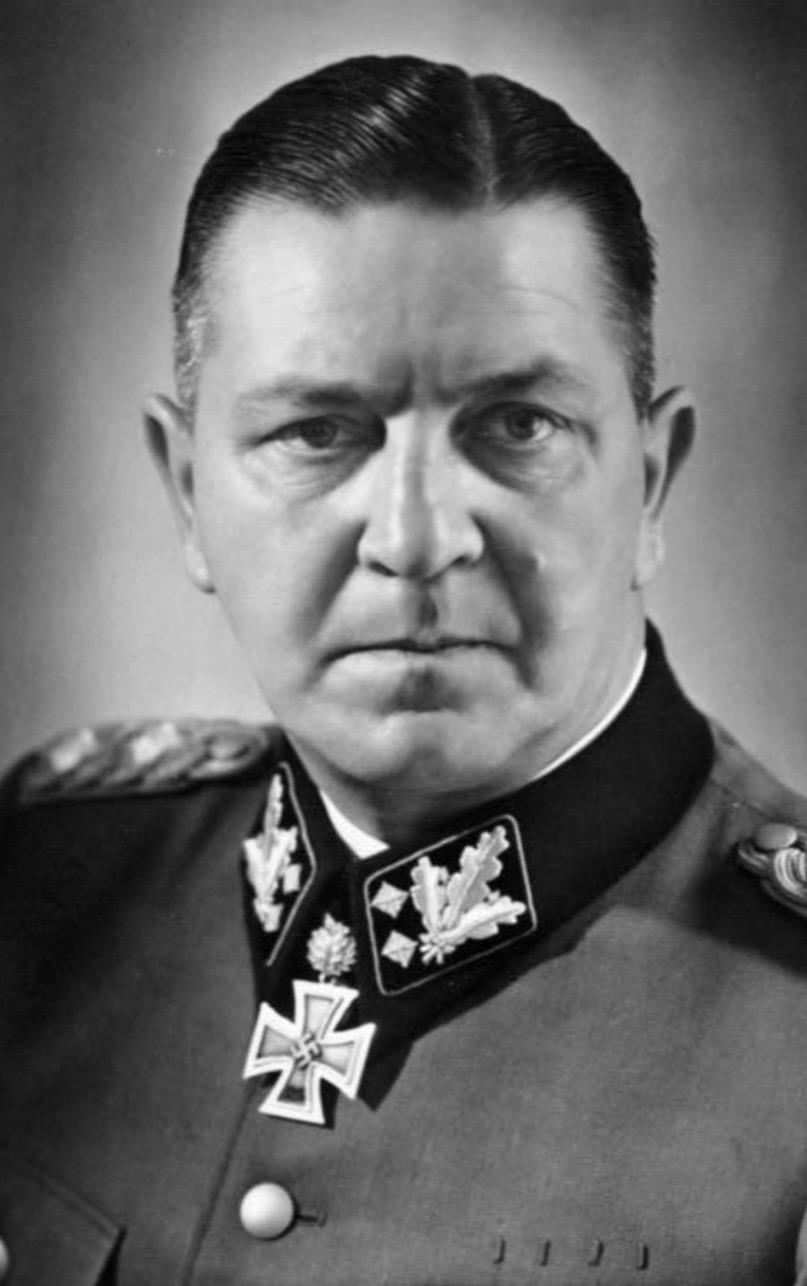
Theodore Eicke
Theodor Eicke was born on 17 October 1892 in Hudingen, a small town in Alsace-Lorraine, then part of the German Empire. He came from a modest background; his father worked as a station master, and the family had no significant political influence. His early life gave little indication of his later role. He struggled at school and left without completing higher education, limiting his early career options.
In 1909, he enlisted in the German Army, joining the Bavarian infantry. Military life provided structure and purpose. During the First World War, he served mainly in administrative and paymaster roles rather than distinguishing himself in frontline combat. Like many veterans, Germany’s defeat in 1918 and the instability that followed left him embittered and receptive to nationalist ideas.
After the war, he remained involved in military-related service, joining paramilitary groups and later the Bavarian police. These roles gave him experience in enforcement and internal security, though his rigid personality and extreme views led to conflicts with superiors and eventual dismissal. His political views became more radical during the late 1920s.
He joined the Nazi Party and soon became a member of the Schutzstaffel. His loyalty and ruthlessness gained the attention of Heinrich Himmler, who saw him as a reliable enforcer. Although there were setbacks, including a period in a psychiatric clinic amid internal SS disputes, his career recovered due to Himmler’s continued support.
In June 1933, he was appointed commandant of Dachau concentration camp. The camp was initially disorganized, but he imposed strict discipline, formal regulations, and a rigid command structure. Harsh punishments and absolute obedience became central features. These measures transformed Dachau into a model for the wider concentration camp system.
The administrative framework developed there was later applied across other camps, including systems of prisoner control and routine brutality enforced by SS guards. His methods combined bureaucratic efficiency with ideological extremism, making him a key figure in shaping the camp system.
His rise continued after involvement in the Night of the Long Knives in 1934, where he took part in the killing of Ernst Röhm. This demonstrated loyalty to Hitler and Himmler and secured further promotion. He was then appointed Inspector of Concentration Camps, overseeing their expansion and standardization across Germany.
It is important to note that he was no longer commandant of Dachau by the time Allied forces liberated the camp in April 1945. His career had shifted to frontline military command during the war. He became commander of the SS Totenkopf Division, a Waffen-SS unit formed largely from concentration camp guards, and served on the Eastern Front against the Soviet Union.
His life ended well before the liberation of Dachau. On 26 February 1943, during fighting near Kharkov in present-day Ukraine, his reconnaissance aircraft was shot down by Soviet forces. He was killed instantly. Because of this, he never faced capture, trial, or accountability in the way many other SS officials did after the war.
After the liberation of Dachau by American troops on 29 April 1945, investigations into the camp system exposed the structures and methods he had helped create. Although he was already dead, his role as an early architect of the concentration camp system was documented in postwar trials and historical records. His legacy remained tied to the system of repression and brutality that originated in places like Dachau and spread throughout Nazi-occupied Europe.