Spring Truncheons
The so-called “Gestapo spring truncheon” is a term commonly used by collectors and historians to describe a compact, spring-shaft baton associated with German police and security services during the period of Nazi Germany, particularly the 1930s and 1940s. Despite the name, there is little firm evidence that such truncheons were uniquely designed for or exclusively issued to the Gestapo. Rather, they appear to have been part of a broader category of expandable or flexible batons that were already in existence in Europe before the rise of the Third Reich, and which continued to be used in various forms by police and security personnel.
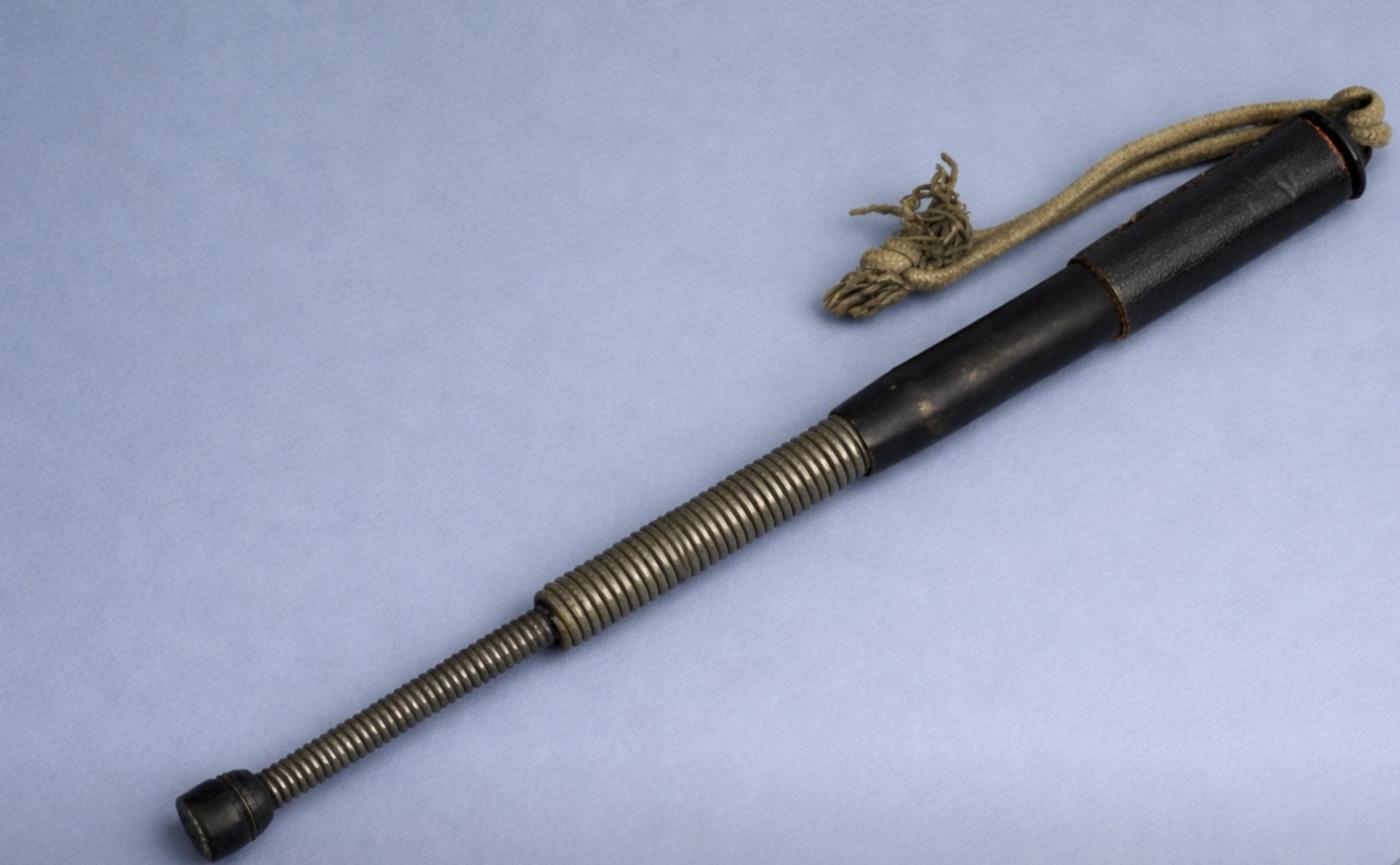
The design itself was not a German invention. Spring truncheons had already been developed in Britain and elsewhere in the late nineteenth century, emerging from industrial advances in steel production and precision engineering. These batons typically consisted of a weighted tip attached to a tightly wound steel spring, with a handle often made of metal or covered in leather. The spring allowed the weapon to flex slightly or extend, concentrating force at the tip while still being compact enough to conceal. German versions followed the same general principles, suggesting that they were either influenced by earlier European designs or directly adapted from them.
Manufacture of these truncheons in Germany was likely carried out by small arms makers, police equipment suppliers, and metalworking firms rather than a single centralized producer. Cities such as Solingen, long associated with blade and metal goods production, and other industrial centers would have had the capability to produce such items. However, unlike standard military equipment, these truncheons were rarely marked with official acceptance stamps, maker’s marks, or unit identifiers, which makes precise attribution difficult today. Surviving examples are often identified based on construction style, materials, and provenance rather than clear documentation.
In terms of use, these spring truncheons were most likely carried by plainclothes personnel, including members of the Gestapo, Kriminalpolizei (Kripo), and possibly Sicherheitsdienst (SD) operatives. Their compact and easily concealed nature made them suitable for officers who needed to operate without drawing attention. Uniformed police and military personnel generally relied on more standard and visible equipment. It is also possible that some of these truncheons were privately purchased rather than formally issued, as was common practice with certain types of personal equipment at the time.
As for their use within concentration camps, there is no strong, consistent documentary evidence that spring truncheons were standard or commonly issued to guards. The guards in these camps, primarily drawn from the SS-Totenkopfverbände, typically carried more conventional equipment such as wooden truncheons, rifle butts, or other readily available implements. However, given the wide variety of personal equipment used and the fact that some items were privately obtained, it cannot be entirely ruled out that individual guards may have possessed or used such spring batons on occasion. If they were present, they would have been incidental rather than part of any officially issued or standardized kit.
One of the reasons the term “Gestapo truncheon” persists is due to the association of these objects with the feared reputation of Nazi security services. After the war, Allied soldiers and civilians encountered such items among captured equipment and souvenirs, and the connection—whether accurate or assumed—became embedded in collector terminology. Over time, this label has been repeated in auctions, museums, and publications, even though definitive documentary proof linking a specific model exclusively to the Gestapo is limited.
There are also variations in construction that suggest different periods or manufacturers. Some examples have more robust springs and heavier heads, indicating a focus on delivering maximum impact, while others are lighter and more refined. Handles may be plain metal, knurled for grip, or covered in leather, and many include a wrist strap or lanyard to prevent loss during use. The overall appearance often reflects practical design rather than ceremonial or standardized military styling.