
Sterling Submachine Gun
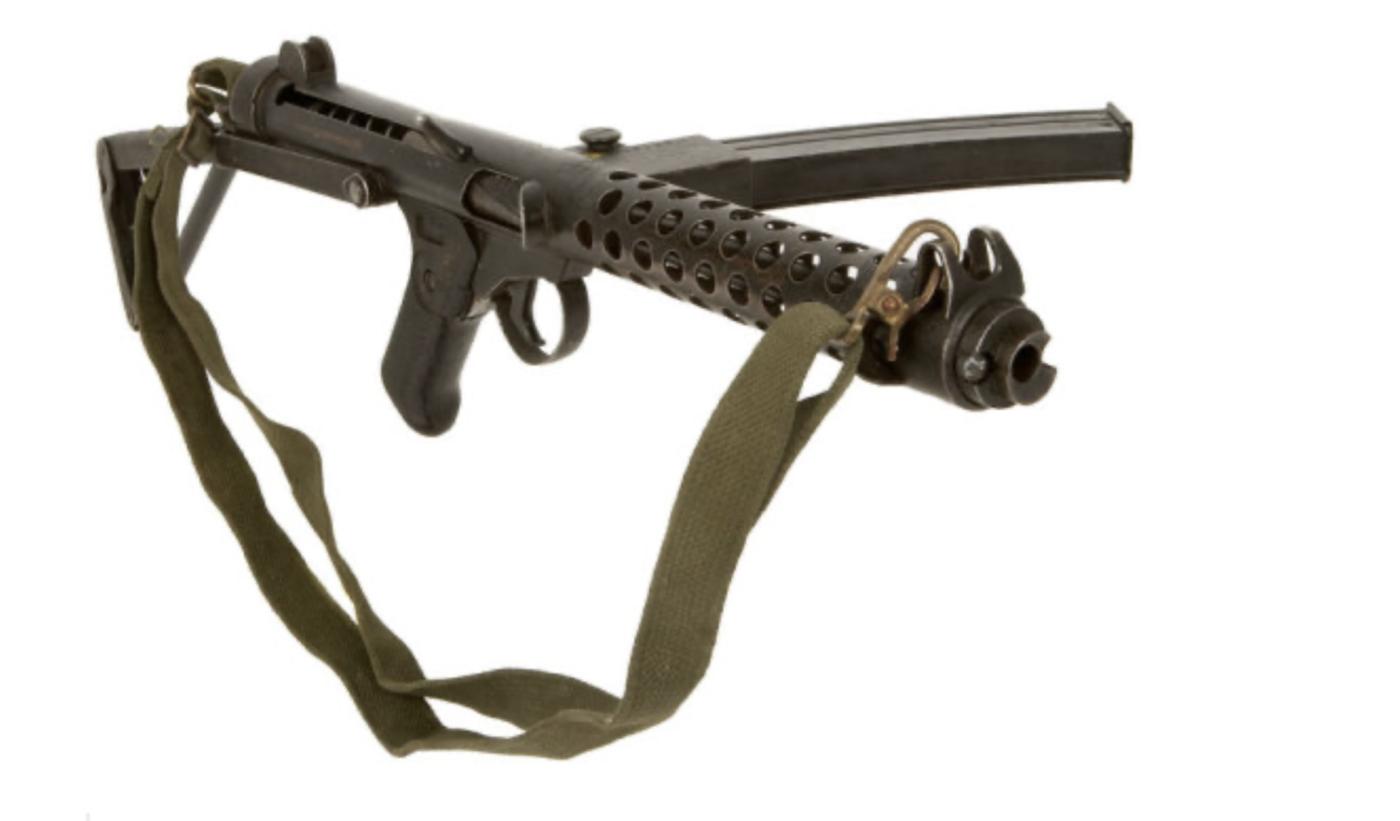
The Sterling submachine gun L2A3, commonly known as the Sterling Mk 4, was the final and most widely issued standard version of Britain’s Sterling family of 9×19mm submachine guns. It was designed to replace the wartime Sten and to correct many of the shortcomings that had become apparent during service in the Second World War. Entering British service in the early Cold War period, the L2A3 went on to serve for several decades and became one of the most recognisable British small arms of the second half of the twentieth century.
The origins of the Sterling lie in wartime efforts to find an improved successor to the Sten. In 1944 the British Army issued a requirement for a new submachine gun that retained the Sten’s simplicity and low production cost but offered greater reliability, durability, and soldier confidence. The design that emerged was developed by George William Patchett while he was working with what would later become the Sterling Armaments Company. Early versions were trialled during the closing stages of the war and immediately afterwards, often referred to in documentation as the Patchett machine carbine. Although the war ended before adoption, post-war trials continued as the British Army reassessed its infantry weapons in light of new strategic realities.
By the early 1950s the Patchett design had matured into an adopted service weapon, entering service as the L2A1. Incremental improvements followed, resulting in the L2A2 and finally the L2A3. The L2A3, also designated the Sterling Mk 4 in commercial and export contexts, became the definitive service pattern. It was this version that equipped most British units and many foreign users. The suppressed version, known as the L34A1, was developed separately for specialist roles, while the L2A3 remained the standard unsuppressed infantry and support weapon.
Manufacture of the L2A3 was carried out primarily by the Sterling Armaments Company at Dagenham in Essex, which handled the majority of production for British service and export contracts. Additional production for British military use was undertaken at the Royal Small Arms Factory Enfield, reflecting standard British practice of combining private industry with state arsenals for major service weapons. For overseas customers, the Sterling Mk 4 was also produced under licence in several countries, including India and Canada, extending its manufacturing footprint well beyond the United Kingdom.
Exact production figures are difficult to pin down with complete precision due to licensed manufacture and incomplete records, but historians generally estimate that well over 400,000 Sterling submachine guns of all variants were produced worldwide. Of these, the L2A3/Mk 4 accounted for the largest share, with British production alone running into the hundreds of thousands between the early 1950s and the late 1970s. When licensed foreign manufacture is included, total production may approach or exceed half a million weapons, making the Sterling one of the most widely produced British-designed submachine guns.
Mechanically, the L2A3 was an open-bolt, straight-blowback submachine gun chambered for the 9×19mm Parabellum cartridge. While this operating system was conventional, the Sterling’s designers paid close attention to the practical details that affected reliability in harsh conditions. The tubular steel receiver was robust and well finished by the standards of British service weapons, reflecting an intention to produce not merely a stopgap but a durable long-term arm.
One of the most distinctive technical features of the Sterling was its bolt. Machined with helical grooves along its exterior, the bolt was intended to reduce friction and help clear dirt and debris from the receiver during operation. This feature was frequently highlighted in official descriptions and later analyses, and it contributed to the Sterling’s reputation for reliability in muddy, sandy, and otherwise adverse environments. The recoil system, often described as a dual or concentric spring arrangement, further supported smooth operation and durability.
The magazine was another area where the Sterling represented a clear step forward from the Sten. The L2A3 used a curved 34-round magazine with a double-column, double-feed layout. This was a deliberate effort to address the feeding issues that had plagued the Sten’s magazine system. In service, the Sterling magazine was generally regarded as far more tolerant of dirt and rough handling, and it played a major role in improving overall confidence in the weapon.
In terms of handling, the L2A3 was designed to be compact and adaptable. It featured a metal under-folding stock that could be swung beneath the weapon when not in use, making it suitable for vehicle crews, airborne troops, and operations in confined spaces. When extended, the stock provided a stable shoulder platform that improved control during automatic fire. The sights were simple and rugged, typically providing settings for short- to medium-range engagement, consistent with the submachine gun’s intended role.
The Sterling’s rate of fire was moderate compared to many contemporary submachine guns, which helped with controllability and ammunition economy. This made it well suited to short, controlled bursts rather than long, wasteful streams of fire. Combined with its ergonomics, build quality, and improved magazine design, this characteristic contributed to the weapon’s generally positive reputation among those who used it.
In service, the L2A3 was issued across a wide range of British units, including the British Army, Royal Marines, and RAF Regiment. It saw use during the Cold War in numerous overseas deployments and internal security operations, and it was also widely exported, both directly from Britain and through licensed production abroad.
By the late twentieth century, changing doctrine and the widespread adoption of assault rifles firing intermediate cartridges led to the gradual withdrawal of the Sterling from front-line service. In British use, the L2A3 remained in service into the 1990s before being replaced by more modern weapons such as the SA80 family. Despite this, the Sterling Mk 4 left a strong legacy. It is often remembered as one of the most successful British submachine guns, combining wartime simplicity with post-war refinement, and standing in sharp contrast to the more improvised reputation of its Sten predecessor.