Stahlecker Report
By 31 January 1942, Einsatzgruppe A, one of the mobile killing units deployed by Nazi Germany in the occupied Soviet territories, formally reported that it had murdered 229,052 Jews. This figure appeared in a detailed internal document commonly known as the Stahlecker Report, named after the unit’s commander, Franz Walter Stahlecker. The report was submitted to senior leadership within the SS and the Nazi security apparatus and was intended to demonstrate the progress and “success” of mass killing operations in the Baltic states and parts of northern Russia following the German invasion of the Soviet Union in June 1941.
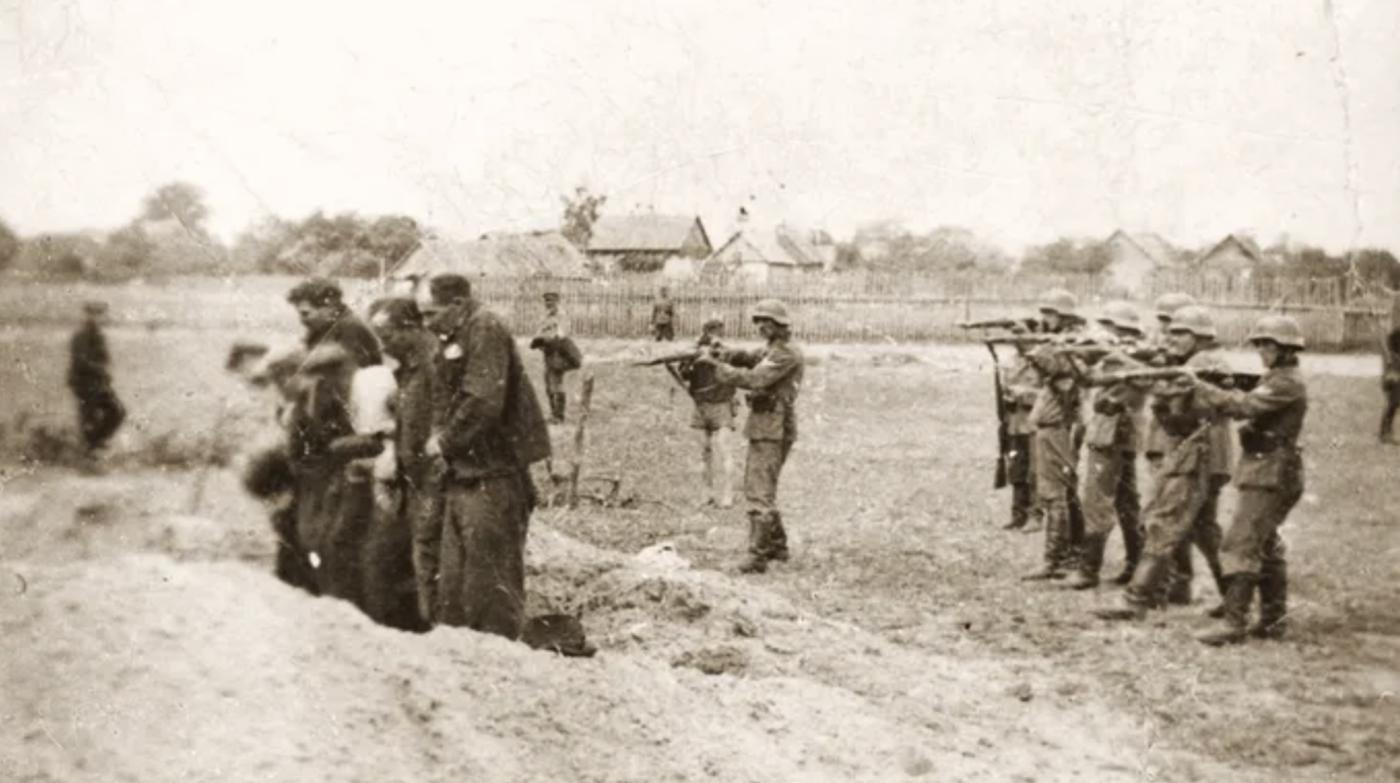
Einsatzgruppe A operated primarily in Lithuania, Latvia, and Estonia, as well as areas around Leningrad. It functioned under the authority of the SS and the Reich Security Main Office and worked closely with the German army, local police forces, and auxiliary units. The killings described in the report were carried out through mass shootings, typically conducted near forests, ravines, or pre-dug pits, rather than in extermination camps. Men, women, children, and the elderly were murdered in coordinated actions that often wiped out entire Jewish communities within days or weeks of German occupation.
The figure of 229,052 Jews murdered by 31 January 1942 is significant because it reflects how rapidly genocidal violence escalated in the months before the Wannsee Conference, which later formalized the bureaucratic coordination of what the Nazis called the “Final Solution.” Einsatzgruppe A began its operations in the summer of 1941, and the report shows that by the end of that year and into January 1942, the near-total destruction of Jewish life in the Baltic region had already been achieved. Estonia, for example, was declared “Judenfrei” in the report, meaning free of Jews, a chilling indicator of how complete the killings had become.
The report was written in a cold, statistical style that treated mass murder as an administrative task. Tables and summaries listed numbers of victims by location, offering no acknowledgment of individual lives. This bureaucratic language was deliberate. It served to normalize genocide within the Nazi command structure and to present mass killing as an expected and measurable outcome of policy. The inclusion of such precise figures also suggests that the killings were carefully tracked, contradicting later claims by perpetrators that the violence was chaotic or uncontrolled.
Another important aspect of the report is its emphasis on cooperation with local collaborators. Einsatzgruppe A described assistance from Lithuanian, Latvian, and Estonian auxiliary forces, particularly in the early stages of the killings. While German SS officers directed the operations, local units often participated in arrests, guarding, and executions. This collaboration was highlighted in the report as evidence of political reliability and ideological alignment, though it also reveals how Nazi occupation policies deliberately exploited local antisemitism and the collapse of civil authority.
The report also sheds light on the ideological motivations behind the killings. Jews were consistently described as enemies, partisans, or supporters of Bolshevism, reflecting the Nazi fusion of antisemitism and anti-communism. By framing Jewish civilians as security threats, Einsatzgruppe A sought to justify mass murder as a form of wartime necessity rather than racial extermination, even though the scale and targets of the violence make its genocidal intent unmistakable.
Historically, the Stahlecker Report is one of the most important documentary pieces of evidence for understanding the Holocaust by bullets, the phase of the genocide carried out primarily through mass shootings in Eastern Europe. It demonstrates that long before the gas chambers of Auschwitz reached their full operation, hundreds of thousands of Jews had already been systematically murdered. The report’s survival has allowed historians to reconstruct timelines, identify command responsibility, and counter denial by showing that the perpetrators themselves openly documented their crimes at the time.
After the war, documents like this were used in war crimes investigations and trials, including proceedings related to the SS and the Einsatzgruppen. Although Franz Walter Stahlecker himself was killed in combat in 1942 and never stood trial, the report bearing his name became a lasting testament to the scale, organization, and intent of Nazi mass murder. It remains one of the clearest examples of how genocide was embedded within administrative reporting structures, transforming extraordinary violence into routine paperwork while entire communities were erased.