Spetsnaz
Russian spetsnaz, short for spetsialnogo naznacheniya or “special purpose forces,” refers to a wide spectrum of elite units serving under the Russian military, intelligence services and internal security agencies. Rather than one unified organization, spetsnaz is a collection of specialized groups designed for missions beyond the capacity of conventional troops. Their heritage can be traced to World War II reconnaissance and partisan units, but the first modern spetsnaz units were formally created in 1949 under the GRU, the Soviet military intelligence directorate. Initially formed as small deep-reconnaissance companies, these units expanded into battalions by the late 1950s and into full brigades by the early 1960s as Cold War strategy increasingly relied on covert and unconventional operations.
Training for spetsnaz is famously demanding, covering weapons mastery, explosives, airborne operations including high-altitude jumps, combat diving, mountain warfare, camouflage, infiltration skills, survival training, tactical field medicine and intense physical conditioning. Stress-based tests are a major component, designed to build psychological resilience and decision-making under pressure.
Their exact numbers remain classified, but estimates often place the total strength of Russian spetsnaz at around 15,000 personnel across all agencies, including GRU military spetsnaz brigades, FSB counter-terrorism units, National Guard special forces and naval special warfare detachments.
A defining element of spetsnaz capability is the training infrastructure that supports them. The GRU’s principal training centre is located at Senezh near Solnechnogorsk, north of Moscow. This facility is one of Russia’s most secretive special forces centres and hosts advanced instruction for elite reconnaissance and direct-action teams. Another major spetsnaz base is at Kubinka-2, used historically for airborne-linked special operations units. The FSB’s Alpha and Vympel groups train primarily at a secure facility near Balashikha in the Moscow region, which includes urban-assault complexes, live-fire buildings and counter-terrorism simulation environments. Naval spetsnaz forces train at coastal bases such as the one near Ochamchira (historically during the Soviet period) and modern facilities in locations including Murmansk and Novorossiysk, where combat diving, underwater demolition, and amphibious infiltration skills are taught. Additional spetsnaz brigades are stationed in places like Tambov, Novosibirsk, Ussuriysk and Krasnodar, each with its own training ranges tailored to regional terrain such as forests, mountains or Arctic conditions.
Their missions include reconnaissance, deep-penetration infiltration, sabotage, disruption of communications and infrastructure, elimination or capture of high-value targets, intelligence gathering and precision raids. Domestically, spetsnaz units perform counter-terrorism, hostage rescue and anti-insurgency operations. They have been active in Afghanistan, the Chechen wars, the North Caucasus insurgency, Georgia, Crimea, Syria and Ukraine, among many other operations.
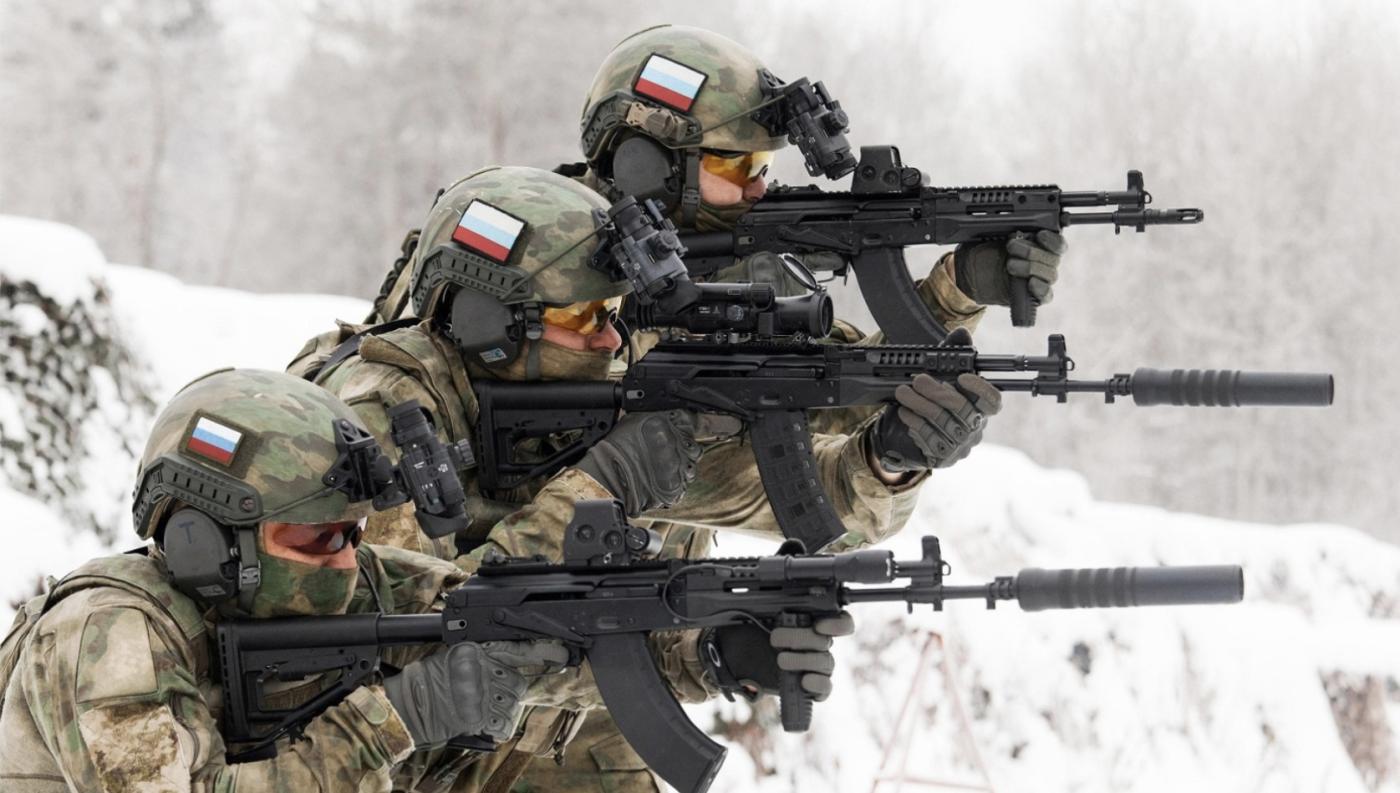
Spetsnaz weaponry is varied and chosen according to mission requirements. Common rifles include the AK-74M and AK-12, with certain units using the AK-103 or compact AK-S74U for close-quarters work. Suppressed rifles such as the AS Val and VSS Vintorez are iconic tools for stealth operations. Snipers use the SVD, the SV-98 and increasingly the modern Orsis T-5000 for long-range precision. Submachine guns like the PP-19 Bizon, PP-19-01 Vityaz and PP-2000 are favoured in urban counter-terrorism missions. Standard sidearms include the Makarov PM, the Yarygin PYa and the MP-443 Grach, with specialized units using additional niche pistols including underwater firearms for naval spetsnaz.
Spetsnaz forces remain a core component of Russia’s military and security structure, valued for their adaptability, unconventional capabilities and ability to conduct high-risk missions in politically sensitive or denied environments. Their mixture of varied weaponry, specialized training centres, harsh selection standards and broad mission spectrum has ensured their role as one of the most formidable special operations communities in the world.