Sling Shot
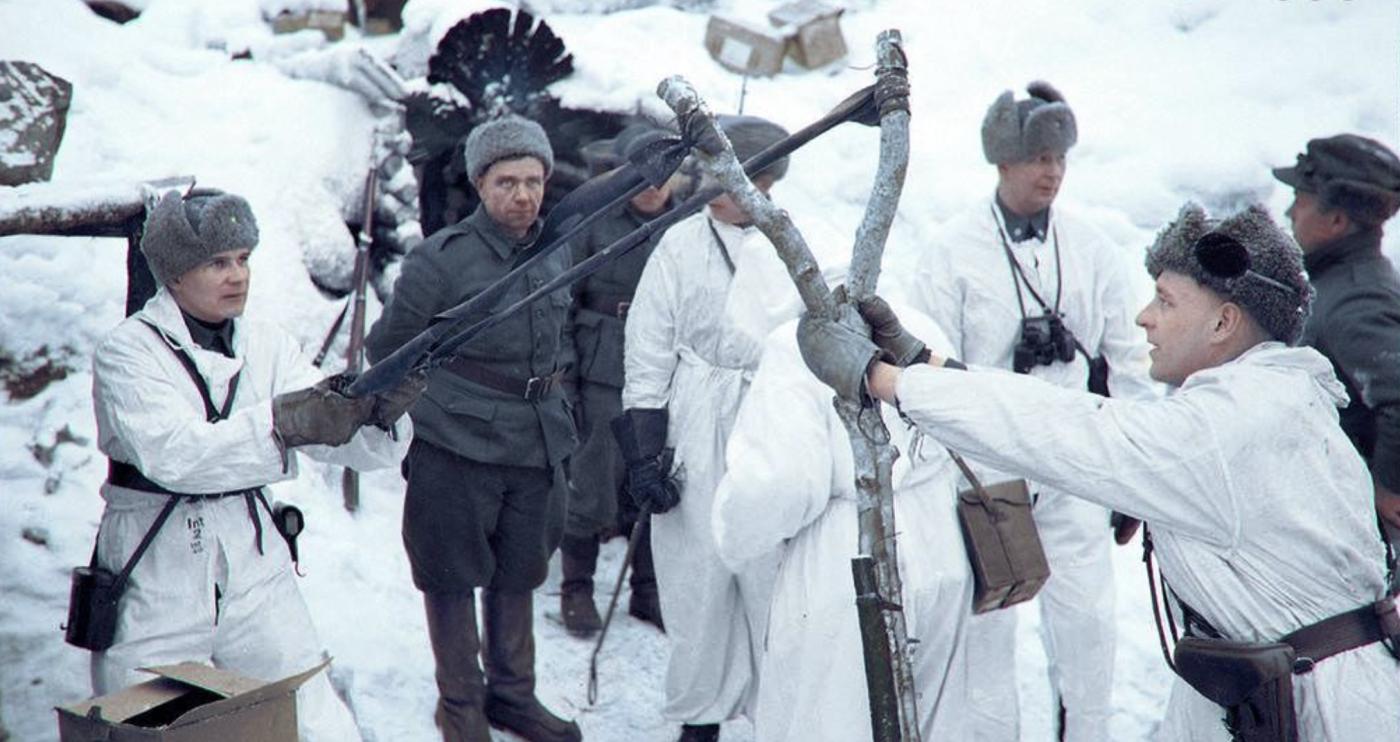
Finnish soldiers on the Winter War and Continuation War front were famous for making the best use of whatever they had, and one of the more curious pieces of battlefield improvisation was the small hand-powered slingshot used to lob hand grenades at Soviet positions. These devices were not children’s toys adapted for war so much as purpose-built field inventions: forked wooden frames, heavy rubber bands, leather pouches, and a knack for judging trajectory. They emerged from the practical challenge of getting explosives farther than a soldier could reasonably throw them, especially in deep snow, forest combat, and trench exchanges where exposing yourself for even a second could be fatal.
A typical Finnish stick grenade weighed significantly more than a standard stone or projectile, but with powerful bands scavenged from vehicle inner tubes or industrial rubber, the slingshot could launch a grenade in a high arc out to surprisingly useful distances. Accounts vary, but field reports suggest a range of roughly 40 to 70 meters was achievable in good conditions. That exceeded the average safe throwing distance of most soldiers, especially when wearing thick winter gear. The projectile traveled quietly, so the Soviets often didn’t notice it coming until the explosion. In close-quarters forest fighting, this gave Finns a psychological and tactical edge, letting them harass trenches, dugouts, or advancing infantry without giving away their positions.
These improvised launchers excelled in static or semi-static engagements where Finnish troops needed to send grenades over brush, snow berms, or hillocks. Their simplicity made them ideal: one could carve the frame in minutes, attach rubber bands, and be combat-ready. Ammunition was simply standard grenades, and there were always plenty of those. Using the slingshot also conserved rifle grenades and mortars for when heavier firepower was truly needed. Given the Finnish emphasis on mobility and economy of equipment, the little launcher fit perfectly into the guerrilla-style tactics used especially in the Winter War.
There was also a certain mischievous ingenuity to the weapon. Finnish soldiers joked about their “silent artillery,” and some even painted or decorated their slingshots. Because they produced no muzzle flash or smoke, they were excellent for night raids or harassment actions. In a war where temperature regularly dropped below –30°C, any device that required no metal mechanism—thus no risk of freezing—was inherently valuable. If the rubber stiffened, it could be warmed inside a coat for a few minutes and function again.
Though never an official weapon, the Finnish slingshot left an impression on those who witnessed it. It demonstrated how innovation isn’t always about engineering complexity; sometimes it comes down to understanding terrain, exploiting silence, and maximizing the simplest tools available. In a conflict filled with dramatic asymmetries, from manpower to mechanization, the Finns showed that even a humble wooden fork and a strip of rubber could become a small but effective equalizer.