Semovente 75/18
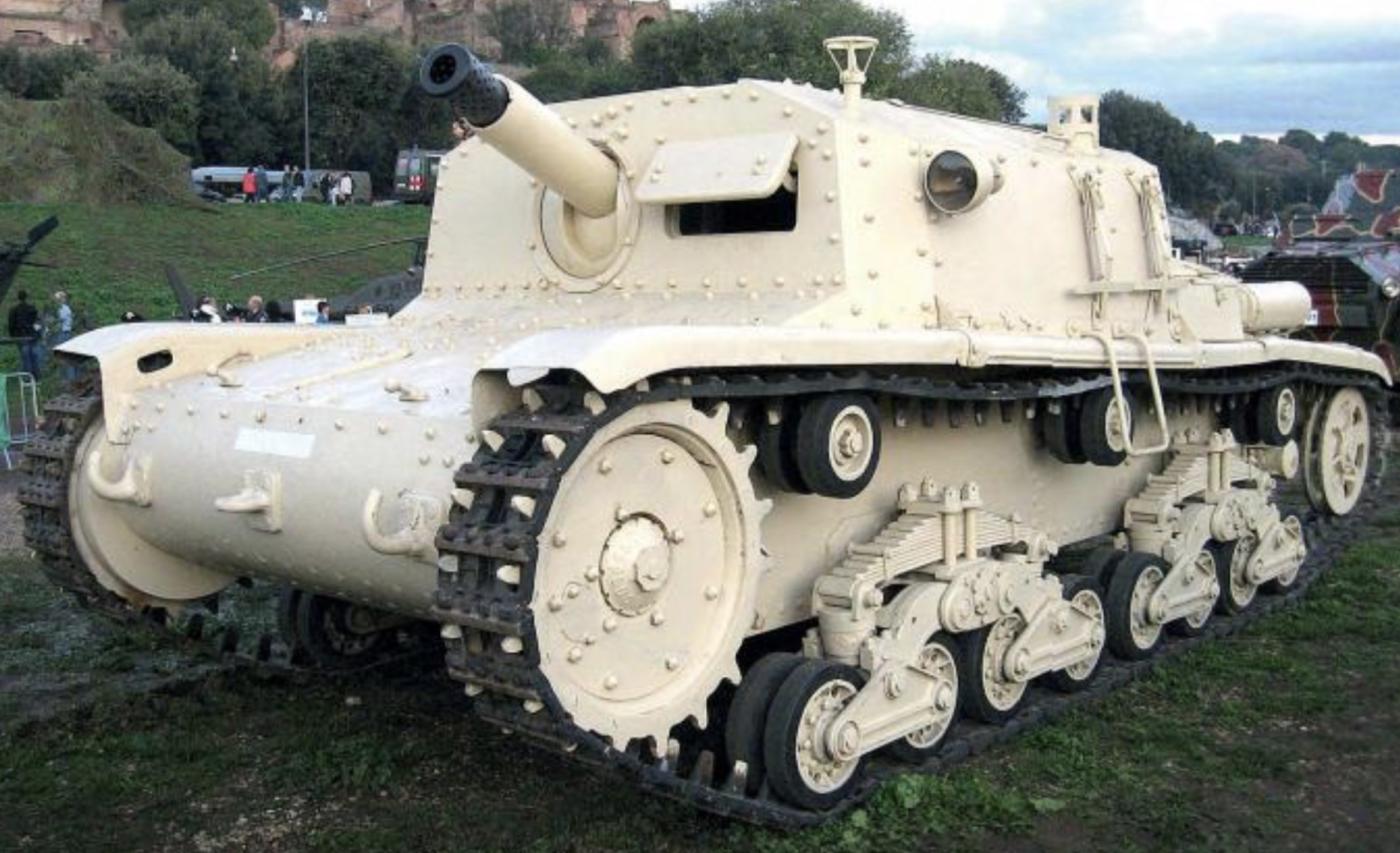
The Semovente 75/18 was the Italian armored vehicle the Allies came to respect—sometimes grudgingly—during the desert fighting, not because it was especially fast or heavily armored, but because it appeared at the right moments, delivered hard-hitting blows, and vanished again before British gunners could silence it. It emerged from Italy’s attempt to find an expedient answer to the growing inferiority of its medium tanks. The design work came from Ansaldo, the long-established Genoese engineering firm already responsible for most of the nation’s armored development, and its production was handled jointly by Ansaldo and Fiat. What they created was not a tank in the traditional sense but a low-silhouetted self-propelled gun mounting a 75 mm howitzer in a fixed casemate atop the M13/40 and later M14/41 tank chassis. It offered Italy’s armored units something they had lacked: a reliable mobile gun with enough punch to challenge British and later American armor.
The first prototypes appeared in 1941, and production ran until the 1943 armistice. Total numbers vary slightly between sources, but roughly 262 Semovente 75/18 vehicles were completed across all chassis variants, making it one of Italy’s most numerous armored fighting vehicles of the war. Its crew of three—a driver, a commander-gunner, and a loader—worked in close quarters within a steel box that was well sloped at the front but thin on the sides. With combat weight hovering around fourteen tons and a top speed in the neighborhood of twenty to twenty-five miles per hour depending on the engine model, it was never meant to charge across the desert like a cruiser tank. Its real value lay in what the 75 mm Obice da 75/18 gun could deliver.
The gun was originally a mountain howitzer adapted for armored use, firing a 75 mm high-explosive round with good fragmentation performance, but more importantly for armored duels, it could fire a shaped-charge round. This HEAT projectile, designated Effetto Pronto, was capable of penetrating roughly 70 to 80 mm of armor regardless of range because of its chemical design. That gave the Semovente a theoretical penetration edge over many early Allied tanks, allowing it to strike effectively even at distances where conventional armor-piercing rounds would have lost velocity and power. Its practical accurate range tended to be a few hundred meters against moving armor, although trained crews could and did engage at longer distances, particularly in defensive ambushes.
The fighting in North Africa showed the Semovente at its best. Italian armored formations had previously suffered from tanks that were generally outgunned and poorly protected, but the low silhouette and heavier punch of the 75/18 finally gave them a weapon capable of supporting both infantry and armor in a meaningful way. It was usually deployed in mixed groups with medium tanks, acting as a mobile gun line. Against Montgomery’s Eighth Army, Semoventes were often concealed in shallow hull-down positions, waiting for British armor to approach before unleashing sudden volleys of HEAT shells. Crews learned to use the desert’s folds and ridges to maximum advantage, popping up to fire and then backing away under cover before British gunners could fix their position. Reports from British tank crews frequently described the surprise of being hit by what they initially assumed to be German assault guns, only to find that the source was Italian.
Though it could not match the armor thickness or overall firepower of the German StuG III, the Semovente 75/18 shared the same basic tactical concept and proved surprisingly resilient when handled by experienced crews. It was also mechanically simpler and generally more dependable than Italy’s turreted tanks, a fact appreciated by units fighting in sand and heat. Some German units received Semoventes after the Italian armistice and continued to use them in 1944, a testament to their practicality.
In many ways, the Semovente 75/18 marked the moment when Italian armored doctrine briefly aligned with battlefield reality. It offered stable firepower, decent mobility, and an effective anti-tank capability at a time when Italian forces desperately needed all three. Despite its modest numbers and the limitations of the chassis it rode upon, it carved out a reputation strong enough that Allied crews learned to treat any low Italian vehicle silhouette with caution. For an expedient design created in a hurry, it became one of Italy’s most successful armored vehicles of the entire war.