SD KFZ 254 armoured vehicle
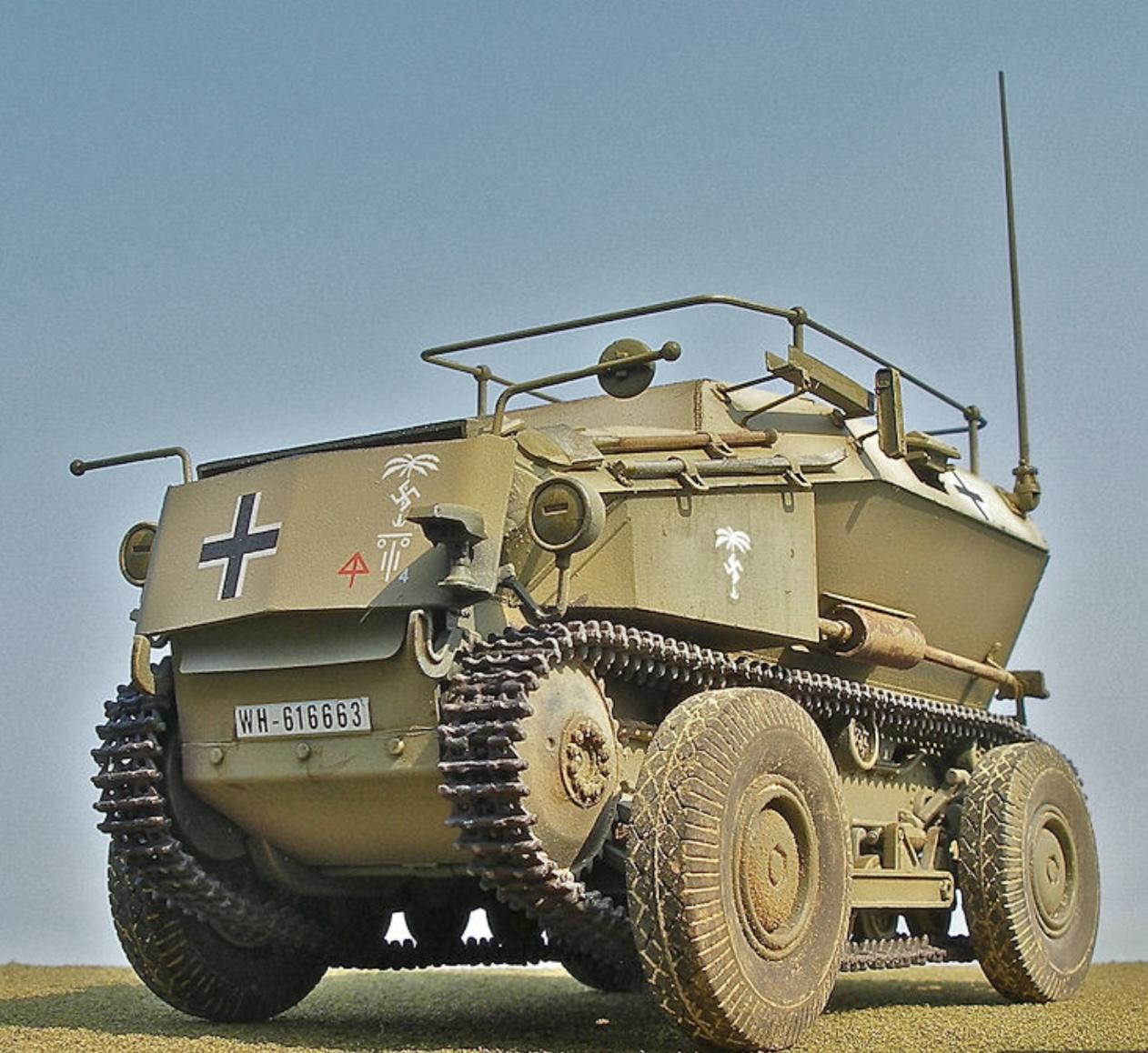
The Mittlerer Gepanzerter Beobachtungskraftwagen Sd.Kfz. 254 was one of the most unusual armoured vehicles fielded by Germany in the Second World War. It combined a fully tracked running system with four retractable road wheels, allowing the crew to switch between tracks for cross-country mobility and wheels for rapid movement on firm roads. This dual-mode design was highly unconventional and reflected its origin not in Germany, but in pre-war Austria.
In 1936 the Austrian subsidiary of Saurer, based in Graz, began developing a compact fully tracked artillery tractor for the Austrian Bundesheer, designated RR-7. By 1937 testing had shown the design to be promising, and in 1938 the first production examples appeared. The concept was innovative: Saurer’s engineers created a short tracked chassis and added four large pneumatic wheels mounted outside the track run. When stationary, the driver could raise or lower these wheels using a powered mechanism linked to the transmission. When lowered, the vehicle ran as a wheeled armoured car with its tracks lifted clear of the ground, reducing track wear and allowing much higher road speeds. When raised, the vehicle behaved like a conventional tracked tractor, ideal for mud, snow or soft terrain.
After the German annexation of Austria in 1938, the Wehrmacht absorbed the RR-7 project. Only a handful of the unarmoured tractors had been built, and German ordnance planners decided to preserve the design. Requirements shifted several times, but eventually the chassis was adapted into a fully enclosed armoured artillery observation and radio vehicle. This new form received the designation Sd.Kfz. 254. Production remained with Saurer in Austria, and the total number built was small. Most modern estimates place the figure at around 140 vehicles, including both the early RR-7 chassis and the later armoured Sd.Kfz. 254 models.
The Sd.Kfz. 254 was issued mainly to Panzer division artillery regiments as a mobile platform for forward observers. It also served in reconnaissance roles when required. Several examples were deployed to North Africa with the Afrika Korps from 1941, while others served on the Eastern Front and in European theatres with formations such as 7th and 20th Panzer Divisions. Its endurance and ability to transition between wheels and tracks made it particularly useful in fast-moving, wide-open environments.
On wheels, the vehicle could reach speeds of roughly 60 km/h and had an impressive operational range of around 500 km, unusually high for an armoured vehicle of its class. When ground conditions deteriorated, the wheels were retracted and the tracks engaged, allowing it to traverse terrain that would halt normal wheeled cars. This flexibility made the Sd.Kfz. 254 something of a hybrid between a half-track, a light tank, and an armoured car.
Armor protection ranged from about 6 to 15 mm, sufficient for defence against small-arms fire and shell splinters but not anti-tank weapons. The welded armour plates formed an angular hull with a sharply sloped glacis and a faceted superstructure, along with large rear doors for crew entry and equipment access. The vehicle typically carried a crew of seven: driver, co-driver, commander, radio operator, and several observers or map-readers. The rear compartment held long-range radio sets such as the FuG 8, usually identifiable by a distinctive frame antenna around the roofline, paired with shorter-range sets depending on the mission.
Firepower was minimal because the Sd.Kfz. 254 was not intended to fight directly. Most vehicles mounted only a single 7.92 mm MG34 for self-defence, usually positioned on a pintle mount near a forward hatch. Observation instruments, rangefinders and map tables were more important than weapons, as the vehicle’s key mission was to coordinate artillery fire rather than engage in combat.
An interesting detail of the design is that the wheel-track system was mechanically complex and required careful maintenance. Crews often reported that switching modes was reliable but demanded regular lubrication and inspection. The vehicle’s silhouette, with wheels tucked outside the track guards, was distinctive and made the Sd.Kfz. 254 stand out even among the diverse equipment of early-war German forces. Although produced in small numbers, it demonstrated a creative attempt to merge wheeled and tracked mobility in a single reconnaissance and observation platform—an idea that, while not widely adopted later, showed remarkable engineering ambition for its time.