
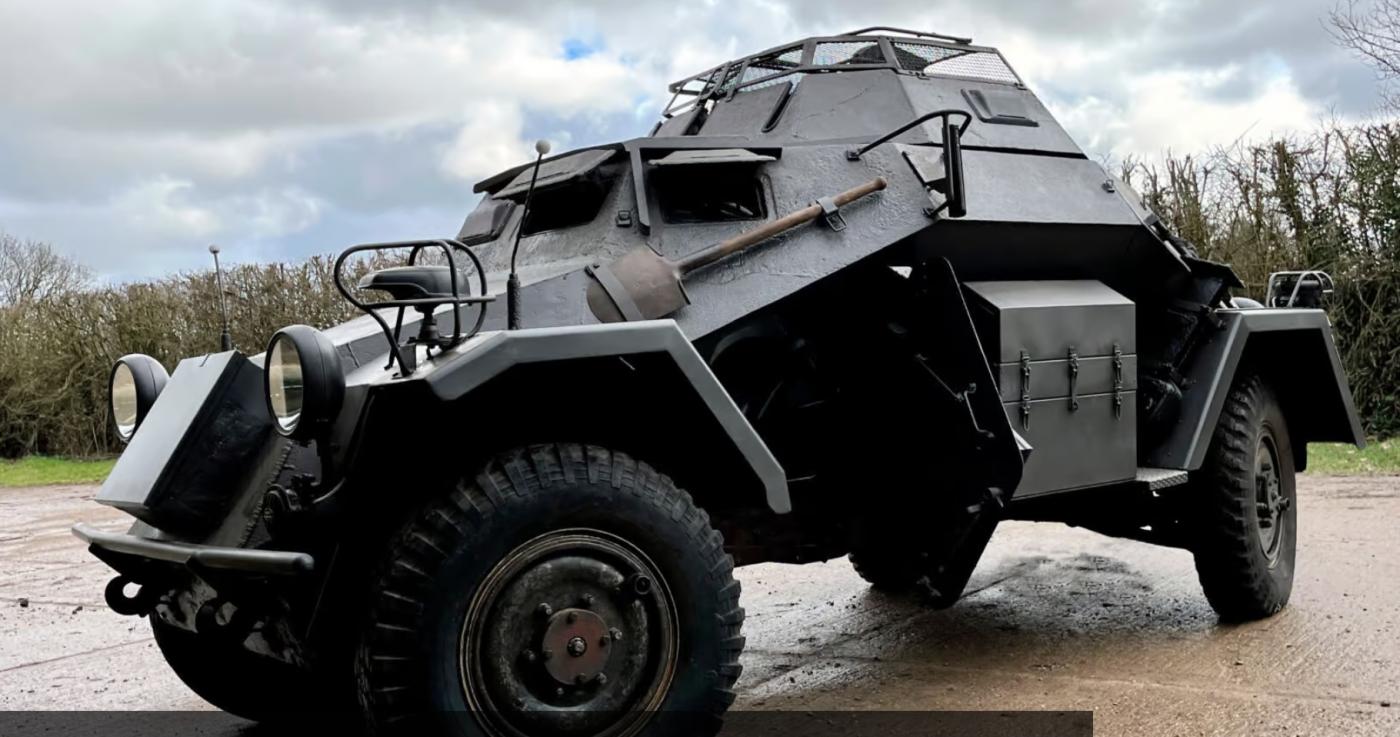
SD KFZ 222 armoured car
The Sd.Kfz.222, officially designated Leichter Panzerspähwagen (2 cm), was a German World War II light armored reconnaissance car developed to give frontline units a fast, mobile platform for scouting, security duties, and screening advances. Its design originated in the early 1930s as the Wehrmacht sought modern wheeled armored vehicles to replace improvised First World War–era scout cars. Development was carried out primarily by Horch, a member of Auto Union, which also produced most of the chassis components. Final assembly was handled by Horch and other Auto Union plants in Zwickau, with some subcontracting to associated factories as wartime needs increased.
Production began in 1936 and ran until 1943. Across all batches, approximately 990 to just over 1,000 Sd.Kfz.222 vehicles were built, a relatively modest number compared to tanks but significant for a specialized reconnaissance platform. They served with reconnaissance battalions on every major front: Poland, France, North Africa, the Balkans, the Soviet Union, and later in defensive operations across Europe.
The Sd.Kfz.222 used the Horch Type 801 chassis, a 4×4 system giving it better off-road mobility than many contemporary armored cars. Steering on both axles improved maneuverability, and independent suspension helped it traverse rough ground at speed. It had a top speed of roughly 80 km/h (50 mph) on roads and a cruising range of about 300 km (186 mi), making it ideal for fast-moving reconnaissance work. Armor thickness ranged from 5 to 14.5 mm—enough to stop small-arms fire and shell fragments but not designed for direct combat with enemy armor.
Its most recognizable feature was its small open-top hexagonal turret fitted with mesh anti-grenade screens. The main weapon was a 2 cm KwK 30 L/55 autocannon, later upgraded in some vehicles to the KwK 38 version with a higher rate of fire. This was paired with a coaxial 7.92 mm MG 34 machine gun. The 20 mm cannon gave it enough firepower to suppress infantry, engage light vehicles, and deter enemy scouts, though it was not suited to fighting tanks. Ammunition storage varied by production series but usually included around 180 rounds of 20 mm ammunition and several thousand rounds for the machine gun.
The crew typically consisted of three men: a driver, a radio operator/loader, and a commander who also served as the gunner. Early models lacked a proper long-range radio, which limited reconnaissance effectiveness; later versions incorporated improved communication equipment such as the FuG 5 radio set.
One interesting aspect of the vehicle’s evolution was its adaptation to specific theaters. In North Africa, for example, dust and heat caused significant mechanical strain, leading to modified air-filters and engine cooling systems. The open-topped turret, while providing excellent visibility, exposed the crew to weather, small-arms fire from elevated positions, and shrapnel. Despite these drawbacks, the Sd.Kfz.222 remained popular with crews because of its speed, reliability, and good field of view—critical for a scout vehicle.
Although eventually overshadowed by more advanced armored cars such as the Sd.Kfz.234 series, the Sd.Kfz.222 played an important role throughout the early and middle years of the war.