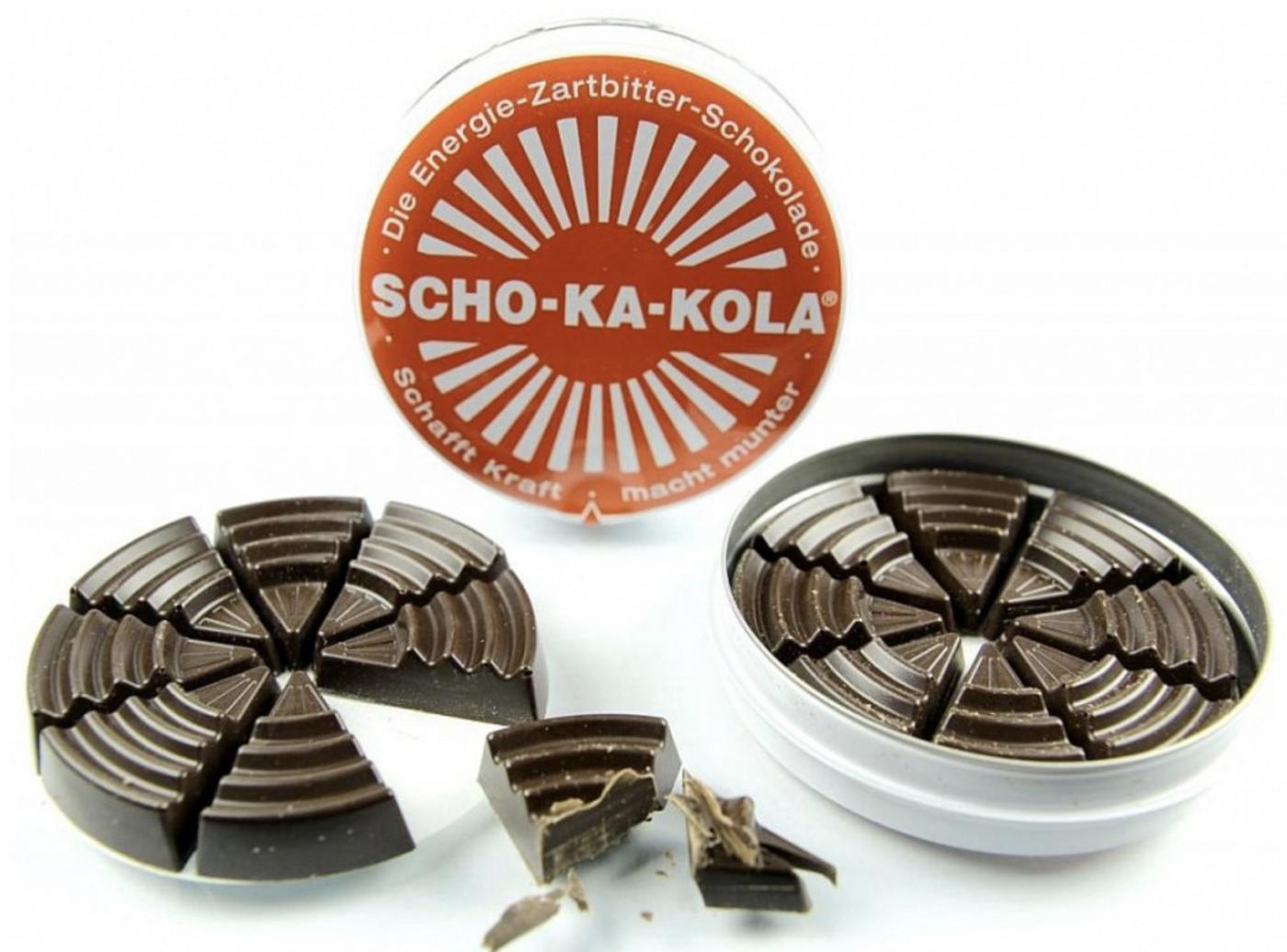
Scho-Ka-Kola
German military chocolate in the Second World War was far more than a simple treat. It played a practical role in keeping soldiers awake, energised, and in better spirits during long and exhausting operations. The most famous chocolate of all was Scho-Ka-Kola, a brand that became deeply woven into the daily life of the German armed forces.
The story of Scho-Ka-Kola began in 1935, when the Hildebrand company in Berlin set out to create a new kind of performance food. Inspired by Germany’s growing interest in caffeinated products for athletes and aviators, they experimented with combining cocoa, roasted coffee, and kola nut extract. The result was a dark, slightly bitter chocolate that delivered a steady boost of energy. Its name came from its key ingredients: Schokolade, Kaffee, and Kola.
This new chocolate was packaged in distinctive round tins, each containing triangular pieces rich in cocoa mass, sugar, coffee extract, kola nut powder, cocoa butter, and a hint of vanilla. Thanks to the kola nut and coffee content, one full tin carried the caffeine punch of about two strong cups of coffee. Even before the war began, the Luftwaffe had taken notice of this unusual stimulant food.
When war broke out in 1939, demand for Scho-Ka-Kola surged. Hildebrand alone could no longer supply the quantities needed, so several other confectionery firms were brought in to help manufacture it under military direction. Production centres around Berlin supplied the Luftwaffe, the Kriegsmarine, and various Wehrmacht units, with priority going to roles where alertness meant survival.
Nowhere was this chocolate more appreciated than in the German navy. Life on a U-boat was brutally demanding: stale air, constant noise, little sleep, and endless hours on watch. Scho-Ka-Kola became a quiet companion during nerve-wracking patrols. Crews kept it stored in tight compartments, and officers often handed it out during long night shifts or during difficult manoeuvres on the surface. Its long shelf life and compact size made it ideal for submarine conditions, where every inch of space was precious.
The Luftwaffe embraced it just as eagerly. Pilots carried tins in their flight bags for long missions, while ground crews relied on it during late-night maintenance work. The Wehrmacht also issued it as part of special or emergency rations, particularly during winter operations or long marches.
Although wartime supply problems meant that availability varied, surviving accounts give us a sense of how much was normally consumed. A frontline soldier might receive one or two tins a week when supply chains were functioning well. Luftwaffe pilots often had access to two or three tins weekly because of the demands of air operations. U-boat crews typically stowed 20 to 30 tins per patrol for around 40 to 50 men, giving each sailor roughly one tin per week.
Alongside Scho-Ka-Kola, the military also distributed plainer chocolate bars made by companies like Stollwerck and Sarotti. These had no special stimulants and were valued mostly as a calorie-dense morale boost.
Several interesting facts surround this unique chocolate. Before and during the war it was marketed to civilians as a product that improved focus and mental performance, making it popular with drivers and students. Its famous sunburst red-and-white tin became a recognisable symbol of energy and alertness. On the front lines, it was prized enough to be used as a barter item, especially on the Eastern Front. Allied soldiers often kept captured tins as souvenirs, intrigued by both its flavour and its stimulating effect. Remarkably, Scho-Ka-Kola is still produced today in nearly its original form, making it one of the few wartime rations that survived into modern times.