Schiessbecher grenade launcher
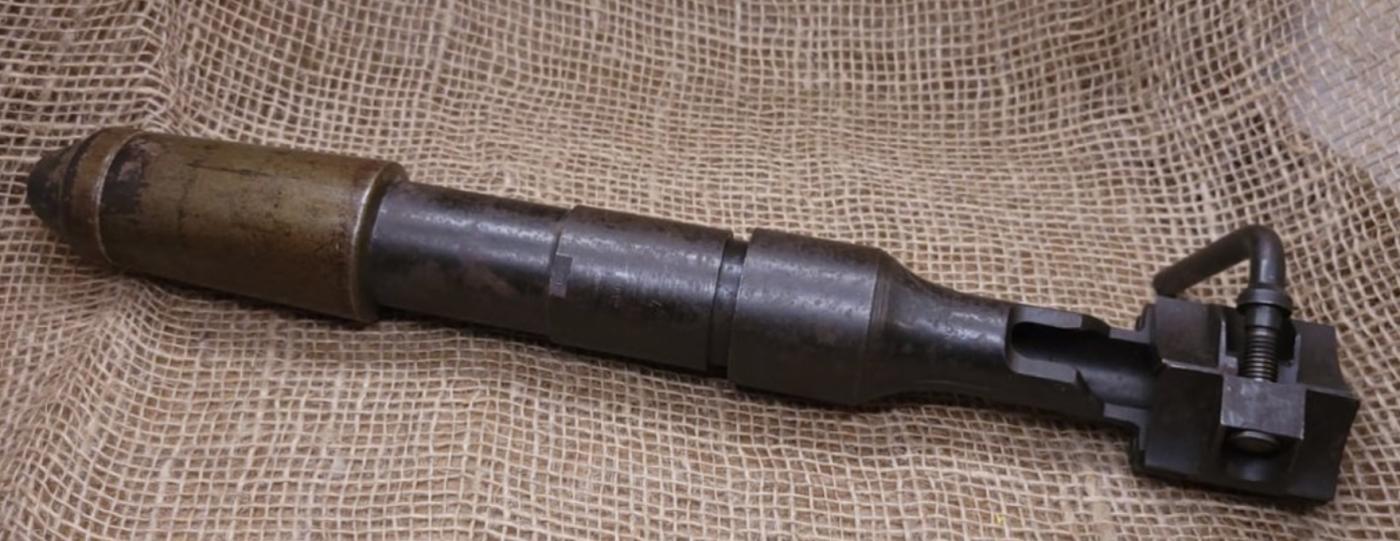
The Schießbecher, known to Allied intelligence simply as the German rifle grenade launcher, was one of the more adaptable close-support tools used by German infantry during the Second World War. It appeared as a small, cup-shaped device clamped to the muzzle of a standard service rifle, most commonly the Karabiner 98k, although it could also be fitted to earlier Gew 98 variants and even to some semiautomatic rifles like the G43. Its name literally meant “shooting cup,” and that was almost exactly what it was: a carefully engineered steel cup, rifled on the inside, into which a variety of specialized grenades could be seated and launched with a dedicated blank cartridge.
The design work stemmed from pre-war experiments within the Heereswaffenamt, where German ordnance specialists studied lessons from the First World War and sought to create a more precise and mechanically reliable rifle grenade system. The final form of the Schießbecher was completed around 1942, developed largely under the technical direction of engineers working within the Polte and Hasag networks, although the actual manufacturing effort was spread across several firms to meet wartime demand. Companies such as Rheinmetall-Borsig, Steyr-Daimler-Puch, and the Berlin-Lübecker Maschinenfabrik produced significant batches of the launchers and their associated sighting equipment. By the war’s midpoint, roughly one and a half million units had been manufactured, a number large enough that even late-war Volksgrenadier formations frequently received them.
The launcher itself was a 30 mm cup, about 14.5 cm long, weighing just under 750 grams, and fitted by means of a collar and clamp to the rifle muzzle. A quadrant sight, adjustable for ranges between 25 and 250 meters, was usually issued with it. Launching was done with a special blank 7.92×57 mm Patrone 30 cartridge, designed to burn at a specific rate so as not to shatter the grenade or the cup.
The grenades fired from the Schießbecher came in several types, each with a distinct purpose. The standard general-purpose explosive grenade, the Gewehr-Sprenggranate, was made of a steel body containing a high-explosive filling—most often a TNT or amatol mixture—fitted with a nose impact fuze designed to detonate on contact with a solid surface. There was also an anti-tank rifle grenade, the Gewehr-Panzergranate, which employed a shaped-charge warhead capable of penetrating around 70 to 80 mm of armor under ideal conditions, though its real-world effectiveness was often less due to the difficulty of achieving the proper angle of impact. In addition, there were smoke grenades, signal grenades, and even small anti-personnel fragmentation types, each designed to be as lightweight as possible while still surviving the violent acceleration of launch.
The effective range varied with the model, but most explosive grenades could be lobbed between 70 and 150 meters with useful accuracy; the lightest types could reach roughly 250 meters under optimal conditions, though hitting anything at that distance required considerable skill. The shaped-charge anti-tank grenades were usually fired at much shorter distances, sometimes as little as 30 to 70 meters, because accuracy and impact angle mattered far more than range.
Despite its modest appearance, the Schießbecher gave an ordinary rifleman a surprising level of firepower, bridging the gap between hand grenades and heavier infantry weapons. It could put an explosive charge onto a rooftop, behind a wall, or into a trench without exposing the soldier who fired it. Its main drawback was the time required to clamp it on, adjust the sight, and load the special cartridge and grenade—steps that made it more deliberate and less instinctive than simply throwing a grenade. But in defensive positions or planned attacks, its versatility made it a valued tool throughout the war.
By 1944 and 1945, the Germans increasingly shifted toward simpler, cheaper anti-tank weapons like the Panzerfaust, which required no aiming sights, no special cartridges, and no rifle. Even so, the Schießbecher continued in service to the end, its millions of units still circulating through the shrinking ranks of the Wehrmacht. As a piece of wartime engineering, it reflected Germany’s preference for precise, adaptable devices that squeezed as much capability as possible out of familiar equipment, turning a standard rifle into a miniature launcher capable of delivering a remarkable variety of munitions when the infantry needed it most.