
Russian Spade Mortar
The Soviet spade mortar of the Second World War was one of those strange weapons that could only have come from a moment of desperation, invention and hard battlefield need. Officially known as the 37 mm VM-37 mortar-spade, it was an attempt to give the ordinary Red Army infantryman something more than a rifle, bayonet, grenade and entrenching tool. It was meant to be both a small shovel for digging cover and a light mortar for throwing explosive bombs at an enemy position. On paper it was clever. In the mud, snow and chaos of the Eastern Front, it proved far less successful.
The idea behind the weapon was simple enough. A soldier already carried a small entrenching spade, and the Red Army badly needed more light firepower at the lowest level of infantry fighting. If the handle of the spade could be made into a mortar barrel, and the blade of the spade could become the base plate, then every rifleman, or at least selected men in a platoon, could carry a tiny artillery weapon without adding a full mortar team. It was an idea born from the brutal reality of 1941, when the Soviet Union had been invaded by Germany and the Red Army was being forced to improvise, simplify and produce weapons at incredible speed.
The VM-37 was developed during the summer of 1941 by NII-13, a Soviet research institute under the People’s Commissariat of Armaments. It is sometimes linked with the famous Soviet weapons designer Mikhail Grigorievich Dyakonov, who had earlier worked on grenade-launching weapons, and some older descriptions call it a “Dyakonov system” mortar-spade. However, the wartime VM-37 that reached troops is more safely described as an NII-13 design rather than the work of one clearly documented individual designer. It was accepted into service on 3 September 1941, showing just how quickly the Soviet authorities were willing to move when they thought a weapon might help stop the German advance.
Manufacture was ordered through the Soviet state armaments system rather than by a commercial company in the Western sense. The design was intended for rapid production, using a simple steel tube for the barrel, a shovel blade that doubled as the base plate, a small support leg or bipod, and purpose-made 37 mm bombs. The exact factory-by-factory production story is not as clearly recorded as it is for more famous Soviet weapons such as the PPSh submachine gun or the 82 mm mortar, but it was produced under wartime state orders for the Red Army. The original intention was extremely ambitious. Soviet orders called for 10,000 examples to be supplied very quickly, with output then rising dramatically, and plans existed for hundreds of thousands of weapons and millions of rounds. In reality, the project failed before anything like those numbers could be achieved. Most accounts give total production at roughly 15,000 to 15,500 mortars, with large stocks of ammunition also produced.
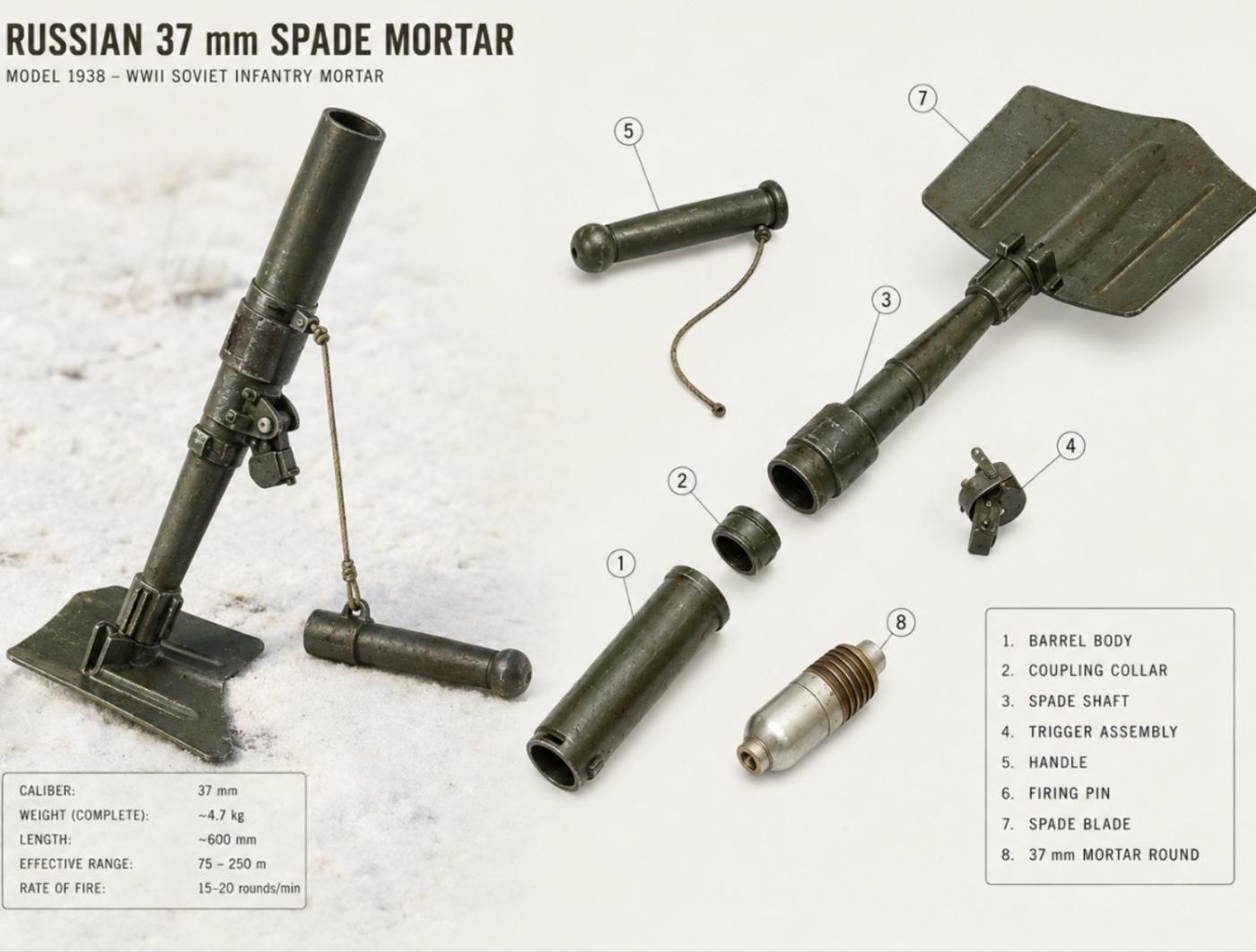
The weapon got its name for the most obvious reason: it really was a mortar built into a spade. In the marching position it looked like an oversized entrenching tool. The hollow steel handle was the mortar barrel, while the blade formed the base plate. When the soldier wanted to fire it, the blade was placed on the ground and the barrel was angled upward. A small supporting leg was attached to hold the barrel in position. The mortar was muzzle-loaded, meaning the bomb was dropped down the open end of the barrel. At the bottom was a fixed firing pin. As the bomb slid down, its propelling cartridge struck the pin and fired, throwing the bomb out in the same basic way as a conventional mortar.
The calibre was 37 mm, making it a very small mortar. The bomb weighed roughly 450 to 500 grams, or about one pound, and was an explosive fragmentation round. The soldier could carry around 15 bombs in a special fabric bandolier or pouch arrangement. This gave the individual infantryman a small supply of explosive firepower that could be carried without a full crew, base plate, sighting system and ammunition bearer. In theory, that made the VM-37 ideal for patrols, scouts, airborne troops, or riflemen attacking machine-gun nests and trenches at short distance.
Its range was modest. The minimum range was about 60 metres, and the maximum range was around 250 metres. That put it beyond hand-grenade distance but far below the reach of larger 50 mm, 82 mm or 120 mm Soviet mortars. Its muzzle velocity was low, around 65 to 70 metres per second, and it was intended for lobbing shells in a high arc rather than firing directly. The idea was that a soldier could drop small bombs behind cover, into a trench line, or near a machine-gun position when a rifle or grenade could not easily reach.
Accuracy was one of its greatest weaknesses. The VM-37 had no proper sight. The soldier aimed it by eye, judging angle and direction while watching where the bombs fell. This might sound acceptable for a simple close-range weapon, but in battle it was a serious problem. A small 37 mm bomb did not have a large explosive effect, so near misses were often not enough. A larger mortar could compensate for imperfect accuracy with a heavier shell and wider fragmentation pattern, but the VM-37 could not. If the bomb landed a few metres away from the target, the result might be little more than noise, dirt and light fragments.
The weapon was also awkward as a shovel. A normal infantry spade needed to be strong, balanced and comfortable, especially for men digging into frozen ground, heavy clay or snow. The VM-37 was longer, heavier and more complicated than a standard entrenching tool. Its hinged parts and barrel arrangement made it less suitable for hard digging. In winter conditions this mattered enormously. On the Eastern Front, a soldier’s ability to scrape a firing position, foxhole or shelter could be the difference between life and death. A shovel that was also a delicate weapon was not always a better shovel.
Its performance in snow and soft ground was especially disappointing. The 37 mm bomb was already small, and when it burst in deep snow much of its fragmentation effect could be swallowed before reaching the enemy. The base plate could also deform or shift during firing, and the lack of a proper sight made repeated accurate fire difficult. Soviet testers and troops soon found that the clever design could not escape its contradictions. It was not as good as a proper mortar, and it was not as good as a proper spade.
The VM-37 did have some interesting features. It was extremely light for a mortar, weighing about 1.5 kg as the mortar itself, or roughly 2.4 to 2.5 kg in some descriptions when considered as a complete carried item. It could be operated by one man, and it could be brought into action quickly. The blade was not just a shovel head but also the firing base. The supporting leg was carried inside the barrel when not in use. A canvas sleeve was fitted around the barrel to protect the soldier’s hands from heat during firing and from freezing to the metal in winter. These details show that the designers were not merely making a novelty weapon; they were trying to solve real practical problems for a soldier in the field.
There was also a certain grim logic behind it. In 1941, the Red Army was fighting for survival. German infantry had machine guns, mortars, artillery support and combat experience. Soviet commanders wanted more explosive fire at the platoon and squad level, and the spade mortar seemed to offer a cheap way of multiplying firepower. A line of soldiers equipped with such weapons might, in theory, shower a forward enemy position with small bombs before closing in. For airborne units or troops cut off from heavier support, even a weak mortar could be better than no mortar at all.
But battlefield weapons are judged by what they do under stress, not by what they promise in a drawing office. The VM-37’s shortcomings became obvious very quickly. It was too inaccurate, too weak, and too inconvenient. Its bombs lacked destructive power. Its range was short. It demanded skill from ordinary soldiers at a time when many Red Army units were being rebuilt, rushed to the front and given only limited training. The man firing it had to expose himself, judge the angle, watch the burst, correct by eye and hope the tiny bomb did enough damage. Against a dug-in enemy, that was rarely enough.
Production was stopped early in 1942, and on 24 February 1942 the VM-37 was officially removed from production and service. Some examples remained in the field for a while, and there are references to isolated use later in the war, but it disappeared quickly compared with successful Soviet weapons. The Red Army instead relied on more effective mortars, especially the 50 mm company mortars early on and the famous 82 mm and 120 mm mortars that became mainstays of Soviet fire support.
The ammunition did not entirely go to waste. Stocks of 37 mm bombs were later adapted for other uses, including improvised or purpose-made anti-personnel mine arrangements. This was typical of wartime economies, where even a failed weapon could leave behind useful explosives, fuzes or components. The mortar-spade itself, however, became a curiosity rather than a success.
What makes the Soviet spade mortar so interesting is not that it was a great weapon, but that it shows the pressure and imagination of wartime design. It was a product of urgency: a tool for digging, a weapon for firing, and a symbol of a military system trying to arm millions of men as quickly as possible. It promised to turn every infantryman into a miniature mortar crew, but the reality was less impressive. The Red Army needed weapons that were rugged, powerful and simple to use. The VM-37 was simple in appearance, but difficult to use well, and its effect on the enemy was too small to justify its inconvenience.
In the end, the Russian spade mortar earned its place in military history as one of the strangest weapons of the Second World War. It was a shovel that could shoot, and a mortar that could dig, but it never truly excelled at either task. Its story is a reminder that clever ideas are not always good battlefield ideas. In a war of mud, snow, artillery, machine guns and mass infantry assaults, the VM-37 was an ingenious failure: memorable, unusual, and unmistakably born from the desperate months when the Soviet Union was fighting for survival.