Operation Bagration
Operation Bagration was one of the most devastating military disasters ever suffered by Germany, and the liberation of Minsk in July 1944 became one of its great turning points. By the summer of that year the Red Army had recovered from the terrible losses of 1941 and 1942, had won the great struggles at Stalingrad and Kursk, and was now ready to tear open the German front in the east. The target was Army Group Centre, the powerful German formation that had once driven deep into the Soviet Union during Operation Barbarossa. It had held a huge bulge in Belorussia, covering the roads to Poland, the Baltic and East Prussia, but by 1944 it was exposed, overstretched and badly weakened. When the Soviet offensive began, it was not simply another push forward. It was a carefully planned destruction battle, designed to smash the German armies in Belorussia, encircle them, and open the way west.
The operation was named after Prince Pyotr Bagration, a Russian general killed during Napoleon’s invasion of Russia in 1812. That name carried a deep historical meaning, for the Soviet Union was now throwing back another invading army that had once seemed unstoppable. The offensive began on 22 June 1944, exactly three years after Hitler had launched the invasion of the Soviet Union. This timing was no accident. It was a powerful message that the tide had fully turned. Germany had entered Russia in 1941 with confidence, speed and brutality; now, three years later, its once-mighty army in the east was about to be shattered on the same lands it had devastated.
The German high command expected a Soviet blow, but it badly misread where the main danger lay. Adolf Hitler and many senior officers believed the Soviets would strike farther south, perhaps toward Ukraine or the Balkans. Army Group Centre was therefore not given the reserves it needed. Its divisions were understrength, its armour was limited, and its defensive positions were long and difficult to hold. Many German commanders understood that the front was vulnerable, but Hitler’s rigid orders made matters worse. He demanded that cities and strongpoints be held at all costs, even when withdrawal would have saved men and allowed a shorter line to be formed. This refusal to retreat turned many German formations into trapped garrisons waiting to be surrounded.
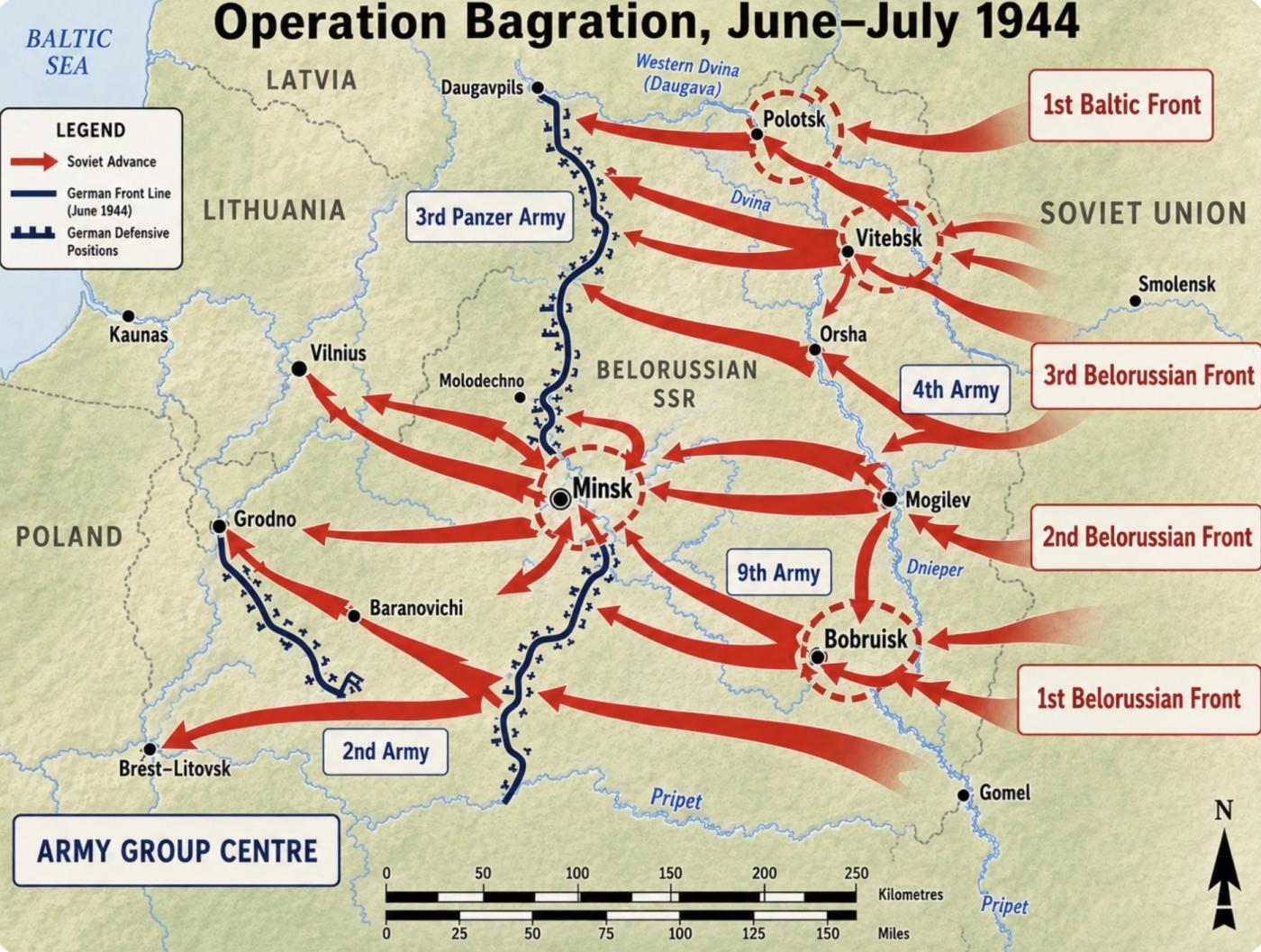
The Soviet plan was huge in scale. Four major fronts, equivalent to army groups, were thrown into the battle: the 1st Baltic Front, the 3rd Belorussian Front, the 2nd Belorussian Front and the 1st Belorussian Front. They were supported by vast numbers of guns, tanks, aircraft, engineers and partisan fighters operating behind German lines. The Red Army had learned hard lessons from earlier disasters. By 1944 its commanders were far more skilled in deception, coordination and deep operations. They used maskirovka, the Soviet art of military deception, to hide the true scale and direction of the attack. False radio traffic, camouflage, night movements and carefully concealed troop concentrations helped keep the Germans uncertain until it was too late.
Partisan activity also played a major role before the offensive began. In the forests and villages of Belorussia, Soviet partisans attacked railways, bridges, supply routes and communication lines. This made it harder for the Germans to move reserves, repair damage or understand what was happening at the front. When the main attack came, German units were not only struck from the front by massed Soviet armies but also disrupted in the rear. The whole German system of movement and command began to break down under pressure.
The first blows fell against Vitebsk, Orsha, Mogilev and Bobruisk. These were not isolated attacks but coordinated hammer strokes meant to break the German front into pieces. Soviet artillery barrages smashed trenches, bunkers and gun positions. Tanks and infantry then surged forward through the gaps, while aircraft attacked roads, bridges and retreating columns. At Vitebsk, German forces were ordered to hold their ground and were soon surrounded. At Bobruisk, another major encirclement developed, trapping large numbers of German troops. The German line did not bend in an organised way; it began to collapse in sections.
Once the front was broken, the Soviet advance became a race toward Minsk. The city was the capital of Belorussia and a major road and rail centre. For the Germans it was vital because many of their retreat routes passed through or near it. For the Soviets it was both a military and symbolic prize. Minsk had been under German occupation since 1941, and its people had endured years of terror, executions, forced labour, starvation and destruction. The liberation of the city would not only be a battlefield success but also a moment of deep importance for Belorussia and the Soviet Union.
As Soviet forces drove west, German units tried desperately to escape the trap forming around them. Roads became packed with retreating soldiers, vehicles, horse-drawn carts, wounded men and broken equipment. Soviet aircraft attacked these columns from the air, while fast-moving tank and cavalry-mechanised groups cut across the countryside to block the exits. The Germans were no longer conducting a controlled withdrawal; many formations were fleeing in disorder, trying to avoid being encircled before the Soviet jaws closed.
Minsk was liberated on 3 July 1944 by forces of the 3rd and 1st Belorussian Fronts. Soviet tank formations entered the city after a rapid advance, and the German defenders were unable to hold it. But the greater disaster for Germany was not only the loss of the city itself. East of Minsk, a huge pocket had formed. Tens of thousands of German troops from Army Group Centre were trapped, cut off from supply and surrounded by Soviet forces. Attempts to break out became scenes of chaos and slaughter. Groups of German soldiers moved through forests and villages, short of ammunition, food and fuel, while Soviet units closed in from all sides.
The destruction around Minsk was enormous. Entire German corps were broken apart. Command structures collapsed. Units lost contact with each other and with higher headquarters. Many soldiers were killed, captured or scattered. By the time the fighting in and around the Minsk pocket ended, Army Group Centre had suffered a catastrophic defeat from which it never truly recovered. The Red Army had not simply pushed the Germans back; it had annihilated much of the German force holding the central Eastern Front.
The scale of the German loss was staggering. Operation Bagration destroyed or crippled dozens of divisions and inflicted hundreds of thousands of casualties, including killed, wounded, missing and captured. Some estimates place total German losses during the operation at around 400,000 men or more. The Soviet losses were also heavy, but the strategic result was overwhelming. Army Group Centre, once one of the strongest formations in Hitler’s army, was smashed. The road to Poland was opened, and the Germans were forced into a desperate retreat across a vast front.
The liberation of Minsk showed how far the Red Army had advanced in skill and power since the dark days of 1941. At the start of the war, German armoured spearheads had encircled Soviet armies with frightening speed. In 1944 the situation was reversed. It was now the Soviets who were breaking through, surrounding enemy forces and destroying them in huge pockets. The same kind of deep battle that had once brought disaster to the Soviet Union was now being used against Germany with devastating effect.
For the people of Minsk, liberation came after three years of brutal occupation. The city had been badly damaged, and its population had suffered terribly. German occupation policies in Belorussia were among the harshest of the war. Villages were burned, civilians were murdered, and Jewish communities were destroyed in the Holocaust. Minsk itself had been a centre of repression, forced labour and mass killing. When Soviet troops entered the city, they found a place scarred by war and occupation. Liberation brought relief, but it also revealed the scale of destruction left behind.
For Germany, the fall of Minsk was one of the clearest signs that the war in the east was lost. The defeat came only weeks after the Allied landings in Normandy on 6 June 1944. Hitler was now fighting for survival on two enormous fronts. In the west, British, American, Canadian and other Allied troops were forcing their way inland from France. In the east, the Soviet Union was tearing through Belorussia and driving toward Poland. Germany no longer had the manpower, fuel, aircraft or reserves to stop both disasters at once.
One of the most remarkable features of Operation Bagration was how completely it achieved surprise and destruction. The Germans had strong defensive positions in places, and many of their soldiers fought hard, but they were overwhelmed by the scale, planning and speed of the Soviet attack. Once the first lines were broken, the German system could not recover. Hitler’s orders to hold fixed positions turned retreat into encirclement. Lack of reserves meant gaps could not be sealed. Soviet mobility and air power made escape increasingly difficult. The result was not a defeat in the ordinary sense but a collapse.
Minsk became the centrepiece of that collapse. Its liberation marked the moment when the destruction of Army Group Centre became undeniable. The German army had been hammered into retreat across Belorussia, leaving behind dead men, prisoners, wrecked vehicles, abandoned guns and shattered formations. The Red Army continued to advance after Minsk, pushing toward Vilnius, Brest, the Vistula and the borders of East Prussia. The front had moved hundreds of miles west, and Germany’s defensive position in the east had been transformed in a matter of weeks.
Operation Bagration is sometimes overshadowed in western memory by the Normandy landings, which took place in the same summer. Yet in terms of the destruction of German forces, Bagration was one of the most decisive campaigns of the Second World War. It ripped the centre out of the German Eastern Front and showed that the Wehrmacht could no longer recover from major Soviet offensives. The liberation of Minsk was not just the freeing of a capital city; it was the visible proof that Hitler’s invasion of the Soviet Union had come full circle.
By the time the guns moved west of Minsk, the meaning of the battle was clear. Germany had entered Belorussia as a conqueror in 1941, burning and killing its way across the land. Three years later, its armies were being destroyed in the same region by a Soviet force that had grown stronger, better led and more ruthless in pursuit of victory. Minsk stood as a symbol of liberation, revenge and military ruin. Operation Bagration did not end the war, but it made Germany’s defeat in the east inevitable. The once-feared Army Group Centre had been smashed, and the road to Berlin was now beginning to open.