On this day in military history…
The Battle of Kursk began on 5 July 1943 and became one of the greatest clashes of armour, men and machines in the history of warfare. It was the moment when Hitler tried to regain the initiative on the Eastern Front after the disaster at Stalingrad, but instead found the German Army thrown into a battle the Soviet Union had been preparing for with extraordinary depth, patience and determination. What began as a German attempt to cut off a huge Soviet bulge in the front line became a turning point that confirmed the Red Army had grown into a force capable not only of stopping Germany, but of driving it back all the way to Berlin.
After the defeat at Stalingrad in early 1943, the German Army was badly shaken. The loss of the Sixth Army had been a catastrophe, and the aura of German invincibility had been broken. Yet the Wehrmacht was not finished. It still possessed experienced commanders, powerful armoured formations and some of the best tactical battlefield skills in the world. In the spring of 1943 the front line in western Russia had formed a large Soviet-held salient around the city of Kursk. This bulge pushed westwards into German lines and tempted Hitler and his generals with what looked like an opportunity. If German forces could attack from the north and south, meet behind the salient and trap the Soviet armies inside, it might restore German confidence and cripple Soviet strength for months.
The plan was given the codename Operation Citadel. From the north, General Walter Model’s Ninth Army would attack southwards from the Orel area. From the south, Field Marshal Erich von Manstein’s forces, including General Hermann Hoth’s Fourth Panzer Army and Army Detachment Kempf, would drive northwards from the Belgorod and Kharkov region. If all went well, the two German pincers would close around Kursk and destroy a large part of the Red Army. It was a classic German encirclement plan, the same type of operation that had brought huge victories in 1941, but by 1943 the war in the east had changed.
The Soviets knew the attack was coming. Through intelligence, aerial reconnaissance, captured prisoners and partisan reports, they had built a clear picture of German intentions. Stalin was initially tempted to strike first, but senior commanders such as Marshal Georgy Zhukov argued for a different approach. The Red Army would absorb the German blow, bleed the attacking panzer divisions white, and then unleash its own counteroffensives once the enemy had exhausted himself. It was a cold and calculating plan, but it showed how much Soviet command had matured since the disasters of 1941.
Around Kursk, the Soviets constructed one of the most formidable defensive systems ever seen. They did not rely on a single line, but built layer after layer of defences stretching deep behind the front. There were trenches, anti-tank ditches, minefields, barbed wire, hidden gun positions, camouflaged artillery, bunkers and prepared fallback positions. Villages were turned into strongpoints, roads were registered by artillery, and tank-killing zones were prepared with great care. The scale was staggering. Millions of mines were laid, including vast belts of anti-tank and anti-personnel mines. Soviet engineers worked day and night, while civilians helped dig trenches and prepare defensive works. By the time the Germans attacked, the Red Army was not simply waiting on the front line; it was waiting inside a great armoured trap.
The German attack had already been delayed several times. Hitler wanted to wait for new weapons, especially the Panther tank, the heavy Ferdinand tank destroyer and more Tiger tanks. These machines were powerful, but many were still unproven. The delay gave the Soviets more time to prepare, and every extra week made the Kursk salient more dangerous for the attackers. Some German commanders were uneasy. Manstein believed an earlier attack might have stood a better chance, while others doubted whether the operation should be launched at all. Hitler hesitated, postponed, and finally committed. By then, secrecy had been lost and surprise was almost impossible.
In the early hours of 5 July 1943, the Battle of Kursk began. Before the Germans launched their main assault, Soviet artillery opened fire on German assembly areas. The Red Army believed the attack was imminent and tried to disrupt it before it could fully begin. The bombardment did not stop the offensive, but it added confusion and showed the Germans that the Soviets were ready. Soon afterwards, German artillery and aircraft answered with their own heavy bombardment, and the great offensive began.
On the northern face of the salient, Model’s Ninth Army advanced into some of the strongest defences on the Eastern Front. His troops included infantry, assault guns, panzers and heavy armour, but progress was slow almost from the start. Minefields broke up formations, anti-tank guns opened from concealed positions, and Soviet artillery battered the advancing troops. German engineers had to clear paths under fire while tanks and assault guns tried to push through narrow lanes. Every mile cost men, machines and time. The northern attack never achieved the sweeping breakthrough the Germans needed. Instead of a fast armoured drive, it became a grinding struggle against deep defences.
The fighting in the north was brutal. German infantry had to clear trenches, woods and fortified villages, while Soviet troops fought stubbornly from prepared positions. The Red Army had learned to let German armour move forward into kill zones before striking from the flanks. Anti-tank rifles, mines, artillery and dug-in guns all played their part. German tanks could still win local fights, but they could not break the whole system. Model’s forces pushed forward, but only slowly, and with losses that could not easily be replaced.
In the south, the German attack made greater progress. Manstein’s forces had more room for manoeuvre and some of the strongest armoured formations available to Germany, including units of the Waffen-SS Panzer Corps. The Tigers were especially feared because their armour and 88 mm guns gave them great power at long range. Soviet tank crews often had to close the distance dangerously before they could hope to destroy them. Yet even here, where the Germans drove deeper than in the north, they were still moving through belts of mines, anti-tank guns and defensive positions that wore them down with every advance.
The air war over Kursk was also immense. The Luftwaffe committed large numbers of aircraft to support the offensive, including dive-bombers and ground-attack aircraft. The Soviet Air Force, which had suffered terribly earlier in the war, was now much stronger and better organised. The skies above the battlefield filled with fighters, bombers and attack aircraft. Control of the air shifted from place to place, and both sides suffered heavy losses. Aircraft attacked tanks, supply columns, artillery positions and troop concentrations, adding to the chaos below.
One of the most important features of Kursk was not simply the number of tanks involved, but the way the battle was fought. The Germans relied on concentrated armoured blows to break through, but the Soviets had created defences designed specifically to absorb and blunt those blows. The first line was not expected to hold forever. It was intended to slow, damage and disorganise the attackers before they reached the next line, and then the next. Behind the defences stood large Soviet reserves, including tank armies ready to counterattack when the German spearheads were weakened.
The new German Panther tank made its major combat debut at Kursk, but its first appearance was troubled. On paper it was a formidable weapon, with sloped armour and a powerful long-barrelled gun. In practice, many Panthers suffered from mechanical problems, fires and breakdowns, especially in the opening days. Some were lost before they had made any real contribution. The Ferdinand tank destroyer also had a powerful gun and thick armour, but it lacked a machine gun for close defence, making it vulnerable when Soviet infantry got near. These new machines showed the direction of German armoured design, but at Kursk they were not enough to change the outcome.
The Soviet T-34 remained the backbone of Red Army armoured strength. It was not invincible, and by 1943 German guns could destroy it more easily than before, but it was rugged, mobile and available in huge numbers. Soviet industry had become a weapon in itself. Factories far beyond the Urals were producing tanks, guns and aircraft on a massive scale. The Red Army could replace losses in a way Germany increasingly could not. At Kursk, this difference mattered enormously. Germany needed a decisive victory; the Soviet Union could afford a battle of attrition more than the Germans could.
As the battle developed, the southern German spearheads pushed towards Prokhorovka, a name that would become one of the most famous associated with Kursk. On 12 July 1943, Soviet armoured forces launched a major counterattack near the area, leading to a fierce and confused clash at close range. For years it was often described as the largest tank battle in history, with hundreds of tanks charging into each other across the steppe. Modern historians have debated the exact numbers and losses, and the older dramatic image has been revised, but there is no doubt that Prokhorovka was a savage and important fight. Soviet commanders threw their armour forward to stop the German advance, and although losses were heavy, the German drive was checked.
By this stage, Operation Citadel was already losing momentum. In the north, the German attack had stalled. In the south, even where gains had been made, the cost was severe and no decisive breakthrough had been achieved. Then the wider strategic situation changed. On 10 July, the Western Allies landed in Sicily, threatening Italy and forcing Hitler to think about the Mediterranean. On 12 July, the Soviets launched Operation Kutuzov against the German-held Orel salient north of Kursk. This was the second part of the Soviet plan: once the German offensive had been absorbed, the Red Army would strike back.
Hitler called off Operation Citadel, though fighting around the salient and nearby fronts continued. For the Germans, the failure was devastating. They had committed precious armoured reserves, elite formations and new weapons, but had not achieved the encirclement they needed. Many German units remained tactically dangerous, and Manstein would still conduct skilled defensive operations, but the chance to regain the strategic initiative in the east was gone. From this point onwards, the Wehrmacht would mostly react to Soviet offensives rather than dictate events.
For the Soviet Union, Kursk was a triumph of preparation, intelligence, industrial strength and battlefield endurance. It proved that the Red Army could defeat a major German summer offensive when it knew where the blow was coming. It also showed that Soviet commanders had learned how to combine defence and counterattack on a huge scale. They no longer relied only on courage and numbers, though both were present in abundance. They used depth, deception, reserves, artillery, armour and air power in a far more sophisticated way than earlier in the war.
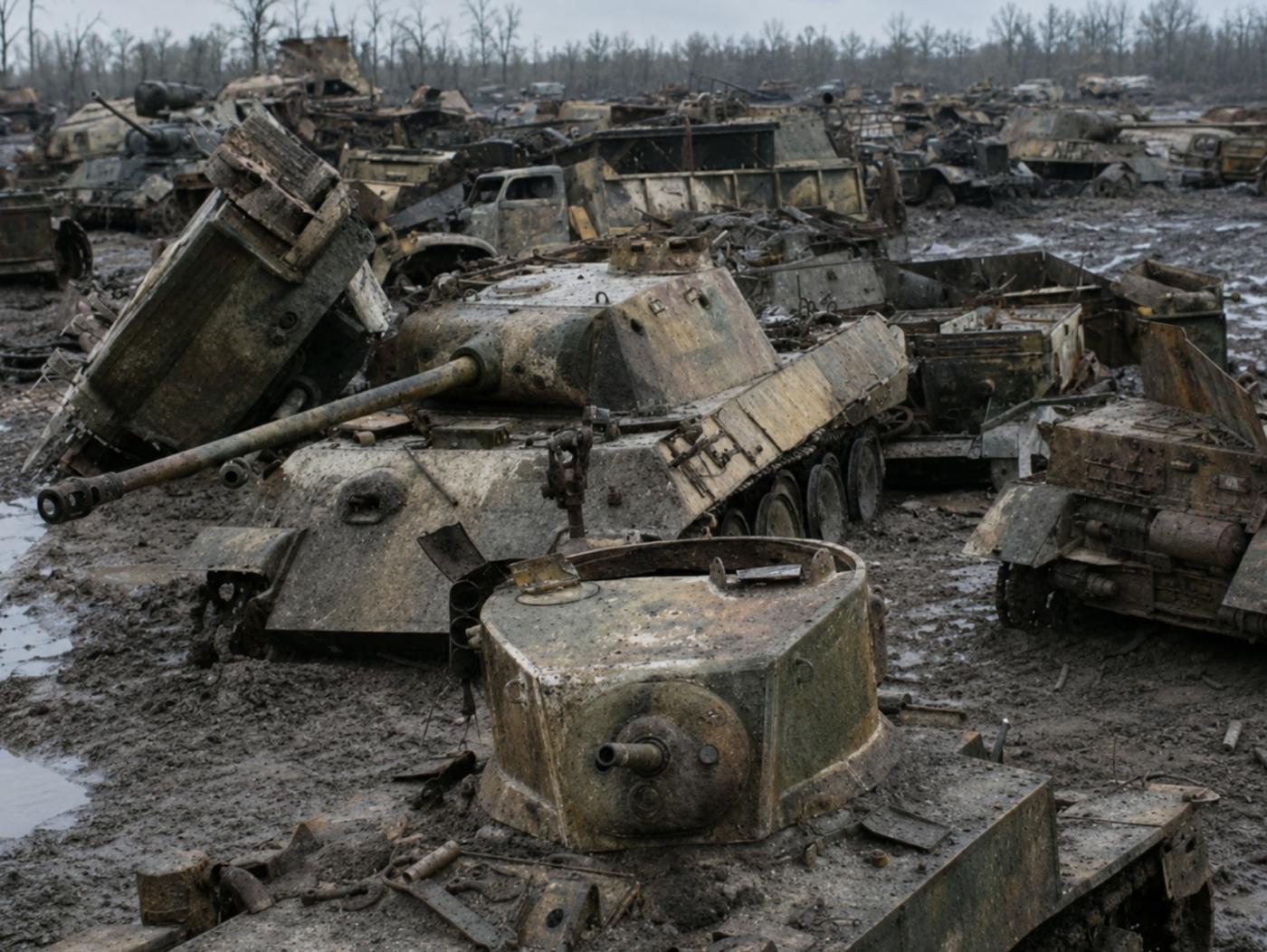
The cost was enormous on both sides. Tens of thousands of men were killed, wounded or missing, and thousands of tanks, guns and aircraft were destroyed or damaged during the wider battle and the Soviet counteroffensives that followed. Exact figures have long been debated because both sides counted losses differently and because the battle covered a wide area over several weeks. What cannot be doubted is the scale. Kursk was not a single neat battlefield, but a vast storm of combat across open steppe, villages, defensive belts, minefields and burning tank wrecks.
The battle also had a powerful psychological effect. For Germany, it was another blow after Stalingrad and North Africa. The idea that one more great armoured offensive could restore the situation in the east had failed. For Soviet soldiers and civilians, it was proof that the invader could be beaten not only in winter, not only in city fighting, but in the open during the summer campaigning season where German arms had once been strongest. The victory gave the Red Army confidence and opened the way for further offensives that would liberate Orel, Belgorod and Kharkov.
Kursk is often remembered as the greatest tank battle of the Second World War, but that description only tells part of the story. It was also a battle of intelligence, engineering, logistics and willpower. It was won as much by the men who dug the defences, laid the mines, moved the shells and repaired the tanks as by the tank crews who fought in the smoke and dust. It was a battle where Germany attacked with some of the most powerful weapons it had, only to discover that the Soviet Union had built a defensive fortress across the landscape and had the reserves ready to strike back.
When the first guns opened on 5 July 1943, Hitler hoped Operation Citadel would restore German fortunes after the humiliation of Stalingrad. Instead, the Battle of Kursk became the point where the eastern war changed beyond recovery for Germany. The Wehrmacht still had years of fighting ahead, and the road to Berlin would be long and bloody, but after Kursk the direction of the war was clear. The Red Army had taken the full weight of Germany’s last great offensive in the east, survived it, and then moved forward. From the burning fields around Kursk, the long Soviet advance to victory truly began.