Royal Australian Regiment
The Royal Australian Regiment, usually known as the RAR, is one of the most important infantry formations in Australian military history. It was created on 23 November 1948, at a time when Australia was reshaping its army after the Second World War and deciding what kind of permanent force it needed in a changing world. Until then, Australia had relied heavily on wartime volunteer armies and militia-style forces, but the post-war years made it clear that the country needed a professional regular infantry regiment that could serve at home, overseas, and in emergencies without having to be built from scratch each time.
The regiment grew out of the 34th Australian Infantry Brigade, which had been formed in 1945 for occupation duties in Japan after Japan’s surrender. Its three infantry battalions were the 65th, 66th and 67th Australian Infantry Battalions, made up largely of experienced volunteers from the Second Australian Imperial Force. These men had already seen the discipline and strain of war, and they became the foundation of Australia’s first permanent regular infantry regiment. On 23 November 1948, the three battalions were renamed the 1st, 2nd and 3rd Battalions of the Australian Regiment. In 1949, King George VI granted the regiment the title “Royal”, and from then on it became the Royal Australian Regiment.
At its beginning, the regiment consisted of three battalions rather than one single mass of soldiers. A full infantry battalion of the period was usually around 700 to 900 men when properly manned, so the regiment’s paper strength would have been roughly a few thousand soldiers, although actual numbers varied as Australia reduced, reorganised and rebuilt its post-war army. The important point is that the RAR began as a compact professional force, not a huge wartime army. It was intended to provide Australia with disciplined regular infantrymen who could be deployed quickly and could carry the traditions of the wartime Australian soldier into a permanent peacetime army.
The regiment was set up by the Australian Government and Army authorities as part of the creation of the Australian Regular Army. Its royal title came from King George VI, but its practical birth came from Australia’s need for a standing infantry force. One key figure in its early story was Brigadier Ronald Hopkins, commander of the 34th Brigade, who understood the value of building identity, pride and continuity among the regular battalions. Rather than leaving them as numbered occupation battalions with little history or status, the decision was made to bind them together as one regiment with numbered battalions, shared traditions and a common purpose.
The purpose of the Royal Australian Regiment was simple but demanding: to be Australia’s professional infantry arm. Its soldiers were trained to fight on foot, seize and hold ground, patrol, defend, attack, and operate in jungles, mountains, cities and peacekeeping zones. Over time, the regiment adapted to many roles, including light infantry, motorised infantry, mechanised infantry, parachute and amphibious tasks. Yet its core identity remained the same. It was the regiment of the Australian regular infantry soldier, expected to be ready whenever the country called.
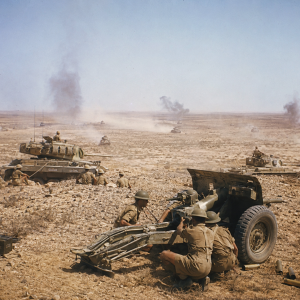
The regiment’s first major test came in the Korean War. The 3rd Battalion, Royal Australian Regiment, was already in Japan when the war began in 1950 and was quickly committed to the fighting in Korea. It took part in hard battles such as Kapyong and Maryang San, where Australian infantry earned a reputation for toughness, endurance and skill under pressure. At Kapyong in April 1951, 3 RAR helped stop a major Chinese advance towards Seoul alongside Canadian and New Zealand forces. The battle became one of the regiment’s proudest honours and remains central to its identity.
The 1st and 2nd Battalions also served in Korea, making the war the first conflict in which all three original battalions of the regiment were involved. Korea showed exactly why the regiment had been created. Australia needed soldiers who were already trained, organised and available, not men who had to be recruited and prepared after a crisis had already begun.
After Korea, the regiment was drawn into the long Cold War struggles in Southeast Asia. It served during the Malayan Emergency, fighting communist guerrillas in difficult jungle conditions, and later during the Indonesia-Malaysia Confrontation, where Australian infantry operated in Borneo and along tense border areas. These campaigns were very different from Korea. They required patience, patrol skill, small-unit leadership and the ability to work in thick jungle where danger often came suddenly and at close range.
The Vietnam War became one of the regiment’s most significant chapters. As Australia increased its commitment, the RAR expanded beyond its original three battalions, eventually raising additional battalions to meet wartime needs. RAR soldiers fought in major actions including Long Tan, Coral-Balmoral, Binh Ba and many smaller patrols and contacts that made up the daily reality of the war. The Battle of Long Tan in 1966, fought mainly by D Company, 6 RAR, became one of the best-known Australian battles of the war. At Coral-Balmoral in 1968, soldiers from the regiment endured heavy attacks and close fighting, proving again the resilience of Australian infantry.
In later decades, the regiment continued to serve wherever Australian governments committed troops. RAR battalions deployed to Somalia, Rwanda, Cambodia, East Timor, the Solomon Islands, Iraq and Afghanistan. In East Timor in 1999, the regiment helped restore order during a dangerous peace enforcement mission after the independence vote. In Iraq and Afghanistan, RAR soldiers operated in modern counter-insurgency and security missions, often working with allied forces and local partners in complex and dangerous environments.
Command of the regiment has always operated through its battalions and the wider Australian Army chain of command. Each battalion has its own commanding officer, usually a lieutenant colonel, while the regiment itself has senior ceremonial and administrative leadership. In wartime, RAR battalions have served under Australian brigades and sometimes under larger Commonwealth, United Nations or coalition formations. Famous commanders associated with the regiment include Lieutenant Colonel Charles Green, who commanded 3 RAR in Korea and was admired for his leadership before he was killed in 1950.
The Royal Australian Regiment was not created for ceremony or display, though it has strong traditions and a proud ceremonial life. It was created because Australia needed a dependable, professional infantry force. From Japan after the Second World War to Korea, Vietnam, East Timor, Iraq and Afghanistan, its soldiers have carried out that role across more than seven decades. Its motto, “Duty First”, captures the spirit expected of its members: service before comfort, discipline before ease, and loyalty to the soldiers beside them. The story of the RAR is therefore not only the story of a regiment, but also the story of modern Australia’s regular infantry and its place in the world.