2nd Balkans War Starts
The Second Balkan War broke out on 29 June 1913 because the alliance that had defeated the Ottoman Empire in the First Balkan War collapsed almost immediately after victory. The Balkan League, made up mainly of Bulgaria, Serbia, Greece and Montenegro, had been created to push the Ottomans out of Europe. It succeeded with remarkable speed in 1912–13, but success created a new and more dangerous problem: how to divide the conquered lands, especially Macedonia. The war that began on 29 June was therefore not a new struggle against the Ottoman Empire at first, but a bitter conflict between former allies who believed they had been cheated of the rewards of victory.
The central cause of the war was Macedonia. Before the First Balkan War, Macedonia was still under Ottoman rule, but it was claimed by several Balkan states for historical, ethnic, religious and strategic reasons. Bulgaria believed it had the strongest claim to most of Macedonia. Bulgarian leaders argued that many Macedonian Slavs were Bulgarians, that Bulgarian schools and churches had been active there for decades, and that Bulgaria had carried the heaviest military burden in the war against the Ottomans. Serbia, however, also wanted a large part of Macedonia, partly because it had been blocked from expanding westward to the Adriatic Sea. Greece, which had captured Salonika, also claimed southern Macedonia and refused to surrender territory it now held by force of arms.
The dispute was made worse by the original agreements between the allies. Serbia and Bulgaria had signed a treaty before the First Balkan War which divided much of Macedonia into zones. Some territory was clearly assigned, while a large “disputed zone” was supposed to be settled later by arbitration, with the Russian Tsar expected to act as mediator. Bulgaria believed Serbia was bound to give up much of the territory it had occupied. Serbia argued that circumstances had changed. It had been denied access to the Adriatic when the Great Powers created an independent Albania, and it insisted that it needed compensation in Macedonia. This was a crucial turning point. What had been planned as a war of liberation against Ottoman rule became a quarrel over compensation, prestige and survival.
Bulgaria felt especially wronged because it had fought the largest and most exhausting battles against the Ottomans in Thrace, including the hard struggle around Adrianople. Bulgarian armies had suffered heavy casualties and had come close to Constantinople. From the Bulgarian point of view, while its main forces were bleeding in the east, Serbia and Greece had occupied the Macedonian territories Bulgaria expected to receive. By the spring of 1913, Bulgarian public opinion was angry and impatient. Many Bulgarians believed that victory over the Ottomans would be meaningless if Bulgaria failed to gain Macedonia.
Serbia, however, was in no mood to retreat. Its army had performed well in the First Balkan War and had occupied much of Vardar Macedonia. Belgrade saw the territory as vital for national security and economic development. Serbia had been deeply frustrated by Austria-Hungary’s opposition to Serbian access to the sea. Vienna feared the rise of a stronger Serbia, especially because Serbia inspired South Slavs inside the Austro-Hungarian Empire. When Albania was created under Great Power pressure, Serbia’s western ambitions were blocked. Macedonia therefore became even more important to Serbia. Serbian leaders were determined not to hand over land they had conquered unless forced.
Greece had its own reasons for resisting Bulgaria. The Greeks had captured Salonika in November 1912 only hours before Bulgarian troops reached the city. Salonika was the greatest prize in the region: a major port, commercial centre and symbol of power. Both Greece and Bulgaria wanted it. The presence of both Greek and Bulgarian forces in and around Salonika created tension, suspicion and occasional violence. For Greece, control of Salonika and southern Macedonia was essential. Greek leaders feared that a larger Bulgaria, stretching from the Black Sea toward the Aegean, would become the dominant power in the Balkans. Greece therefore moved closer to Serbia as both states came to see Bulgaria as the main threat.
The diplomatic situation became more dangerous because Bulgaria was increasingly isolated. Russia had helped encourage the original Balkan League, hoping it would strengthen Slavic and Orthodox influence and weaken the Ottoman Empire. But Russia did not want a war between Serbia and Bulgaria. St Petersburg tried to mediate, yet its influence was limited because both sides distrusted the arbitration process. Serbia believed Russia might favour Bulgaria because of the earlier treaty. Bulgaria believed Russia was failing to enforce the agreement and was becoming too friendly toward Serbia. This loss of Russian control over its Balkan clients was one of the most important diplomatic failures before the First World War.
Austria-Hungary watched events with interest. Vienna feared Serbia far more than Bulgaria and therefore had reason to welcome anything that weakened Serbia. Some Bulgarian politicians hoped Austria-Hungary might support them against Serbia, but this was a dangerous illusion. Austria-Hungary was cautious and did not offer the kind of firm backing Bulgaria needed. Meanwhile Romania, which had stayed out of the First Balkan War, wanted compensation from Bulgaria, especially in southern Dobruja. The Ottoman Empire, badly defeated in the First Balkan War, also watched for a chance to recover lost territory. Bulgaria was therefore surrounded by potential enemies.
Inside Bulgaria, the pressure for action grew rapidly. Tsar Ferdinand of Bulgaria was ambitious and believed his country had been robbed of its rightful gains. The Bulgarian army was proud but exhausted, and its commanders were frustrated by the political deadlock. Prime Minister Stoyan Danev hoped diplomacy might still produce a settlement, but the military and the palace increasingly leaned toward force. Bulgaria’s leaders faced a terrible choice: accept a settlement that many Bulgarians would regard as humiliating, or strike Serbia and Greece before they became even more firmly united.
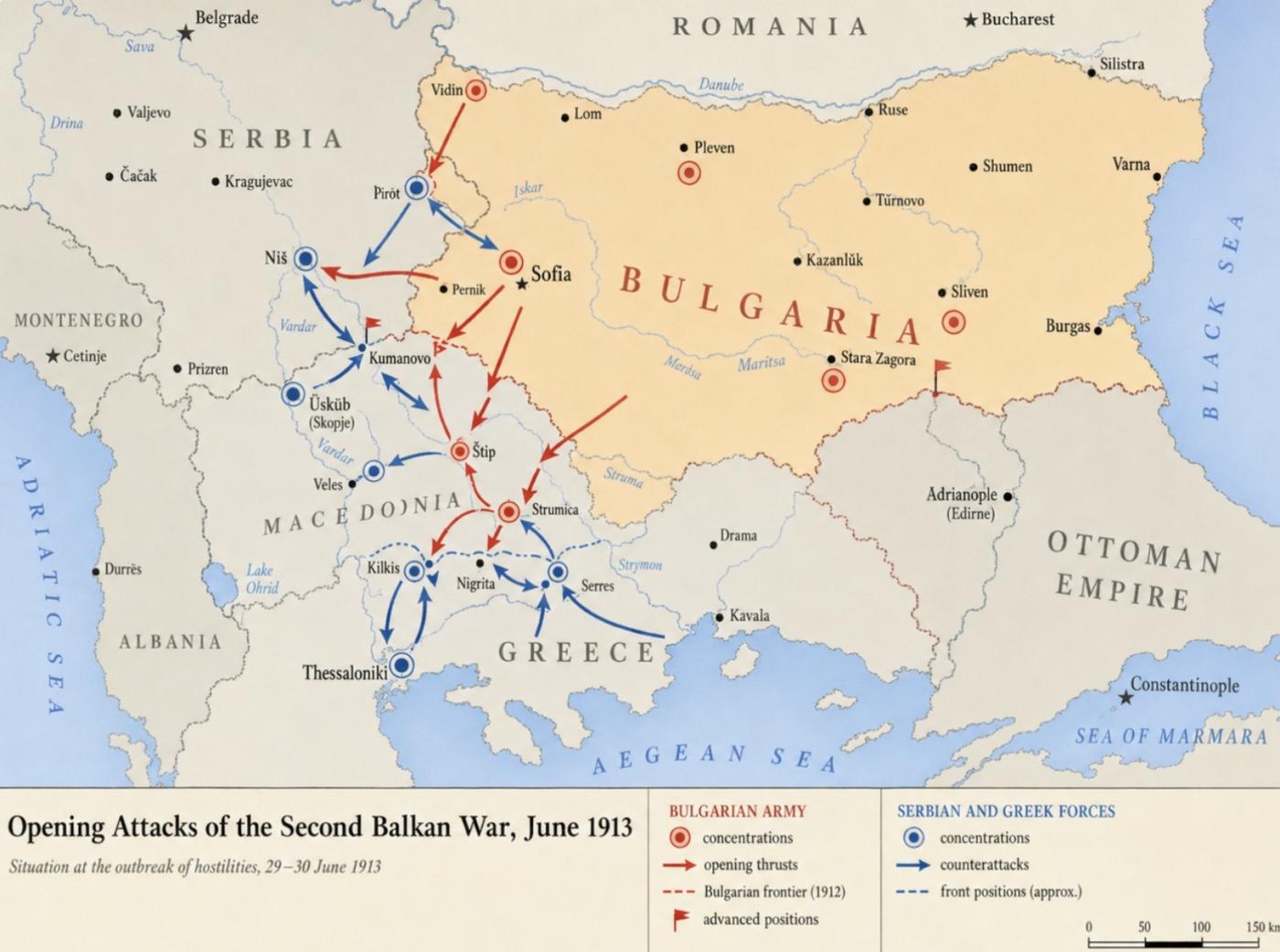
The immediate outbreak came on 29 June 1913, when Bulgarian forces attacked Serbian and Greek positions in Macedonia. The attack is often described as occurring during the night of 29–30 June, because operations began late on 29 June and developed overnight. Bulgaria did not issue a formal declaration of war before launching the assault. This gave the conflict an explosive and chaotic beginning. Bulgarian units moved against Serbian positions along the Bregalnica front and against Greek forces in the south. The aim was to break the Serbian and Greek armies quickly, seize the disputed territories, and force a favourable settlement before outside powers could intervene.
The decision was a disastrous gamble. Bulgaria expected a short, sharp campaign, but it underestimated the strength and coordination of Serbia and Greece. Serbian troops resisted fiercely at the Battle of Bregalnica, one of the decisive battles of the war. The fighting was brutal, confused and costly. Bulgarian attacks failed to produce the rapid breakthrough expected. At the same time, the Greeks counterattacked strongly in southern Macedonia. Greek forces pushed northward after heavy fighting, and the Bulgarian army found itself under pressure on more than one front.
The outbreak of war also allowed Bulgaria’s other enemies to move. Romania entered the conflict against Bulgaria in July 1913, not because of any deep loyalty to Serbia or Greece, but because it wanted territory and saw Bulgaria as vulnerable. Romanian forces crossed the Danube and advanced toward Sofia with little resistance, since Bulgaria’s main armies were already engaged in Macedonia. This was a severe blow to Bulgarian morale and strategy. Even worse for Bulgaria, the Ottoman Empire took advantage of the crisis to reoccupy Adrianople, which Bulgaria had won with great sacrifice only a few months earlier. The war that Bulgaria had begun to secure Macedonia quickly became a national catastrophe.
The Second Balkan War was short but extremely important. It lasted only a few weeks, but it changed the balance of power in southeastern Europe. Bulgaria was defeated and forced to accept the Treaty of Bucharest in August 1913. Serbia gained most of Vardar Macedonia, Greece kept Salonika and much of southern Macedonia, Romania gained southern Dobruja, and Bulgaria was left bitter and resentful. The Ottoman Empire recovered Adrianople in a separate settlement. Bulgaria’s dream of becoming the leading Balkan power was shattered.
The bitterness created by the war did not disappear. Serbia emerged much stronger, almost doubling its territory and population after the Balkan Wars. This alarmed Austria-Hungary, which saw Serbia as a growing threat to imperial stability. Bulgaria, humiliated by its former allies, looked for revenge and later joined the Central Powers in the First World War. Greece also expanded and strengthened its position in the Aegean. The Ottoman Empire, though weakened, survived and recovered some pride by retaking Adrianople.
One of the most interesting features of the outbreak on 29 June is that the war began not because the Balkan states had failed against the Ottomans, but because they had succeeded too well. Victory created expectations that could not all be satisfied. Macedonia was not merely a piece of territory; it was tied to national myths, language, religion, military sacrifice and future security. Each country believed it had justice on its side. Bulgaria believed treaties and ethnic claims supported its position. Serbia believed changed circumstances and battlefield occupation justified its refusal to withdraw. Greece believed possession of Salonika and southern Macedonia was essential to its national future. These incompatible claims made compromise almost impossible.
The war also showed the danger of secret treaties and vague promises. The Serbian-Bulgarian agreement had not settled Macedonia clearly enough. It left a disputed zone and relied on arbitration, but by the time arbitration was needed, the political situation had changed. The Great Powers were involved, but none could impose a settlement acceptable to all. Russia wanted unity among the Balkan Slavs but failed to prevent war. Austria-Hungary wanted to contain Serbia but avoided direct military involvement. The result was a regional war that exposed the fragility of European diplomacy.
The Second Balkan War also helped prepare the ground for the First World War. It hardened rivalries, shifted alliances and increased fear among the Great Powers. Serbia’s growth after 1913 made Austria-Hungary more determined to confront it. Bulgaria’s resentment made it more willing to side with Serbia’s enemies later. Russia’s support for Serbia became more important after its failure to control the Balkan crisis. When Archduke Franz Ferdinand was assassinated in Sarajevo in June 1914, the memory of the Balkan Wars was still fresh. Europe had already seen how quickly a local Balkan dispute could become an international crisis.
The outbreak of the Second Balkan War on 29 June 1913 was therefore a turning point in modern Balkan and European history. It began with a sudden Bulgarian attack on former allies, but its roots lay in years of competing national ambitions and in the unstable settlement that followed the defeat of the Ottoman Empire. Bulgaria hoped to correct what it saw as an injustice, yet the attack united its enemies and brought disaster. The war ended quickly, but its consequences lasted far longer. It left Serbia stronger, Bulgaria resentful, Greece enlarged, Romania rewarded, the Ottoman Empire partially restored in Europe, and the whole region more unstable. In that sense, the shots fired on 29 June were part of the chain of events that led from the Balkan Wars to the wider catastrophe of 1914.