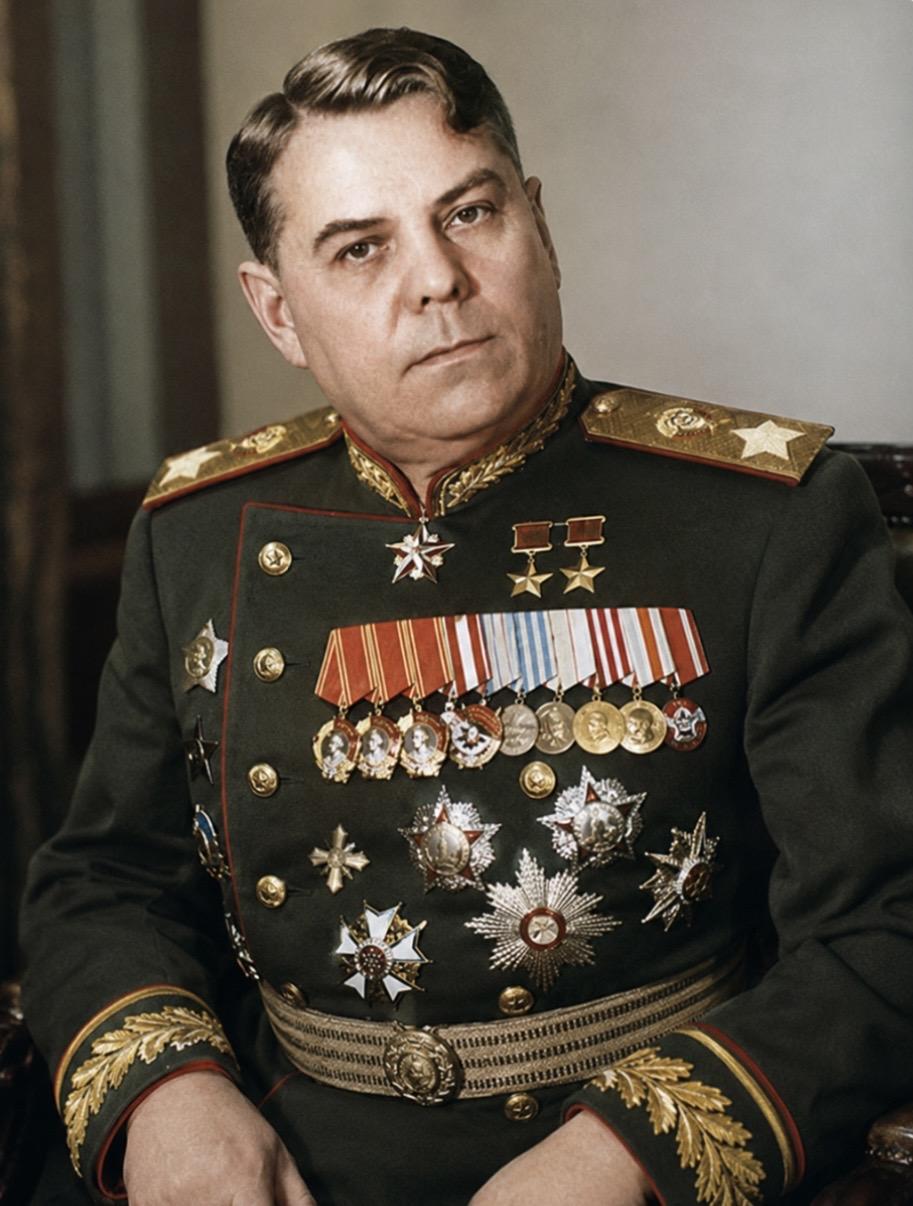
Marshal Alexandr Vasilevsky
Aleksandr Mikhailovich Vasilevsky was one of the most important Soviet military commanders of the Second World War. Although he is often less famous in popular memory than Georgy Zhukov, he played a central role in planning and coordinating many of the Red Army’s greatest victories. He was not only a field commander but also a brilliant staff officer, strategist, and organizer whose calm judgment made him one of Joseph Stalin’s most trusted military advisers during the war.
He was born on 30 September 1895 in the village of Novaya Golchikha, in the Kostroma region of the Russian Empire. He came from a religious and modest family. His father was a priest, and he was originally expected to follow a similar path. He studied at a religious school and later entered a seminary, but the outbreak of the First World War changed the course of his life. Like many young men of his generation, he was drawn into military service by the enormous demands of the war.
In 1915, he entered the Russian Imperial Army. He trained as an officer and was sent to the front, where he served during the First World War. This experience gave him his first serious understanding of modern warfare: mass armies, artillery, logistics, trench systems, and the terrible cost of poor command decisions. He rose to the rank of staff captain in the old imperial army, showing early signs of discipline and competence. However, the Russian Revolution of 1917 and the collapse of the imperial regime transformed the political and military world in which he served.
After the revolution, he eventually joined the Red Army during the Russian Civil War. His background as a former tsarist officer might have made him politically suspect, but the Bolshevik government badly needed trained military professionals. He proved himself useful, reliable, and capable. He served in various command and staff positions, gradually building a reputation as a careful, intelligent, and hardworking officer. Unlike some more flamboyant commanders, he was not known for dramatic gestures or aggressive self-promotion. His strength lay in organization, planning, and the ability to understand the wider strategic picture.
During the 1920s and 1930s, his career continued to develop through regimental and staff positions, supported by further military education. This was a period when the Red Army was undergoing major changes. Soviet military thinkers were developing new ideas about mechanized warfare, deep operations, and the coordination of tanks, aircraft, artillery, and infantry. He absorbed these lessons and became increasingly associated with staff work, where his methodical mind was especially valuable.
The 1930s were a dangerous time for Soviet officers. Stalin’s purges devastated the Red Army’s senior leadership, and many experienced commanders were arrested, imprisoned, or executed. He survived this period, partly because of his professional reputation and partly because he avoided political recklessness. By the late 1930s, he had become an increasingly important figure in the General Staff. His rise was not sudden or glamorous, but it was steady. Senior leaders trusted him because he was precise, disciplined, and capable of turning broad political instructions into practical military plans.
When Nazi Germany invaded the Soviet Union on 22 June 1941, he was serving in the Soviet General Staff. The first months of the war were catastrophic for the Soviet Union. German forces advanced rapidly, encircling huge Soviet armies and capturing millions of prisoners. In this desperate situation, the Soviet high command needed officers who could think clearly under pressure. He became one of the key figures in the Stavka, the Soviet Supreme High Command, working closely with Stalin, Zhukov, and other senior commanders as the country struggled to survive.
His importance grew during the Battle of Moscow in late 1941. Although Zhukov is most strongly associated with the defense of Moscow, he contributed to the planning and coordination of Soviet operations at the highest level. The successful defense of the capital marked a turning point. It proved that the German army could be stopped and that the Soviet state would not collapse quickly. His role in this period showed his value as a strategist who could help manage enormous fronts, shifting reserves, and complicated counteroffensives.
In 1942, he became Chief of the General Staff, one of the most powerful military positions in the Soviet Union. In this role, he was responsible for helping plan and coordinate operations across the entire Eastern Front. His duties required a rare combination of military knowledge, political sensitivity, and personal endurance. He had to work with Stalin, whose leadership could be demanding and suspicious, while also communicating with field commanders facing constantly changing battlefield conditions. He became known for his calm manner, patience, and ability to explain complex military problems clearly.
One of his greatest accomplishments was his role in the planning of Operation Uranus, the Soviet counteroffensive at Stalingrad in November 1942. The Battle of Stalingrad had become a brutal struggle of attrition, with German forces locked in street fighting inside the city. Rather than simply trying to push the Germans back inside Stalingrad, Soviet planners prepared a massive encirclement operation. The plan targeted the weaker Romanian, Hungarian, and Italian forces guarding the German flanks. Along with Zhukov and other senior planners, he helped shape and coordinate this operation.
Operation Uranus was a stunning success. Soviet forces broke through the Axis lines north and south of Stalingrad and linked up behind the German Sixth Army, trapping it inside a huge pocket. The encirclement changed the course of the war. After months of fighting, the German Sixth Army surrendered in early 1943. Stalingrad became one of the decisive defeats of Nazi Germany. His contribution was not merely administrative; he helped coordinate the timing, reserves, and operational design that made the victory possible.
After Stalingrad, he remained central to Soviet strategy. He was promoted to Marshal of the Soviet Union in 1943, one of the highest military ranks in the country. This promotion reflected both his personal ability and the enormous importance of the General Staff in Soviet victory. He helped plan operations that pushed the Germans back across the Soviet Union, including campaigns in Ukraine, Belarus, and the Baltic region. His work involved coordinating multiple fronts, each containing hundreds of thousands of troops, thousands of guns, and large numbers of tanks and aircraft.
He also played a major role in the Battle of Kursk in the summer of 1943. Kursk was the largest tank battle of the war and one of the last major German attempts to regain the initiative on the Eastern Front. Soviet intelligence had identified German preparations, and the high command decided to absorb the attack with deep defensive belts before launching counteroffensives. He helped coordinate the strategic planning that allowed the Red Army to survive the German assault and then go over to the offensive. After Kursk, Germany permanently lost the initiative in the east.
In 1944, he was involved in the planning and coordination of Operation Bagration, one of the most devastating Soviet offensives of the war. Launched in June 1944, the operation destroyed much of German Army Group Centre in Belarus. It was a masterpiece of deception, coordination, and overwhelming force. Soviet troops advanced rapidly, liberating large areas and inflicting catastrophic losses on the German army. His role again reflected his strength as a strategic coordinator, helping ensure that multiple Soviet fronts acted in harmony rather than as separate, disconnected forces.
Although much of his fame comes from staff work, he also served in direct command roles. In 1945, he commanded the 3rd Belorussian Front during the East Prussian campaign after General Ivan Chernyakhovsky was killed. East Prussia was heavily fortified and symbolically important to Germany. The fighting was fierce, especially around Königsberg. He led Soviet forces in the capture of the city in April 1945. This victory further demonstrated that he was not only a planner behind the scenes but also a capable commander in the field.
After the defeat of Nazi Germany in May 1945, he was given another major task: command of Soviet forces in the Far East against Japan. In August 1945, the Soviet Union launched a massive offensive against the Japanese Kwantung Army in Manchuria. He served as commander-in-chief of Soviet forces in the Far East and directed the operation. The campaign was swift and highly successful. Soviet forces advanced through Manchuria, Korea, Sakhalin, and the Kuril Islands, overwhelming Japanese defenses. The operation contributed to Japan’s decision to surrender and marked the end of the Second World War.
His wartime accomplishments were extraordinary. He helped defend Moscow, planned and coordinated the victory at Stalingrad, contributed to the success at Kursk, helped direct the destruction of German Army Group Centre, commanded forces in East Prussia, and led the Soviet campaign against Japan. Few commanders of the Second World War had such a wide range of responsibility. His career combined strategic planning, operational coordination, and field command at the highest level.
After the war, he remained an important figure in the Soviet military establishment. He served as Minister of the Armed Forces of the Soviet Union from 1949 to 1953. In this position, he helped oversee the postwar Soviet military during the early Cold War, a period marked by the beginning of nuclear rivalry with the United States, the consolidation of Soviet control in Eastern Europe, and the reorganization of the armed forces after the enormous strain of the war. However, after Stalin’s death in 1953, the balance of power inside the Soviet leadership changed. Like many senior figures associated with the Stalin era, his influence gradually declined.
He continued to hold senior military and advisory posts, but he never again had the same power he had possessed during the Second World War and the immediate postwar years. He became Deputy Minister of Defense and later served in more ceremonial or advisory roles. Even so, he remained respected as one of the great Soviet commanders of the war. He wrote memoirs, including works that described the Soviet high command and the planning of major operations. These writings helped shape the Soviet memory of the war, though like many official Soviet accounts, they were influenced by political limits and the need to present events in a way acceptable to the state.
He received many honors during his lifetime. He was twice awarded the title Hero of the Soviet Union and received numerous Soviet and foreign decorations. His reputation was that of a disciplined, intelligent, and loyal officer who had played a central role in victory. Unlike some commanders, he was not famous for a fiery personality or dramatic battlefield speeches. His greatness was quieter. He excelled at turning strategy into reality, coordinating vast armies, and making complex operations work.
Aleksandr Vasilevsky died on 5 December 1977 in Moscow at the age of 82. He was buried in the Kremlin Wall Necropolis, an honor reserved for major Soviet leaders and heroes. His legacy remains significant. He was one of the chief architects of Soviet victory in the Second World War and one of the most capable military planners of the twentieth century. While Zhukov often receives more public attention, his contribution was just as essential in many respects. His life showed how careful planning, discipline, and strategic intelligence could shape the outcome of history on an immense scale.