Rotor Propeller Blades
The propeller blades fitted to the early and later marks of the Supermarine Spitfire were produced mainly by the British company Rotol, although another firm, de Havilland, also designed and manufactured propellers used on both the Spitfire and other RAF aircraft such as the Hawker Hurricane. Rotol in particular became one of the most important suppliers of constant-speed propellers to Britain during the Second World War.
Rotol was formed in 1937 as a joint venture between Rolls-Royce Ltd and the Bristol Aeroplane Company. The name itself came from a contraction of “Rolls-Royce” and “Bristol.” Rolls-Royce brought experience in engines and reduction gear design, while Bristol contributed aerodynamic and structural expertise from its aircraft division. The purpose of the new company was to produce constant-speed and variable-pitch propellers that could fully exploit the power of modern aero engines, particularly the Rolls-Royce Merlin and Bristol radial engines.
Before the mid-1930s most aircraft used fixed-pitch wooden propellers. As engines became more powerful and aircraft faster, fixed-pitch propellers limited performance, especially in climb and at high speed. Rotol and de Havilland both developed hydraulic and later electric constant-speed propellers that automatically adjusted blade pitch to maintain optimum engine RPM. This greatly improved take-off performance, climb rate, and efficiency at altitude.
Rotol’s main factory for propeller manufacture was established at Staverton near Gloucester, adjacent to Gloucestershire Airport. Additional production and component work took place at Brockworth and Cheltenham, with subcontractors across Britain making forgings, hubs, and wooden laminations. During the war, production was dispersed to avoid disruption from German bombing. The workforce grew rapidly from a few hundred employees before the war to several thousand at its peak. By around 1943 Rotol and its associated facilities employed well over 3,000 workers directly, with many more in subcontracting firms supplying materials and components.
The design of Rotol propellers involved teams of aerodynamicists and mechanical engineers drawn from Rolls-Royce and Bristol. One of the key figures was Captain George Bulman, a test pilot and technical liaison who helped refine propeller and engine combinations. Engineers worked closely with Rolls-Royce Merlin engine designers to ensure propeller pitch range and hub gearing matched engine characteristics. Test flying was carried out at Hucknall and other airfields where new propeller designs were evaluated on Spitfires, Hurricanes, and later aircraft.
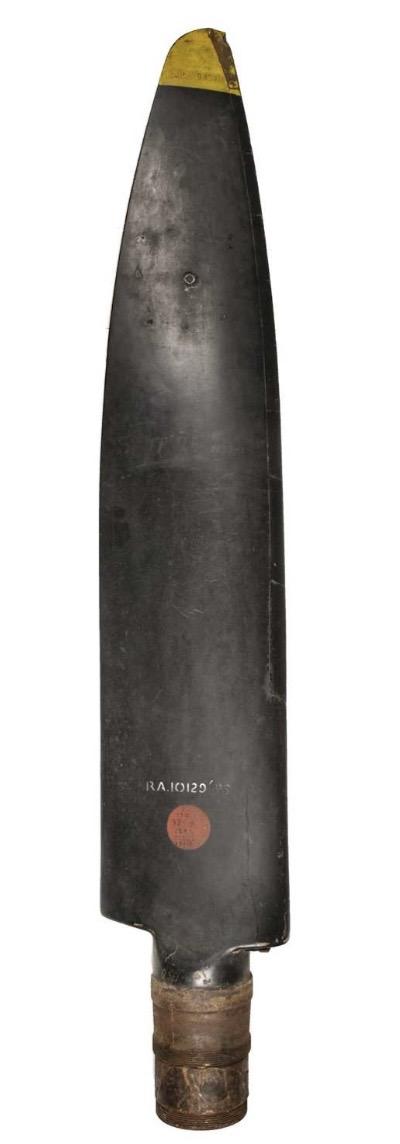
Spitfire propeller blades were made from several different materials over the course of the war. Early Spitfires often used laminated wooden blades, usually constructed from layers of compressed wood such as beech and birch bonded with casein or synthetic resins. These laminations were carefully shaped and glued under pressure to form a strong, lightweight blank. Once cured, the blank was carved and machined to precise aerodynamic profiles. Craftsmen then sanded and balanced each blade by hand to ensure uniformity. The finished blade was covered in fabric and coated with protective varnish or later synthetic finishes. A metal sheath was fitted along the leading edge to protect against rain and debris erosion.
As engine power increased, particularly with later Merlin variants and the Griffon engine, metal blades became more common. Rotol produced forged aluminium alloy blades and later steel-rooted blades with aluminium aerofoil sections. These were machined from forgings, heat-treated for strength, and then polished and balanced. Some late-war propellers used compressed wood known as “Jablo,” a composite developed by Rotol using resin-bonded wood laminations compressed under high pressure. Jablo blades combined the light weight of wood with greater strength and resistance to warping.
The manufacturing process for a typical Rotol wooden blade involved selecting high-quality timber, cutting it into thin laminations, coating each layer with adhesive, and stacking them with the grain oriented for maximum strength. The stack was pressed in a heated mould to form a solid block shaped roughly like a propeller blade. After curing, the block was machined to final shape using templates and gauges. Skilled workers then hand-finished the blade, checking balance by mounting it on sensitive rigs where even small weight differences could be detected. After finishing, blades were fitted into a metal hub assembly that contained the pitch-change mechanism, usually hydraulic and driven by engine oil pressure.
Rotol produced propellers not only for the Spitfire but also for the Hurricane, Bristol Beaufighter, Lancaster, Halifax, and many other British and Commonwealth aircraft. Hurricanes in particular used both de Havilland and Rotol propellers during the Battle of Britain. Many pilots preferred the Rotol constant-speed propeller because it offered superior climb performance and acceleration compared with early two-pitch units. As production expanded, Rotol became a primary supplier for Merlin-powered fighters.
By the height of wartime production, Rotol factories operated around the clock. Women formed a large proportion of the workforce, especially in blade finishing, inspection, and assembly roles. Precision was vital; even slight imbalance could cause dangerous vibration. Each completed propeller assembly underwent rigorous testing before delivery to aircraft manufacturers or maintenance units.
After the war, Rotol continued producing propellers for military and civilian aircraft, including turboprop designs. However, the widespread adoption of jet engines gradually reduced demand for large piston-engine propellers. Production of traditional wooden and piston-engine propellers declined through the 1950s and 1960s. Rotol eventually became part of larger aerospace groups and evolved into Dowty Rotol, continuing to manufacture advanced propellers for turboprop aircraft well into the modern era.
An interesting aspect of wartime propeller manufacture was the level of craftsmanship involved. Despite increasing mechanisation, many stages still relied on skilled hand work. Some Spitfire propeller blades carried small inspection marks or serial numbers that allowed them to be traced back to individual batches or workers. Because wooden blades could absorb moisture and change slightly in weight, maintenance crews sometimes had to rebalance propellers in service. Damaged wooden blades could occasionally be repaired, whereas metal blades usually required replacement.
The development of Rotol propellers played a major role in improving RAF fighter performance. The combination of Rolls-Royce Merlin engines and efficient constant-speed propellers gave the Spitfire and Hurricane the climb and speed needed to compete with German aircraft. Without the advances made by Rotol and de Havilland in propeller technology and manufacturing, the effectiveness of these famous fighters would have been significantly reduced.