On this day in military history…
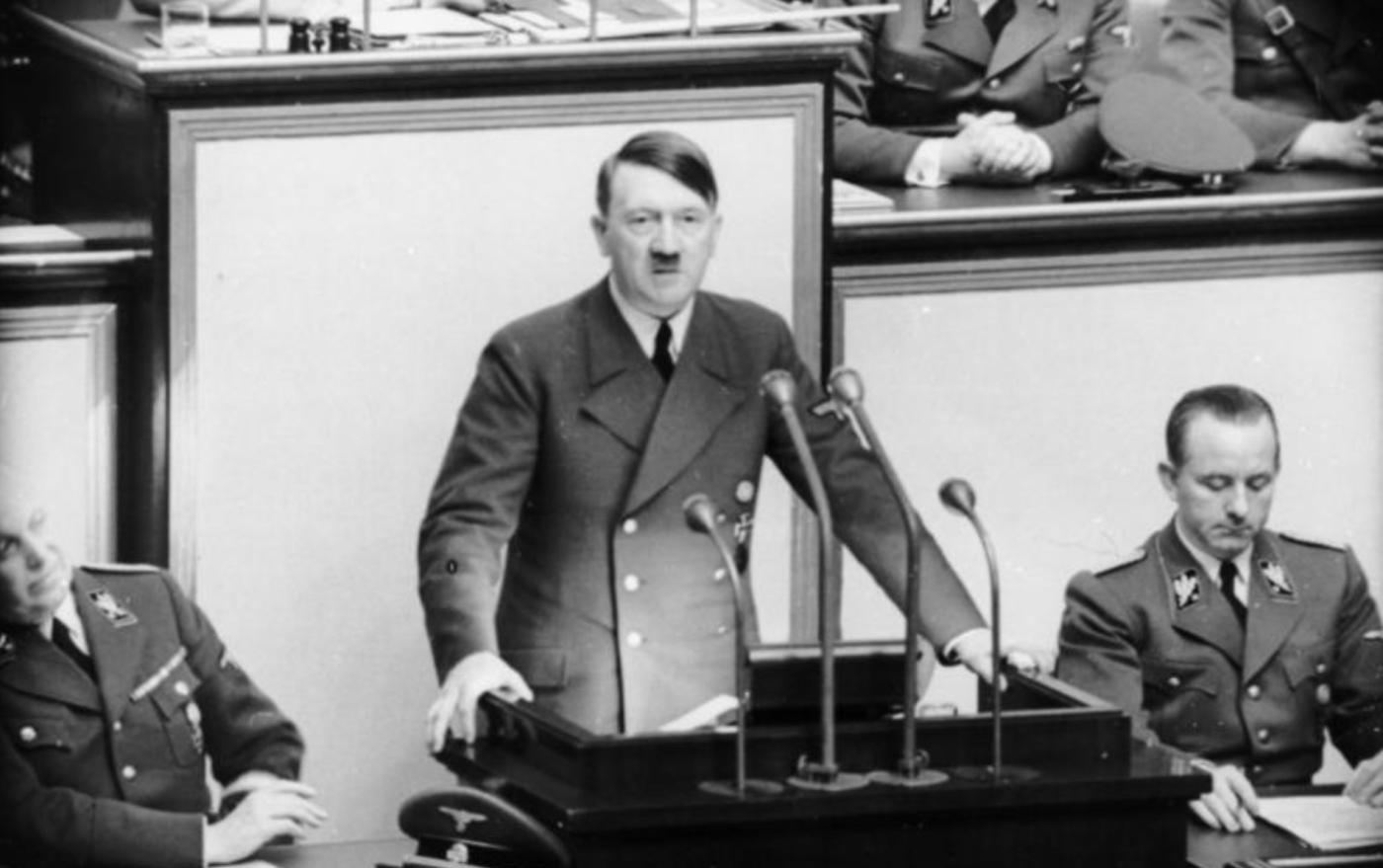
In the winter of 1945, Berlin was a city already half-consumed by ruin. Buildings stood hollowed and blackened, the streets choked with rubble and refugees, and the thunder of distant artillery never truly faded. Inside the Reich Chancellery, however, a strange stillness prevailed on the evening of 24 February. The great corridors that had once echoed with the rigid formality of the Nazi state now carried only the muffled steps of guards and aides, their faces pale and drawn by weeks of sleeplessness. It was here, in a dimly lit reception room deep within the Chancellery complex, that Adolf Hitler prepared to deliver what would become one of his final internal addresses.
Those present were not the cheering crowds of earlier years, nor the uniformed masses that had once filled parade grounds. Instead, the gathering was small and composed of senior figures who remained in Berlin as the war closed in. Among them were Joseph Goebbels, the Propaganda Minister who had chosen to remain with his family in the capital; Martin Bormann, Hitler’s private secretary and increasingly powerful gatekeeper; Hermann Fegelein, liaison to Heinrich Himmler and the SS; and several senior military and administrative officers still operating within the shrinking sphere of Nazi control. A handful of secretaries and adjutants stood near the walls, notebooks in hand, ready to record the Führer’s words. Also present were members of the Reich Chancellery staff and a small security detail drawn from the SS Leibstandarte units assigned to protect the building.
By the time Hitler entered the room, shortly after nightfall, the contrast between the man and the myth that had once surrounded him was unmistakable. He appeared visibly aged beyond his years. His uniform hung loosely on his thin frame, and his complexion had taken on a grey, almost waxen tone. Witnesses would later describe his gait as uneven, his left hand trembling noticeably when not clenched behind his back. The familiar intensity in his eyes remained, but it was tempered by exhaustion and strain. The once commanding presence that had electrified rallies now seemed diminished, confined within the narrow space of the Chancellery’s interior.
Before the address began, Goebbels quietly raised the question of recording or broadcasting the speech. For years, Hitler’s words had been transmitted across Germany by radio, amplified by loudspeakers and repeated in newsreels. But this time, Hitler refused. He spoke sharply and decisively, ordering that the speech was not to be broadcast, recorded for public dissemination, or released beyond those present. He insisted that the German public was already burdened by hardship and that this address was intended solely for those still directing the war effort in Berlin. In truth, his reluctance also reflected a growing awareness that the image he presented no longer matched the propaganda carefully crafted over the preceding decade. The haggard figure standing before them was far removed from the triumphant leader portrayed in earlier broadcasts.
When he began to speak, his voice was lower and more strained than in previous years, yet it carried a familiar cadence. He spoke first of the military situation, acknowledging the relentless pressure from Soviet forces advancing from the east and the Western Allies pressing from the west. He insisted that Germany remained engaged in a struggle for survival and declared that surrender was unthinkable. His words moved between defiance and fatalism, asserting that history would judge the conflict as one in which Germany had fought against overwhelming odds and a coalition of enemies determined to destroy it.
He addressed those present directly, thanking them for their loyalty and urging them to maintain discipline within the capital. Berlin, he declared, must stand as a symbol of resistance regardless of the military outcome. He spoke of the need to hold key defensive positions, to maintain order among the civilian population, and to prevent any sign of collapse within the administrative structure of the Reich. Several times, he returned to the theme of loyalty, insisting that betrayal from within posed a greater threat than the enemy at the gates.
As the speech continued, his tone shifted between moments of anger and periods of reflection. He criticised commanders whom he believed had failed to carry out orders with sufficient determination, yet he also acknowledged the immense strain placed upon German soldiers and civilians. At one point he paused, appearing momentarily lost in thought, before resuming with renewed intensity. Those listening could sense the tension between his determination to project authority and the physical toll the war had taken on him.
He spoke of Berlin itself, describing the city as the heart of the Reich and declaring that its defence would carry symbolic weight far beyond its strategic importance. He urged those present to prepare for a prolonged struggle within the city and warned against any attempt to negotiate or seek compromise with advancing forces. The speech contained repeated assertions that the German people would endure and that the collapse predicted by enemy propaganda would not come easily.
Despite the grim circumstances, he attempted to frame the situation in terms of historical destiny. He spoke of future generations who, he claimed, would look back on the final months of the war as a test of national resolve. Yet even as he invoked such themes, his delivery lacked the fervour that had once characterised his public addresses. The pauses were longer, the gestures less forceful, and the physical strain more evident.
Those present listened in near silence. Goebbels stood with arms folded, watching intently. Bormann occasionally made notes, his expression unreadable. The military officers maintained rigid postures, though several appeared visibly fatigued. The atmosphere in the room was heavy with the awareness that the war was entering its final phase, and that the authority once radiating from the Chancellery now existed largely in words.
As the address drew to a close, Hitler reiterated his earlier order: the speech was to remain confidential. No transcripts were to be circulated beyond essential internal channels, and no mention of the gathering was to appear in official communications. He dismissed the assembly with a brief nod rather than the extended formalities that had once accompanied such occasions. One by one, those present filed out of the room, returning to their duties within a city already bracing for siege.
The decision to forbid any broadcast ensured that the speech remained largely unknown to the wider German public. Unlike earlier addresses that had been transmitted across the nation, this one existed only in the memories and notes of those who heard it. Within weeks, the situation in Berlin would deteriorate further, and the Chancellery itself would become the centre of the regime’s final days. The gathering of 24 February stood as a quiet, sombre moment within that final chapter, marked less by the grand spectacle of earlier years and more by the stark reality of a leadership confronting the end of its power.