British Airborne Drop Bag
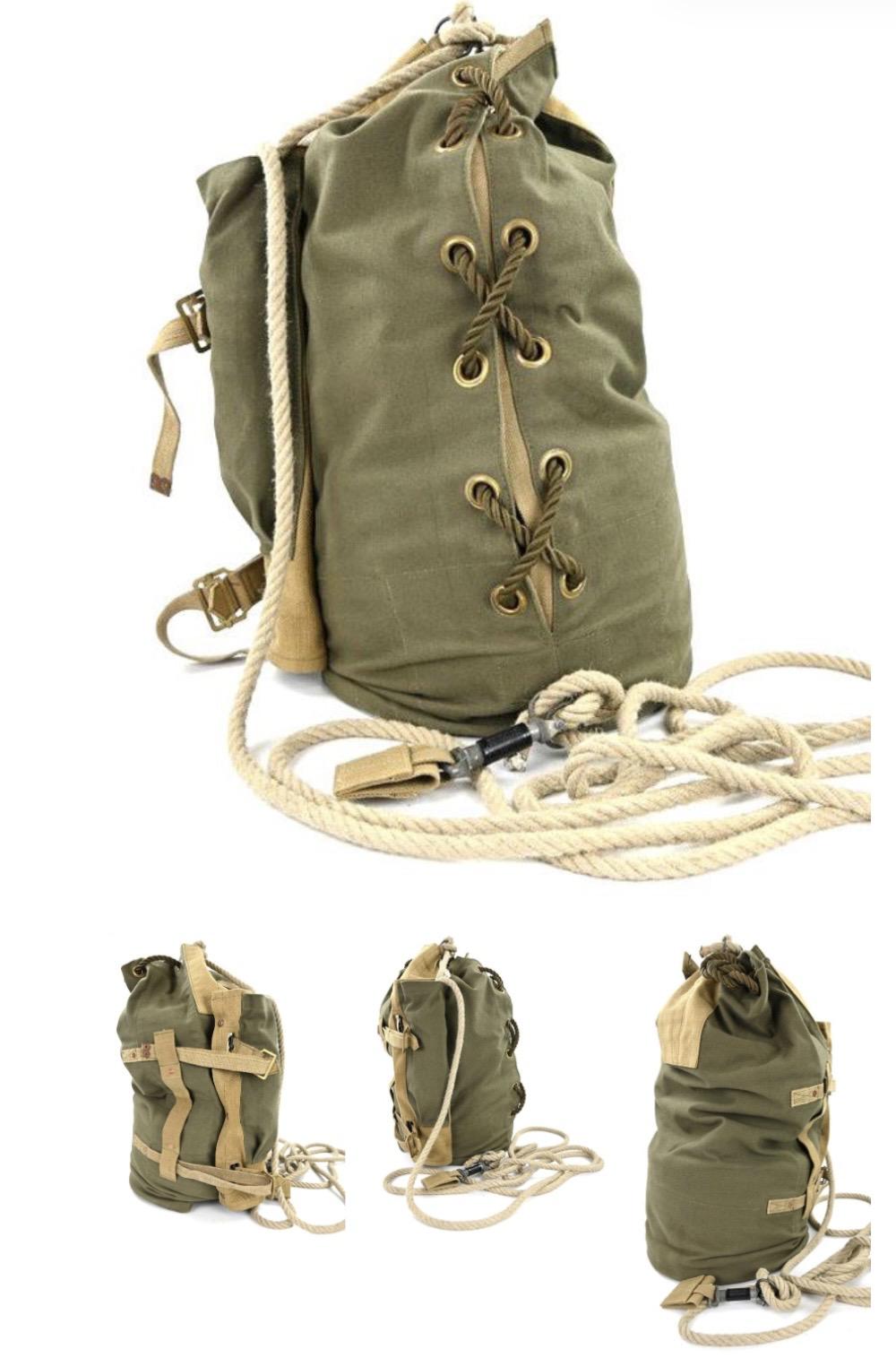
The British airborne forces of the Second World War developed a specialised system of equipment carriage designed to allow paratroopers to jump from aircraft with heavy weapons, ammunition and essential supplies without being dangerously overloaded. One of the most important components of this system was the parachute drop bag, sometimes referred to as a leg bag or equipment drop bag. This item played a vital role in enabling airborne troops to land with the tools needed to fight immediately after reaching the ground.
The drop bag was essentially a long, cylindrical canvas container that attached to the paratrooper’s harness. British paratroopers, particularly those of the Parachute Regiment and Airlanding units, carried far more equipment than a soldier could safely wear during a jump. Jumping with excessive weight on the body risked serious injury on landing and could interfere with parachute deployment. The drop bag allowed this equipment to be carried safely during descent and then released just before landing.
Typically made of heavy-duty khaki canvas with reinforced stitching, the bag was robust enough to withstand the stress of jumping and landing. It was attached by straps and clips to the parachute harness, usually positioned so that it hung below the paratrooper’s legs during descent. The bag was designed to be aerodynamic and balanced so it would not swing wildly or interfere with the parachute lines. A rope or webbing line connected it securely to the harness.
Inside the drop bag was usually the heavier or bulkier equipment that could not be worn on the body during the jump. The exact contents varied depending on the soldier’s role and mission, but common items included extra ammunition, Bren gun magazines, mortar rounds, spare clothing, rations, entrenching tools, radio components, explosives, and sometimes personal kit. A paratrooper carrying a Bren light machine gun might have spare barrels and additional magazines packed inside, while a signals operator might carry batteries and radio parts. The aim was to ensure that once on the ground, each man could quickly retrieve his full combat load and become operational.
The way the drop bag worked during a jump was carefully drilled into every airborne soldier. After exiting the aircraft, the paratrooper’s main parachute would deploy in the usual way. Once the canopy had fully opened and the descent stabilised, the paratrooper would release the drop bag from its stowed position. This did not mean discarding it entirely. Instead, the bag was lowered on its rope or webbing line so that it hung several feet below the soldier. This system reduced the weight directly attached to the body and ensured that the bag would hit the ground first.
Lowering the bag before landing served several important purposes. It prevented heavy equipment from injuring the paratrooper on impact, reduced the risk of broken legs or ankles, and helped stabilise the descent. As the bag touched down slightly before the soldier, it absorbed some of the impact and tension. The rope ensured that the bag remained connected and would not be lost.
Just before landing, the paratrooper adopted the standard parachute landing fall technique, designed to spread the impact across the body. The drop bag, already on the ground, would trail slightly behind or in front depending on wind and descent angle. After landing, the soldier would immediately release his parachute harness and then detach the drop bag. Speed was essential, particularly in combat drops where troops might be under fire or scattered.
Once detached, the drop bag was opened quickly and its contents distributed. The paratrooper would arm himself with any weapons or ammunition stored inside, put on additional webbing or equipment, and prepare to move to the rendezvous point or objective. Training emphasised speed and efficiency. In large airborne operations such as the Normandy landings in June 1944 or Operation Market Garden in September 1944, men were expected to gather their equipment and form up as quickly as possible after landing, often in darkness and under enemy pressure.
Despite its usefulness, the drop bag system had some drawbacks. In high winds or under heavy anti-aircraft fire, paratroopers sometimes landed far from their intended drop zones. If the drop bag became entangled in trees, buildings, or water, equipment could be lost. In night drops especially, some soldiers struggled to find their bags after landing if they became detached or drifted away. There were also cases where the lowering line tangled during descent, causing inconvenience or danger. Nevertheless, the system was generally effective and represented a practical solution to the challenge of delivering heavily equipped soldiers by parachute.
British airborne forces refined their equipment continuously throughout the war. By 1944 and 1945, the drop bag had become standard issue for parachute troops on major operations. It allowed them to carry sufficient firepower and supplies to fight as light infantry immediately upon landing, which was essential given that airborne units often operated behind enemy lines without immediate reinforcement. The drop bag, though simple in appearance, was a crucial element in the effectiveness of Britain’s airborne forces during the Second World War.