Reichstag Berlin
The Reichstag building in Berlin is one of Germany’s most recognisable landmarks, a structure whose history mirrors the turbulent political journey of the nation itself. Its origins go back to the late nineteenth century, when the newly unified German Empire sought an impressive parliamentary building that would reflect its status and ambitions. In 1871 Germany became a unified nation under Prussian leadership, but the new Reichstag, or Imperial Diet, lacked a permanent home. After years of debate about style, location and cost, an architectural competition was held, eventually won by the German architect Paul Wallot. His design blended elements of Renaissance and classical architecture, intended to convey dignity, authority and national pride.
Construction began in 1884 after the laying of the foundation stone by Kaiser Wilhelm I. The project took roughly ten years to complete, finishing in 1894. Building the Reichstag was a major undertaking involving thousands of workers, and it was constructed using sandstone, steel and an enormous amount of decorative detail. One of its most famous original features was its large glass dome, a symbol of transparency in governance long before modern Germany revived the idea. The structure served as the seat of the German parliament of the empire, hosting debates, state events and legislative sessions until the end of the First World War. After 1918 it became the home of the parliament of the Weimar Republic, although the political instability of the era often overshadowed its role.
The building is perhaps most infamous for its association with the Nazis. On 27 February 1933, just weeks after Adolf Hitler was appointed Chancellor, the Reichstag caught fire. The blaze destroyed its plenary chamber and became a pivotal moment in German history. The Nazis instantly blamed a Dutch communist named Marinus van der Lubbe, using the incident as justification to suspend civil liberties and eliminate political opposition. Historians still debate whether the fire was set by van der Lubbe alone or orchestrated by the Nazis as a pretext for seizing total power. What is certain is that the Reichstag fire allowed Hitler to push through the Reichstag Fire Decree and, shortly afterward, the Enabling Act, effectively ending democracy in Germany. The building itself ceased to function as a parliamentary home under the Nazi dictatorship. Its damaged shell was used mainly for propaganda events, military purposes and occasionally as a backdrop for ceremonies, while real power concentrated entirely in Hitler’s hands and in other Nazi institutions.
During the Second World War the Reichstag became a symbol for both sides. For the Nazis it represented a former parliamentary democracy they despised, but for the Allies, especially the Soviet Union, it represented the heart of Nazi power. In reality Hitler’s government no longer used it, but the Soviets chose it as a strategic and symbolic target during the Battle of Berlin in 1945. Heavy fighting took place around the building in the war’s final days, and Soviet soldiers famously raised their flag atop its ruins, creating one of the most iconic images of the war’s end in Europe. The building was left shattered and burnt-out after the conflict.
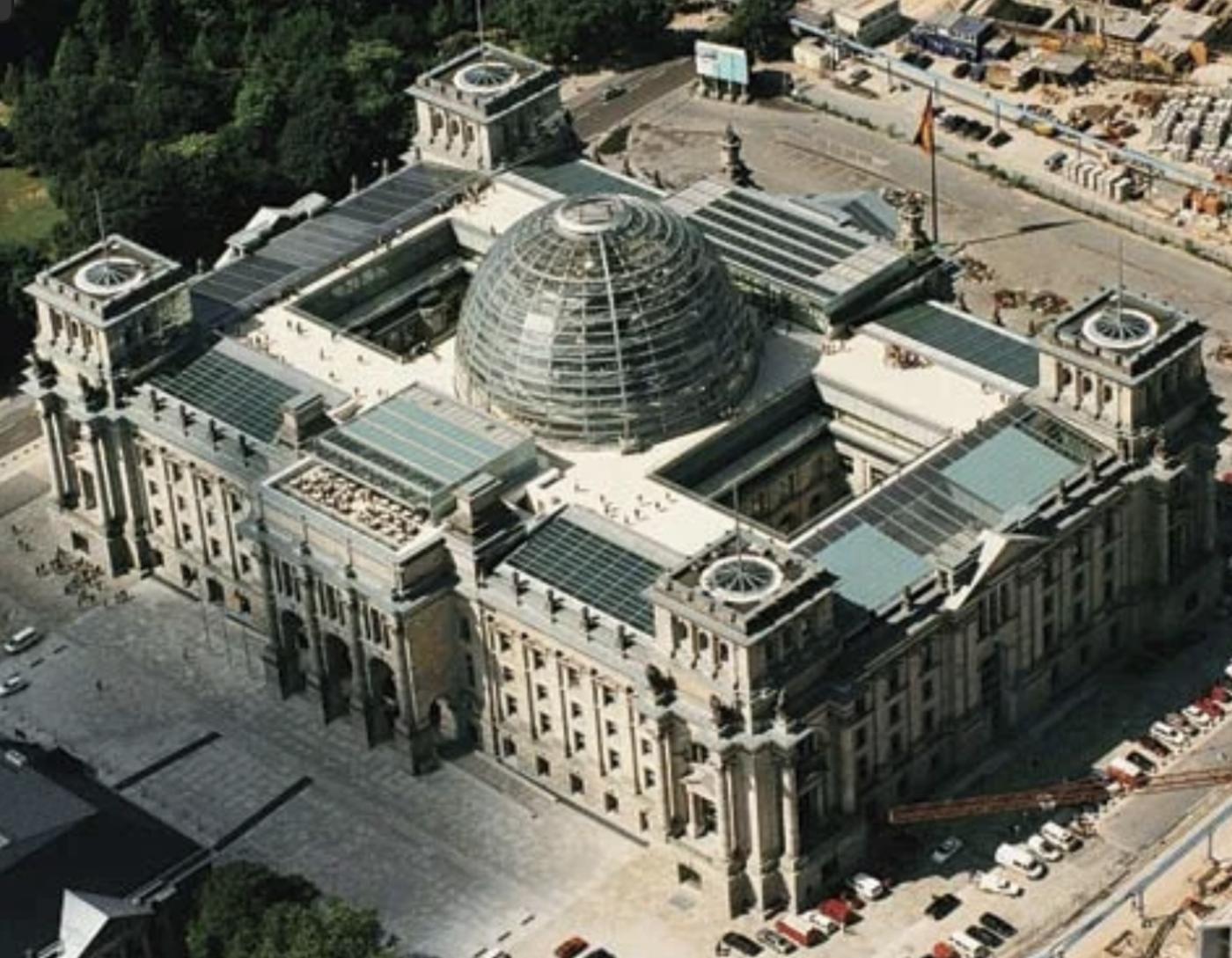
In the divided Germany of the Cold War, the Reichstag sat just on the western side of the Berlin Wall. West Germany used a partially restored version of the building for exhibitions, meetings and ceremonial functions, but not as a parliamentary chamber. It remained a powerful symbol of national unity during decades of separation. After reunification in 1990, the decision was made to restore the Reichstag and use it once again as the seat of parliament. British architect Sir Norman Foster led the reconstruction, completed in 1999, which included the addition of a modern glass dome echoing the building’s original dome. This new dome allows visitors to look down into the parliamentary chamber, representing transparency and democratic accountability.
Interesting details about the Reichstag are numerous. The phrase Dem Deutschen Volke, meaning To the German People, was added to the building’s façade only in 1916 during the First World War, after years of resistance from Kaiser Wilhelm II who disliked such democratic symbolism. During the post-war Soviet occupation, soldiers left thousands of graffiti inscriptions on the inner walls, many of which have been preserved as historical reminders. The modern dome is not just symbolic but also functional, using natural light and an innovative system of mirrors to illuminate the debating chamber below while improving energy efficiency. Today the Reichstag is one of Germany’s most visited sites, drawing millions of people each year who come not only to admire its architecture but also to reflect on the complex and dramatic history it has witnessed.