Prince Of Wales Battle Ship
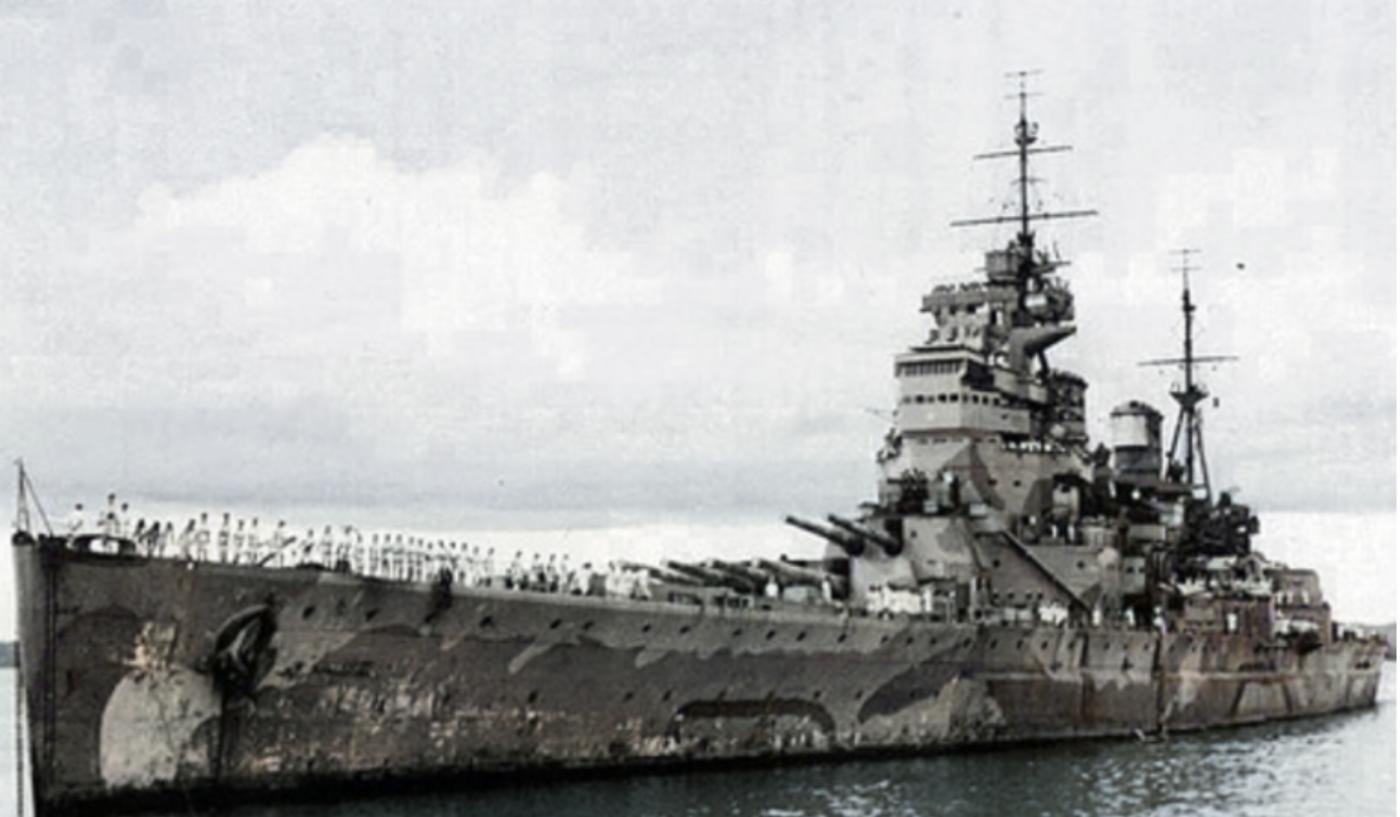
HMS Prince of Wales was built at the Cammell Laird shipyard in Birkenhead on the River Mersey, one of the Royal Navy’s most important heavy shipbuilding centres. Her keel was laid down on 1 January 1937, and although she was launched on 3 May 1939, she faced lengthy delays during the fitting-out stage. Wartime shortages, shifting priorities, and several damaging German air raids on the shipyard slowed her completion considerably. As a result, she did not formally enter Royal Navy service until 31 March 1941. From the moment her keel touched the slipway to the day she joined the fleet, more than four years had passed.
Prince of Wales displaced over 42,000 tons fully loaded and carried a complement of around 1,500 officers and men. Her main armament consisted of ten 14-inch guns housed in one twin and two quadruple turrets, a design intended to save weight but one that proved mechanically complex. These turrets were still suffering from faults when she put to sea, a problem that would reveal itself dramatically during her very first major action.
Barely weeks after commissioning, she sailed with the battlecruiser HMS Hood to intercept the German battleship Bismarck and the heavy cruiser Prinz Eugen. The battle in the Denmark Strait on 24 May 1941 was her baptism of fire. Despite the crew being new to the ship and the main guns experiencing repeated jams, Prince of Wales engaged Bismarck aggressively. She scored several hits, including one that contributed to Bismarck’s later fuel and mechanical problems. After Hood exploded and sank, Prince of Wales continued to duel alone before withdrawing under smoke. She sustained multiple hits herself yet survived, returning to Iceland and then to Rosyth for repairs. Her ability to endure that fight, despite her issues, earned admiration from both friend and foe.
Shortly after these repairs, Prince of Wales undertook a very different mission: transporting Prime Minister Winston Churchill across the Atlantic in August 1941. Off Newfoundland, she hosted Churchill and US President Franklin D. Roosevelt as they drafted and signed the Atlantic Charter, a foundational document of Allied unity. The ship thus became the setting for one of the most important diplomatic meetings of the war.
In late 1941 she was deployed to the Far East as part of the newly formed Force Z, alongside HMS Repulse. Their mission was to deter Japanese aggression, but the rapid Japanese advance soon placed them in direct danger. When Force Z attempted to intercept Japanese troop convoys, land-based bombers located their position on 10 December. Prince of Wales had already been weakened by an early torpedo strike that damaged her portshaft and caused serious flooding, restricting her speed and reducing her ability to evade further attacks. Japanese torpedo bombers exploited this vulnerability, hitting her repeatedly on the port side and overwhelming her damage-control teams. Without friendly air cover, both Prince of Wales and Repulse were doomed. Prince of Wales capsized and sank with the loss of more than 300 men.
Her sinking marked a historic shift in naval warfare: capital ships, no matter how modern or well-armoured, were no longer safe without air superiority. Today her wreck rests off the coast of Malaysia as a protected war grave. Despite a service life of only a year, Prince of Wales played a part in some of the most dramatic episodes of the war—fighting Bismarck, hosting world leaders, and meeting her end in a battle that signalled the rise of air power over the battleship era.