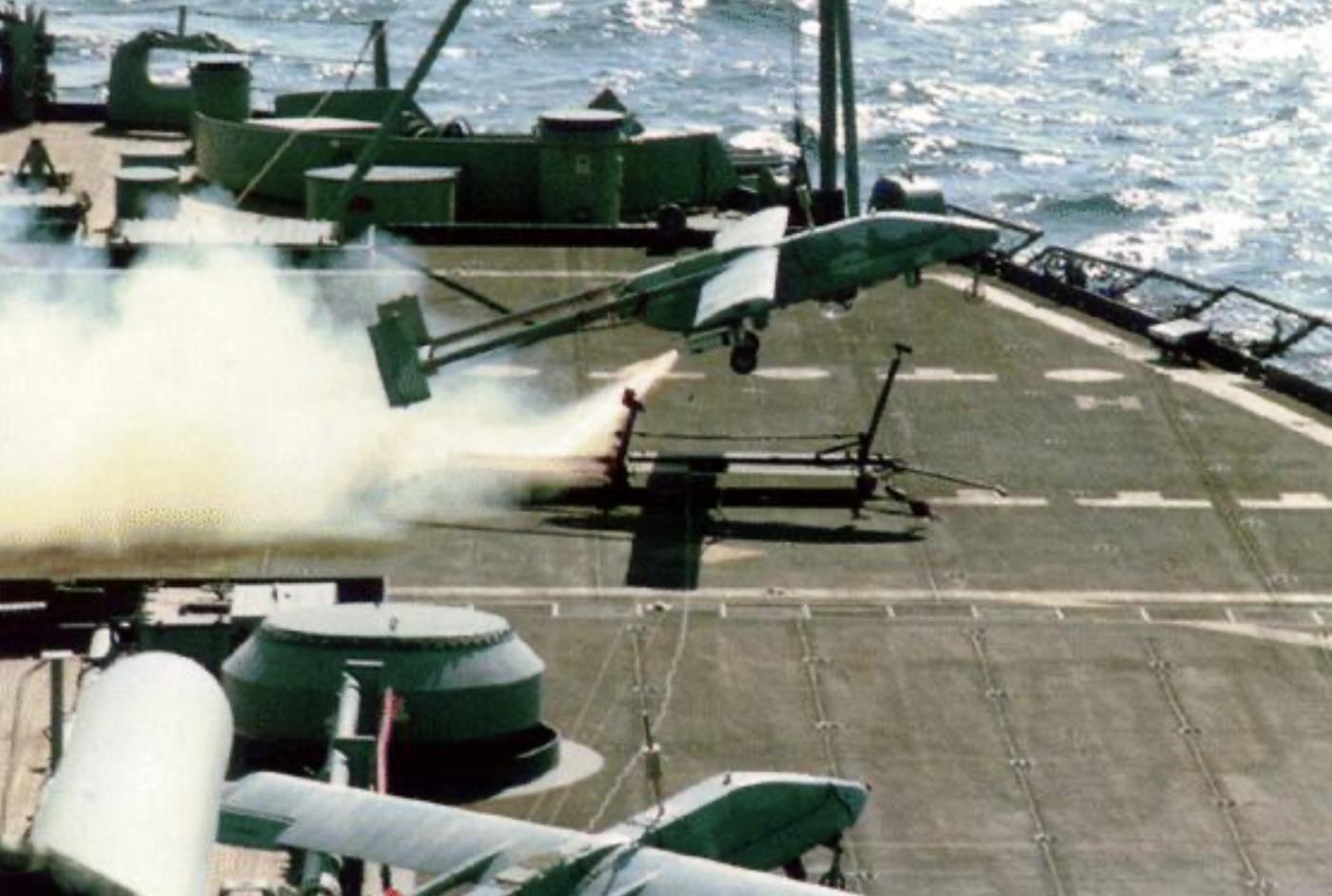
Pioneer ship Drone
On 7 February 1991, during the Gulf War, the United States Navy marked a quiet but revolutionary moment in naval warfare when the battleship USS Wisconsin employed a remotely piloted vehicle to direct fire that destroyed Iraqi naval targets along the Kuwaiti coast. It was the first time in combat that a warship used an unmanned aircraft it controlled itself to locate targets, adjust heavy naval gunfire in real time, and confirm destruction, all while the ship remained at a relatively safe distance offshore. Although unmanned systems had existed for years, this was the first clear demonstration of how they could be fully integrated into frontline naval combat operations.
At the time, Operation Desert Storm was well underway. Coalition forces dominated the air, but the maritime environment in the northern Persian Gulf remained dangerous. Iraqi forces had laid extensive minefields and maintained coastal defenses, including missile sites, artillery, and small patrol boats capable of operating in shallow waters and harassing larger vessels. For major surface combatants, especially a battleship with enormous strategic and symbolic value, approaching the coastline carried significant risk. Yet those same battleships possessed immense firepower, and if that power could be applied accurately from a distance, it could neutralize enemy positions with devastating effect.
Wisconsin was one of two Iowa-class battleships deployed to the Gulf, the other being USS Missouri. These ships had been modernized in the 1980s, not only with missiles but also with the ability to operate the RQ-2 Pioneer remotely piloted vehicle. The Pioneer was a small, propeller-driven unmanned aircraft launched from the ship and controlled by operators on board. In the language of the time, it was called a remotely piloted vehicle rather than a drone, reflecting both the technology of the era and the fact that every movement was directly controlled by human operators rather than autonomous systems.
On 7 February, shortly after Wisconsin took over fire support duties off the Kuwaiti coast, the ship launched a Pioneer to observe Iraqi positions ashore. One of the first targets engaged that day was an Iraqi communications facility. The Pioneer transmitted live video back to the ship, allowing fire control teams to see exactly where the massive 16-inch shells were landing and to make rapid corrections. This process, known as naval gunfire spotting, had traditionally relied on manned aircraft or forward observers ashore. Using an unmanned aircraft for this purpose, especially one launched and recovered by the firing ship itself, was something entirely new in combat.
Later the same day, the most dramatic demonstration of this capability occurred near a coastal marina complex used by Iraqi naval forces. Iraqi patrol boats and small craft were clustered near piers and facilities along the shoreline, making them difficult targets in darkness and haze. Wisconsin again launched the Pioneer, which used its sensors to locate the boats and track the impact of incoming shells. Initial salvos landed short or wide, but within minutes the Pioneer’s real-time imagery allowed gunnery officers to walk the fire directly onto the marina area. One after another, shells struck among the boats and structures, destroying piers and sinking or crippling numerous Iraqi vessels.
By the end of the bombardment, roughly fifteen Iraqi boats had been destroyed or severely damaged. Equally important, the ship was able to confirm the results immediately through the unmanned aircraft, rather than relying on post-strike reports or later reconnaissance. The psychological effect was also notable. Iraqi troops reportedly abandoned positions or fled when they realized that the battleship could see and correct its fire with uncanny accuracy, even at night and from beyond visual range.
This episode represented a fundamental shift in naval warfare. For the first time, a surface combatant had effectively extended its own eyes far beyond the horizon using an unmanned system under its direct control, closing the loop between sensing, shooting, and assessing damage. It reduced risk to pilots, increased accuracy, and allowed the battleship to exploit its long-range firepower to the fullest. What seemed novel in 1991 would, in later decades, become routine as unmanned aerial vehicles became central to naval, air, and ground operations around the world.
The events of 7 February did not receive the same public attention as air strikes over Baghdad or armored battles in the desert, but within military circles they were widely recognized as a turning point. The use of a remotely piloted vehicle by USS Wisconsin showed that unmanned systems were no longer experimental accessories but combat multipliers capable of reshaping how wars at sea were fought. In that sense, the destruction of Iraqi boats along the Kuwaiti coast marked not only a tactical success but the opening of a new chapter in modern naval warfare.