Ottoman Helmets
During the First World War, the Ottoman Empire entered the conflict with no indigenous tradition of steel helmet production, and this shaped the unusual variety seen in Ottoman helmets today. Early in the war, Ottoman soldiers relied mainly on cloth fezzes, kalpaks, or wrapped headgear, which offered no protection against shell fragments. The increasing lethality of modern artillery, particularly after 1915 on fronts such as Gallipoli, Mesopotamia, and Palestine, forced the Ottoman military to seek steel helmet solutions, often through foreign assistance rather than domestic design.
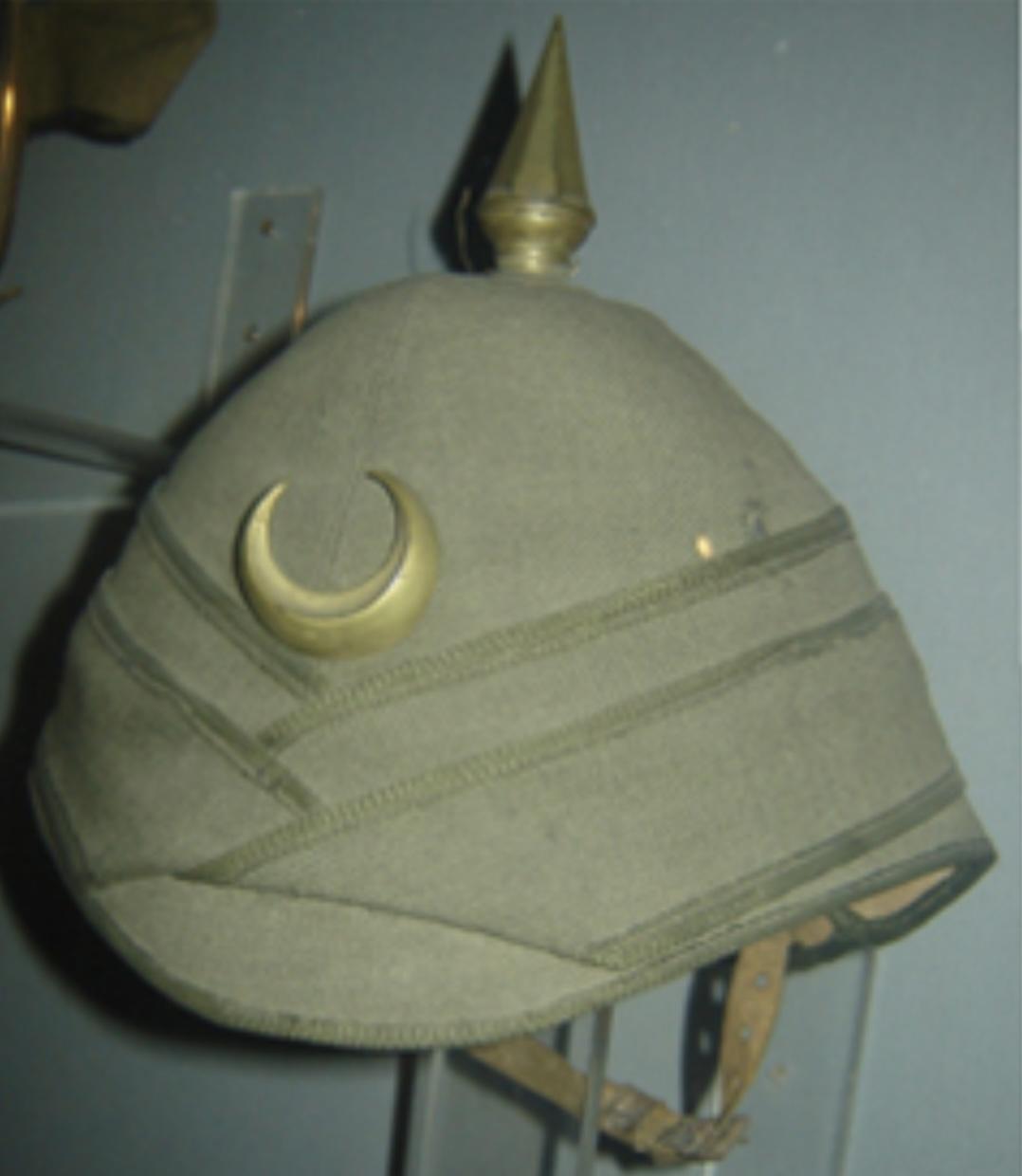
One of the most distinctive helmets associated with the Ottomans is commonly referred to by collectors as the “Kamalası” type, a name derived from Ottoman Turkish terminology rather than a formal model designation. These helmets are characterized by a tall, conical or slightly domed crown and, in some examples, a prominent spike mounted at the top. The spike did not serve an offensive purpose; instead, it reflected both symbolic and practical influences. Symbolically, it echoed earlier European and Ottoman ceremonial headgear, projecting authority and continuity with imperial tradition. Practically, in some interpretations, the spike could help deflect downward-blowing saber strikes or glancing debris, though by the First World War this idea was already obsolete. The presence of the spike was as much about visual identity as function.
Not all Ottoman helmets had spikes, and this difference often came down to production source and intended role. Helmets with spikes are strongly influenced by German patterns, especially early-war German pickelhaube-style helmets. As a Central Powers ally, the Ottomans received military aid, advisors, and equipment from Germany, and some Ottoman helmets were either manufactured in German factories or heavily inspired by German designs. Others were assembled locally using imported components. Spike-less variants, by contrast, tended to be simplified for field use, reflecting lessons learned from the Western Front, where protrusions made soldiers more visible and offered no real ballistic advantage. As the war progressed, smooth-domed helmets became increasingly favored.
Another major visual difference among Ottoman helmets is the presence or absence of the crescent badge. The crescent, long associated with Ottoman state symbolism, served both as a national emblem and a morale booster. Helmets bearing a metal crescent were often intended for regular army units or ceremonial contexts, emphasizing imperial identity. However, not all helmets carried this badge. Some lacked it due to shortages of metal fittings, others because they were produced quickly under wartime pressure, and some because they were intended for non-frontline troops, labor units, or were experimental in nature. In combat conditions, badges could also be removed to reduce glare or prevent the badge from catching on equipment.
Design responsibility for Ottoman helmets was fragmented rather than centralized. Unlike France with the Adrian helmet or Britain with the Brodie, the Ottomans never standardized a single helmet model during the war. German military missions advised on equipment, and German industrial firms contributed designs and manufacturing capacity, but final adoption depended on availability rather than doctrine. Local workshops in Istanbul and other industrial centers are believed to have assembled or modified helmets using imported steel shells, liners, or fittings, resulting in wide variation even among helmets of the same general type.
Production numbers for Ottoman helmets remain uncertain, as many records were lost during the collapse of the empire and the subsequent Turkish War of Independence. Estimates suggest that total production and import numbers were relatively low compared to European powers, likely in the tens of thousands rather than hundreds of thousands or millions. This scarcity helps explain why original Ottoman First World War helmets are rare today and why variations in shape, liner construction, spike style, and badge attachment are so common. No single factory appears to have dominated production, reinforcing the idea of small-batch manufacturing and adaptation rather than mass standardization.
An interesting aspect of Ottoman helmet use is how late they appeared on the battlefield. Many soldiers fought through major campaigns without steel protection at all, and even when helmets were issued, distribution was uneven. Photographs from the period show mixed headgear within the same units, with steel helmets worn alongside fezzes and cloth caps. This transitional state highlights the logistical and industrial challenges faced by the Ottoman war effort and underscores why Ottoman helmets differ so markedly from their European counterparts.
Today, Ottoman First World War helmets stand out not only for their rarity but for their blend of symbolism and improvisation. The presence or absence of spikes and crescent badges reflects a military caught between tradition and modern warfare.